Midway through Braiding Sweetgrass: Indigenous Wisdom, Scientific Knowledge and the Teachings of Plants, author Robin Wall Kimmerer tells the fascinating story of a research project undertaken by one of her graduate students. The topic: do different methods of sweetgrass harvesting contribute to an overall decline in the species observed by local Indigenous people?
Some tribes harvest sweetgrass by pinching off the stems close to the ground while others just yank up the whole plant, roots and all. Which method is better? Which method ensures sustainable regrowth of sweetgrass year after year?
Despite skepticism from her supervising committee that this research was not worthwhile, and maybe not even science at all, the student proceeded. She set up three sets of experimental sweetgrass plots, one set for each method of harvesting and one – the control – where no harvesting was done. Her findings were unexpected: there was no significant difference in the regrowth of sweetgrass between either of the two harvesting methods. But in the control plots, where no harvesting was done, sweetgrass fared poorly. Many stems turned brown and withered, and they produced fewer new shoots in spring.
The research showed that sweetgrass needs to be harvested by humans in order to thrive. But science merely confirmed what the Indian tribes have known for generations:
“If we use a plant respectfully it will stay with us and flourish. If we ignore it, it will go away. If we don’t give it respect it will leave us.” [p. 157]
Here plants and people support each other in a relationship of reciprocity. People care for the plants; they take enough to stimulate robust new growth but they don’t overharvest, never taking more than half. The plants respond by supplying the people with generous quantities of glossy sweetgrass for braiding, basketry and ceremonies.
This story captures the essence of Braiding Sweetgrass: reciprocity and respect are the foundation of healthy relationships that benefit us all, humans and non-humans alike.
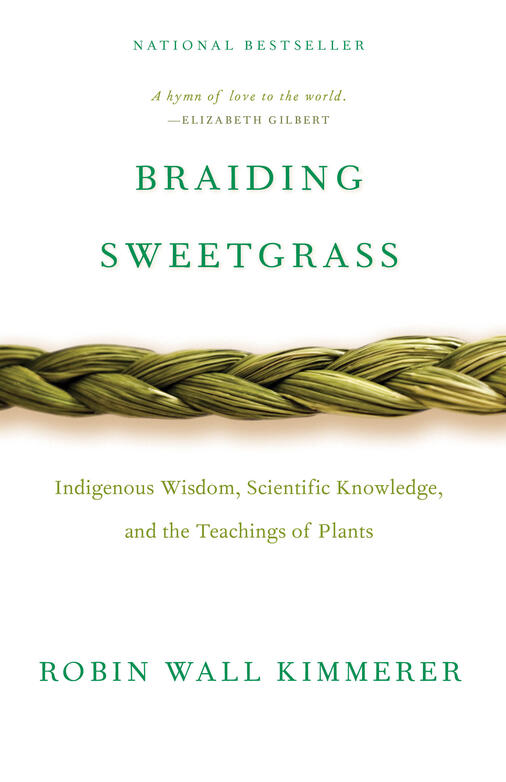
Braiding Sweetgrass:
Indigenous Wisdom, Scientific Knowledge and
the Teachings of Plants
By Robin Wall Kimmerer
Milkweed Editions, Minneapolis, 2013
Robin Wall Kimmerer is a scientist and Distinguished Teaching Professor of Environmental Biology at the State University of New York (SUNY) in Syracuse, NY. Equally important she is an enrolled member of the Citizen Potawatomi Nation. She is also the founder and director of the Center for Native Peoples and the Environment.
Kimmerer introduces the book as a braid of three strands: scientific knowledge, Indigenous ways of knowing, and her life story as one Indigenous scientist trying to bridge the two. It’s a collection of 31 essays, most of them between ten and twenty pages, each containing elements from all three strands. One way or another, most of the essays touch on the theme of reciprocity.
Throughout the book, Kimmerer shows us beautiful examples of how reciprocity between plants and animals is deeply embedded in Nature. It starts with breathing. Plants breath in carbon dioxide and breathe out oxygen. Animals, including humans, inhale oxygen and exhale carbon dioxide.
“Respiration – the source of energy that lets us farm and dance and sing. The breath of plants gives life to animals and the breath of animals gives life to plants. My breath is your breath, your breath is mine.” [p. 344]
From here, it’s a short step to recognizing that we are all related, we are all kin. For Kimmerer and, from what I’ve read elsewhere, for many other Indigenous people, this is much more than an abstract concept. Trees, salmon, rivers and even rocks are people, neighbors, family. The animacy of the world is built into Native languages. Kimmerer describes how the Potawatami language uses the pronoun “who” and not “it” for both human and nonhuman beings. (I loved how Robert Macfarlane did the same thing for rivers in his book Is a River Alive?) She argues that making nature an “it” instead of a “who” absolves us of a moral responsibility and leads us to turn living beings into “natural resources.”
“The arrogance of English is that the only way to be animate, to be worthy of respect and moral concern, is to be a human.” [p. 57]
Of course this applies to many other languages too.
“Maybe a grammar of animacy could lead us to whole new ways of living in the world, other species a sovereign people, a world with a democracy of species, not a tyranny of one – with moral responsibility to water and wolves, and with a legal system that recognizes the standing of other species. It’s all in the pronouns.” [p. 57-8]
Reciprocity and respect lead to important Indigenous practices like the Honorable Harvest: take only what you need (but never more than half) and use everything you take. They also lead to an emphasis on gratitude for the gifts we receive from Nature. In one of the most moving parts of the book, Kimmerer presents the Onondaga tribe’s Address of Thanksgiving, or the Words That Come Before All Else, and compares them to the Pledge of Allegiance.
Unfortunately, for most of us in the “settler” community, the commodification of land has severed our connection to it, and absolved us of moral responsibility. We look upon property as a “bundle of rights” rather than a bundle of responsibilities.
Kimmerer discusses how industrialization and commodification have devastated the Earth’s land, air and water. In one lengthy chapter on the environmental disaster at the Lake Onondaga superfund site, she makes a heartfelt argument that we must restore the land, and more importantly our relationship to it. Despite the enormity of the task, Kimmerer counsels against despair:
“Despair is paralysis. It robs us of agency. It blinds us to our own power and the power of the earth. … Restoration is a powerful antidote to despair. Restoration offers concrete means by which humans can once again enter into positive, creative relationship with the more-than-human world, meeting responsibilities that are simultaneously material and spiritual. It’s not enough to grieve. It’s not enough to just stop doing bad things.” [p.328]
We must restore the land, not just because we have a moral duty to do so, but because doing so will restore us. But we shouldn’t expect to restore Nature to some imagined pre-industrial state; it’s the relationship with Nature that is most important.
“Nature herself is a moving target, especially in an era of rapid climate change. Species composition may change, but relationship endures. It is the most authentic facet of restoration. Here is where our most challenging and most rewarding work lies, in restoring a relationship of respect, responsibility, and reciprocity. And love.” [p. 336]
This means humans must be involved. She rejects the idea that we should just leave Nature alone. The land needs us as much as we need the land in Kimmerer’s view.
“We are bound in a covenant of reciprocity, a pact of mutual responsibility to sustain those who sustain us.” [p. 382]
So how do we do this? Especially the large majority of us who are city dwellers? Kimmerer is not prescriptive, but she is hopeful. She suggests that if you want to develop a connection to the land, plant a garden. I think even a window box would be a good start. She also advises us to be thoughtful about how we spend our money, to consider the natural (or not) origins of the things we buy, consume and wear, and to give thanks for the journey they’ve taken to reach us.
In Braiding Sweetgrass, Kimmerer does not shy away from the terrible problems humans face and the damage we’ve done, but her overall message is hopeful: reciprocity, respect and gratitude can bring healing to the land and to us all.

Unsolicited Feedback
I’m not sure if I’ve ever seen sweetgrass in the wild. The species Hierochloe odorata, also known as wiingaashk in the Potawatomi language, is quite rare in the part of Washington State where I live. Even if I had seen it, I would not have understood its significance until reading this book.
Braiding Sweetgrass is a longish book, just under 400 pages, and some of the essays overlap in some areas, but it’s beautifully written and well worth the effort especially if you haven’t read about this topic before.
It may not be the first book to try to bridge the divide between western science and Indigenous knowledge, but it seems to have inspired or influenced many others since its publication in 2013. I’ve read similar ideas in other books by Indigenous authors including Medicine Wheel for the Planet and In the Spirit of Right and Respectful Relations. Even some recent books by non-Indigenous writers, like When the Forest Breathes and The Trees Are Speaking, highlight Indigenous ways of knowing.
I wholeheartedly agree that all of us should have greater respect for Nature, that we should cultivate closer relationships to the land, and that we should be grateful for all that Nature provides. My main question is how do we scale this up to 8 billion people, most of whom live in cities? How do we feed, clothe and house all of us in a way that is respectful of Nature? Can it be done without industrial scale agriculture, without mining or factories or packaged food? I don’t know the answer to this.
I don’t think Kimmerer is asking us to forego modern life, but she is calling us to live in a healthier more connected relationship to the natural world.
She says that to be indigenous to a place means to care about it as if our children’s lives depend on it. I think we can all do that no matter where we live.
Thanks for reading.
Discover more from Unsolicited Feedback
Subscribe to get the latest posts sent to your email.


I don’t have a lot of books on my shelves of unread books, but Braiding Sweetgrass is one of them. I bought it a year ago at an event at a book store, with great intentions to read it soon. It still hasn’t happened. But I will eventually get around to it. Thanks for sharing about it here; it encourages me to put it in my queue sooner rather than later (at least sometimes in 2026!).
LikeLiked by 1 person
I hope you enjoy it!
LikeLike
Pingback: Undammed | Unsolicited Feedback
This was such a beautiful and important book. I need to read it again. I share your question about scale and applications to urban settings, but I think what is so vital is to bring together science and reverence somehow. The split between them is what drives disintegration.
LikeLiked by 1 person