The words “fascism” and “fascist” get thrown around a lot these days (almost as frequently as the word “woke”). They’re scary words because they conjure images of Nazi Germany, concentration camps and mass murder. But are far-right, authoritarian politicians like Donald Trump, Vladimir Putin, Benjamin Netanyahu and their supporters really fascist? Naomi Klein and Astra Taylor argue that today’s far right is driven by something new: a dangerous apocalyptic ideology they call “end times fascism.” Their book End Times Fascism and the Fight for the Living World examines the people, ideas and motivations behind end times fascism and the best ways to defeat it.
Naomi Klein, professor of Climate Justice at the University of British Columbia, is a Canadian activist, journalist and author. Her work has appeared in The Nation, Harper’s Magazine, The Guardian and others. End Times Fascism is her tenth book. Her previous books include This Changes Everything and The Shock Doctrine.
Astra Taylor is a Canadian-American writer, documentary filmmaker and activist. She has written for The New York Times, The New Yorker and others. End Times Fascism is her eighth book. Her previous books include The People’s Platform and Democracy May Not Exist, but We’ll Miss It When It’s Gone.
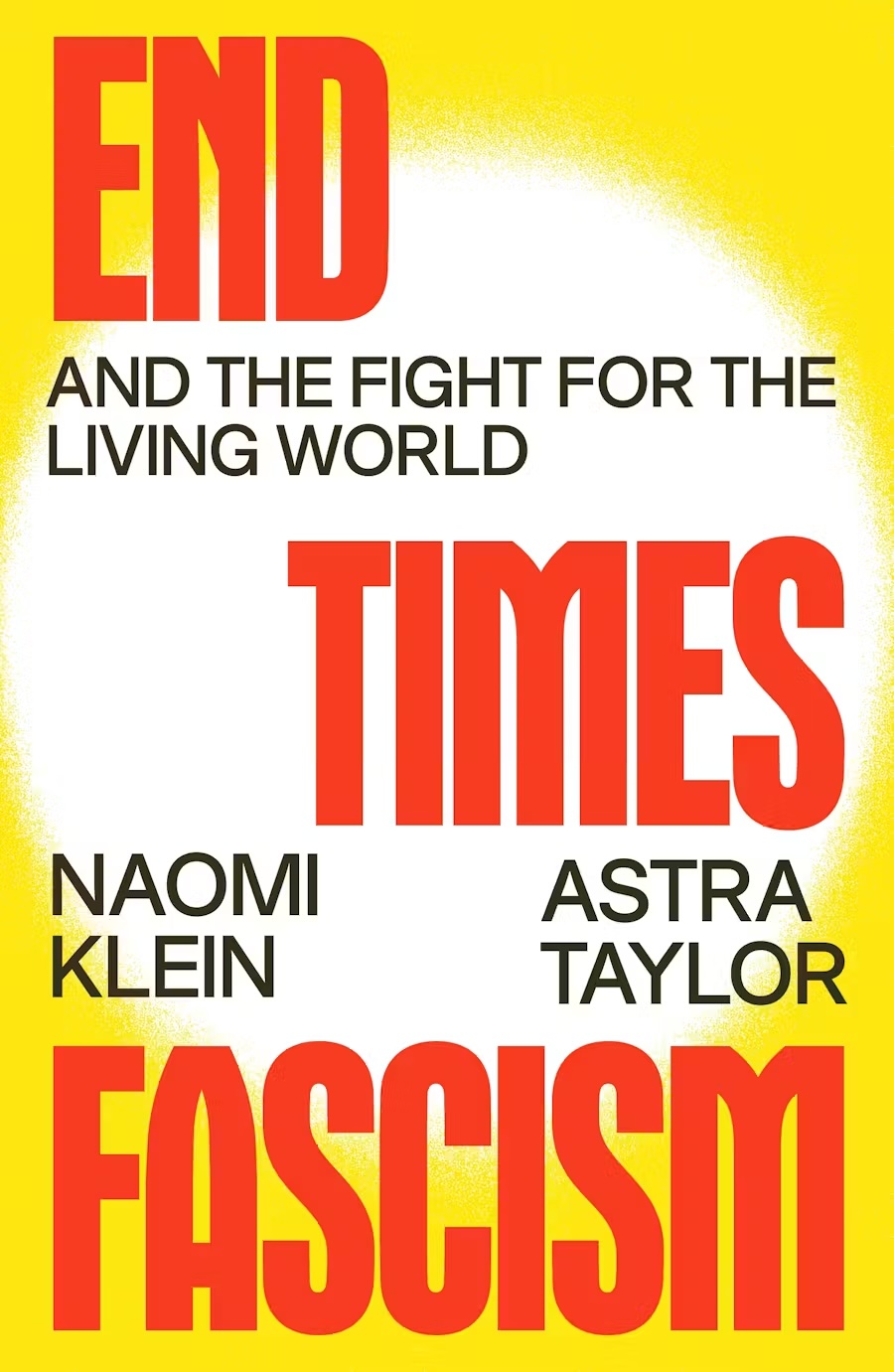
End Times Fascism
and the Fight for the Living World
By Naomi Klein and Astra Taylor
Farrar, Straus and Giroux, New York, 2026
What Is Fascism?
Fascism is hard to pin down because it’s not a uniform ideology and doesn’t draw from a single manifesto like communism. Klein and Taylor quote historian Robert Paxton’s definition:
“Fascism may be defined as a form of political behavior marked by an obsessive preoccupation with community decline, humiliation, or victimhood and by compensatory cults of unity, energy, and purity, in which a mass-based party of committed nationalist militants, working in uneasy but effective collaboration with traditional elites, abandons democratic liberties and pursues with redemptive violence and without ethical or legal restraints goals of internal cleansing and external expansion.” [p. 9]
Not something you can put on a bumper sticker. But it does align pretty well with how the late Madeleine Albright, former US Secretary of State, characterized fascism in her book Fascism: A Warning. Albright described fascism as nationalistic, often focused on a single ethnic group or race, authoritarian and anti-democratic, driven by resentment or humiliation of a group that believes it has been unfairly treated whether that belief is justified or not, and unafraid of using violence for its political ends.
It might seem like an exaggeration to apply the term “fascist” to the Trump administration, especially when compared to Hitler and Mussolini, but the characteristics all fit.
What then is “end times fascism?” Klein and Taylor say that it starts with elements of fascism and layers on the belief that a world-ending apocalypse is at hand and that only a chosen few will survive. End times fascists seek to accelerate that ending while simultaneously sheltering themselves in protective bunkers.
Klein and Taylor identify three related but often conflicting strains of end times fascism: religious, technological and ethno-nationalist. The first three quarters of End Times Fascism are devoted to exploring the beliefs and the people involved in each of these strains. The last section is devoted to methods for opposing and defeating end times fascism.
The authors don’t mince words: they accuse end times fascists of being “quitters,” of abandoning the living world and almost everyone in it, of being traitors to creation. They make a convincing case.
Unfortunately, I think this informative book suffers from trying to corral too many disparate people and ideas into a single narrative. In this review, I’ll highlight what I think were the key points, starting with the three strains of end times fascism.
Blood and Soil
Ethno-nationalism may be the most prevalent version of end times fascism and the easiest to understand. It’s essentially the idea that a “nation” and national identity are based strictly on shared ethnicity, ancestry and bloodlines and not on shared values or citizenship. In the US, J.D. Vance is the best-known proponent of this idea, stating that so-called “heritage Americans” – people with generations of American ancestry – have a greater claim to citizenship than other more recent arrivals (including his own wife). Let’s call it what it is: racism.
The apocalypse that ethno-nationalists fear is the Great Replacement, a conspiracy theory in which white people, and especially white males, are deliberately being replaced as the dominant group in society by an “invasion” of non-white immigrants. As a result, say Klein and Taylor, they want to turn the entire country into a fortified bunker by militarizing the border and expelling as many immigrants as possible, whether they are here legally or not. The brutal operations of ICE in the US are a direct expression of ethno-nationalism.

Photo: David Guttenfelder/The New York Times
As the authors point out, misogyny and locking down the border go hand in hand. That’s because women’s bodies must be controlled in order to purify and replenish the white population.
Klein and Taylor identify a sub-strain of ethno-nationalism called eco-fascism which combines far-right fascist ideas with a twisted form of environmentalism. Eco-fascists, they say, recognize that climate change is driving mass migration around the world (so not a hoax, apparently), but rather than addressing the underlying human causes of environmental destruction they blame overpopulation, especially in the Global South. They justify locking down the border as a way of protecting our pristine environment from being “sullied” by immigrants.
A Religious Apocalypse, Now
Religious end time fascists believe we are fast approaching a biblical end of days as foretold in the Book of Revelations. They include Christian Nationalists and Christian Zionists in America, and Jewish extremists in Israel. They not only eagerly anticipate the arrival of the Messiah or the second coming of Jesus, they are also actively trying to hasten it. They believe they will be among the chosen few who will be saved or raptured or transported to paradise. Heaven is their bunker.
In case you’re not familiar with Christian Zionists, these are people who support the State of Israel because they believe its existence is a prerequisite for the return of Jesus. For the same reason, they also encourage construction of a third Temple in Jerusalem on the site of the present-day al-Aqsa Mosque. As Klein and Taylor point out, Christian Zionists have no special love for Jewish people, they just want them to play their part in a violent end of days apocalypse to usher in the return of Christ.
Increasingly, according to the authors, conflicts between Christian Zionists and Christian Nationalists in the US are tearing apart the far right. Each group accuses the other of heresy and treason. The fundamental disagreement seems to be that Christian Nationalists view America as the promised land, not Israel. They are often antisemitic.
Both Netanyahu and Trump exploit the messianic fervor of religious end times fascists to justify their actions, including the destruction of Gaza or the bombing of Iran.
Religious end times fascists now occupy positions of power and influence in the governments and militaries of the US and Israel. Pete Hegseth and Itamar Ben-Gvir are prime examples. Though they remain a minority, even a fringe minority, in both countries, they still have the power to start wars.
“There are historical moments when we can feel relatively secure in the knowledge that the people who hold our collective fates in their hands will not knowingly bring about world-ending violence. But we do not live in a moment like that.” [p. 60]
The Coming AI Messiah
The third group of end times fascists identified by Klein and Aster are the technology elites racing to develop artificial intelligence. “Technofascists” like Sam Altman, Elon Musk and Mark Zuckerberg are not waiting for the Messiah; they’re trying to create their own god even as they warn that AI poses an existential risk to humanity. They seem to believe their extraordinary wealth will protect them, allowing them to build luxury bunkers in New Zealand or on Mars where they can ride out the impending storm.
Even those proponents who believe AI will lead to superabundance and human transformation seem to take for granted that AI paradise will be limited to the few whose jobs aren’t eliminated or who are willing to bodily fuse with technology.
Either way, these tech elites end up dominating the world through their ownership of AI.
Meanwhile, the authors point out, they have abandoned their climate pledges in a frenzied rush to build fossil-fuel powered data centers. They expect the rest of us to sacrifice what remains of the natural world to satiate AI’s enormous appetite for land, energy, water and computing power. They’ve all fallen in line behind Donald Trump because they want a president who allows them an unregulated path to develop and own this most powerful technology.
“Futureless Fascism”
End times fascism is not a movement in any traditional sense, explain the authors. Unlike 20th century fascists, today’s far-right leaders are not disciplined generals trying to recruit foot soldiers to their cause. Instead, they’re a fractious group of online influencers mainly interested in boosting their own brands. They compete with each other, sometimes viciously, in stoking outrage to gain attention, clicks, and revenue.
Despite their differences, these three versions of end times fascism are similar in several important ways. The authors point out that fascists everywhere direct anger downward at the people least responsible for societal problems – immigrants, single women and trans kids – instead of upwards to the powerful elites and oligarchs. They persuade voters they can no longer afford to care for anyone but themselves and people who look like them. End times fascists maintain that love and care must be strictly rationed, given only to a deserving few. They claim the empathy is a “fundamental weakness.”
More striking is how little they have to offer their followers. Klein and Aster call this “futureless fascism.”
“Having abandoned the horizon of a stable future in favor of profiting off collapse, end times fascists have nothing to offer most of their voters but a bleak vision of a perpetually bunkered nation, besieged by enemies foreign and domestic. Their goals are to purge the country of these out-groups, fortress the border against intruders, and stockpile the resources they need to weather the storms ahead – storms they are, of course, unleashing.” [p. 179]
They don’t even promise to make the trains run on time.
Historian Timothy Snyder calls this “eternity politics” in his book The Road to Unfreedom. Eternity politics is circular, always looping back to a glorious, mythologized past. There is no future. “Make America great again” is pure eternity politics.
Klein and Taylor put it like this:
“In short, we are up against an ideology that has given up not only on the premise and promise of liberal democracy but on the livability of our shared world – on its beauty, on its people, on our children, on other species. There is something treasonous in this. Treasonous, not to an abstraction like a flag or a nation, for we are not nationalists. But treasonous to the unspoken pact made with the web of life that sustains us.
They are traitors to creation, to the wonders of here.” [p. 247]

Photo: Mark Stebnicki/Pexels. https://www.pexels.com/photo/border-wall-at-river-bank-11679654/
The Antidote
To defeat end times fascism and its abandonment of living people and the living world, there must be a competing offer, a clear positive alternative.
Klein and Taylor propose an antidote they call the “politics of hereness.”
“… this emergent new politics is rooted in an expansive open-armed sense of neighborliness, one that transcends borders, race, and political partisanship. It is also rooted in a profound love of place. Love for our boisterous and diverse cities, and love for our imperiled rivers and forests and endangered species. It’s a politics based not on wanting to escape this earthly realm or our animate bodes, but on a deep desire to stay, and to protect all that is irreplaceable and alive.” [p. 23]
The politics of hereness is exemplified by the courageous resistance of Minneapolis citizens to the invasion of armed, masked ICE agents from December 2025 to February 2026, and by the 2025 New York mayoral campaign of Zohran Mamdani, which Klein and Aster cover in detail in the last two chapters of the book.
Hereness, they write, anchors belonging in our actions in the here and now, not in where our ancestors came from. It’s about “the right to stay right where we are,” despite its messiness, working joyously across differences to achieve common goals. Hereness denies escapist fantasies of paradise located elsewhere and restricted only to a chosen few.
An important place to start is public services. Public services provide people with both material resources and communal benefits including a sense of identity and belonging. On the other hand, when public services are cut, community ties are weakened. Thus, the authors maintain the best way to fight fascists is to ensure people feel safe and secure enough not to turn against one another.
“… the best way to help people be their best selves is the help them have better lives in the here and now.” [p. 266]
Unsolicited Feedback
I found End Times Fascism a difficult book to read. That’s partly because the content is so disturbing I could only read it in small doses. The book presents a useful frame for understanding some of the worst people and worst ideas swirling around our politics today. But spending large periods of time immersed in them isn’t healthy.
End Times Fascism was also hard to read because the book did not always fit together very well for me. It’s like the authors have gathered up a large, jumbled collection of threads – individuals, groups, events, trends, and ideas – and tried to weave them together into a single coherent tapestry. They’ve only partially succeeded.
For example, each chapter begins with a lengthy story about some event that presumably illustrates the topic of the chapter. But in many cases, these stories just read like gossip. For example, Chapter 4 on Big Tech and AI opens with a description of a 2024 gathering called “Hereticon” – apparently a conference for people who revel in being heretics –hosted by Peter Thiel, a cofounder of PayPal and Palantir and patron of J.D. Vance. The authors devote about six pages to the conference, the attendees and a theme party called the “Apocalypse Ball.” OK, Peter Thiel is a very powerful person in far-right circles and he has some strange, even nutty, beliefs. But why should we care about a bunch of bozos at a stupid costume party? The authors never explain. In fact, they barely mention the event in the rest of the chapter.
More fundamentally, as the authors clearly point out, the three strains of end times fascism are not a unified movement. They were never going to be spliced neatly together into a single narrative.
The rhetoric in the book was sometimes apocalyptic and conspiratorial. It made Klein and Taylor sound just like the raving extremists they’re criticizing. Here’s an example.
“As warring visions of selective salvation do battle across our warming, heaving, drying planet, the risks of ceding power to people who believe in the desirability and inevitability of Armageddon are becoming more terrifyingly palpable. It is one thing to celebrate apocalyptic battles in theory, quite another to witness them in your community or to watch an endless stream of graphic images from civilian neighborhoods turned into slaughterhouses.” [p. 90]
This over-the-top writing detracted from the solid case they’re trying to make in the book.
The discussion of AI was a little too one-sided for me. The authors present AI elites as a bunch of cartoonish villains. And to be sure, some of them are. They deserve all the criticism they get in the book. But the AI community is not a monolith. There are many who believe AI poses no significant existential risks to humanity, and that in fact it’s just normal technology going through normal growing pains. The backlash against AI data centers discussed in the book has grown so powerful that it’s become a major force in the 2026 US midterm elections. The book doesn’t reflect these nuances or the rapidly evolving AI landscape.
I agree with a clear and frightening warning in End Times Fascism: when elites, either in business or politics, believe they can flout laws and norms with impunity, that the risks facing humanity – risks they are accelerating – don’t apply to them, that their wealth or power will shield them from the devastation they are trying to bring about, they become a threat to our collective safety.
And so I love the antidote of hereness, of committing to staying where we are and who we are with to build a better future. The chapters on Minneapolis and Mamdani were inspiring. More of this please!
Despite its flaws, End Times Fascism is an important and very timely book that will help you understand some of the most powerful and most dangerous forces shaping politics around the world today. Plus it points the way to a better, more inclusive, more livable future.
Thanks for reading.
Related Links
Nahlah Ayed, host. “End Times Fascism: Naomi Klein and Astra Taylor.” Ideas, CBC, 16 Oct 2026, https://www.cbc.ca/listen/live-radio/1-23-ideas/clip/16243608-end-times-fascism-naomi-klein-astra-taylor. An interview with the authors.
Discover more from Unsolicited Feedback
Subscribe to get the latest posts sent to your email.


