There Are Rivers in the Sky by Elif Shafak tells the story of three people connected by two rivers and one raindrop. Arthur Smyth, born into squalor on the banks of the polluted Thames River in Victorian England, discovers the Epic of Gilgamesh while deciphering cuneiform tablets at the British Museum. Narin, a nine-year-old Yazidi girl from the town of Hasankeyf, near the banks of the Tigris River in southeastern Türkiye, waits to be baptized. Finally, Dr. Zaleekhah Clarke, a hydrologist, orphaned at a young age and raised by a wealthy uncle, moves into a houseboat on the Thames to escape her failed marriage.
There Are Rivers in the Sky tells their stories on three interwoven timelines. They converge at Nineveh, an ancient Mesopotamian imperial city, destroyed in 612 BC, situated on the eastern banks of the Tigris River. Its ruins lie on the outskirts of present-day Mosul, Iraq. Arthur journeys to Nineveh in the 1870s in search of missing fragments of the Epic of Gilgamesh. Narin travels there with her family in 2014 to be baptized. And Zaleekhah is eventually drawn there too in 2018.
Shafak builds her story around real-world historical events, slightly modified. The character of Arthur Smyth is loosely based on George Smith, an Assyriologist working at the British Museum who really did discover and translate the Epic of Gilgamesh. Hasankeyf, Narin’s hometown, was drowned by the construction of the Ilisu Dam on the Tigris River pretty much as told in the novel. And ISIS did carry out a horrific massacre of the Yazidi people in and around Mount Sinjar in 2014.
Elif Shafak is an award-winning British-Turkish author who has written 21 books, 13 of them novels. Born in Strasbourg, France, and raised in Ankara, Türkiye, she holds a PhD in political science from the Middle East Technical University in Ankara. Shafak is a vocal advocate for women’s rights and LGBTQ+ rights and freedom of expression. She lives in London. There Are Rivers in the Sky the first of her books that I’ve read.
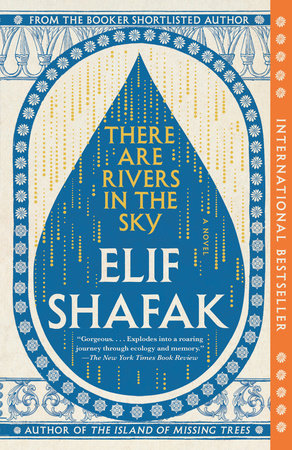
There Are Rivers in the Sky
By Elif Shafak
Penguin Books, New York, 2024
The book explores a variety of themes, like who owns the past? Is it acceptable that cultural artifacts from one country are dug up and transported to another, even for safekeeping?
Can immigrants ever truly belong to their adopted homelands? Or must they constantly strive to “succeed” or “fit in,” however those notions are defined in each place?
Shafak also delves into the history, culture and centuries-long persecution of the Yazidi people, a Kurdish-speaking religions/ethnic minority who live mostly in Iraq and whom I knew almost nothing about.
But mainly There Are Rivers in the Sky is about water, rivers in particular.
“Rivers are fluid bridges – channels of communication between separate worlds. They link one bank to the other, the past to the future, the spring to the delta, earthlings to celestial beings, the visible to the invisible, and, ultimately, the living to the dead.” [p. 432]
But rivers don’t just flow over the land. Water evaporates and rises to form clouds, condenses into rain and falls back to Earth. A raindrop that lands in the hair of an emperor could return, centuries later, as a snowflake that falls on the tongue of an infant child.
I loved the counter-intuitive idea of rivers as bridges, whether on land or in the sky. We are, of course, all connected by water.
Unsolicited Feedback
I can’t remember where I first heard of There Are Rivers in the Sky, but it must have stuck in my head somehow because when I saw it on a bookstore table at Schiphol Airport, Amsterdam, I thought it would be good reading for the long flight home.
I got more than I bargained for.
The book is intricately constructed, deeply researched, long and complex.
I’ve read plenty of novels that follow separate interwoven timelines. Usually the author brings them all together at the end in some kind of resolution. That didn’t really happen in this book. And while the characters are all well-written, I just didn’t feel invested in any of them. Lastly, I found Shafak’s literary device of a recurring raindrop to be contrived and unconvincing. The unifying theme of water would have been just as effective without it.
In the end, I’m not sure I fully “got” this novel and it left me a little mystified.
If you’ve read this book, I’d love to know what you thought of it. Please drop a comment below.
Thanks for reading.
Discover more from Unsolicited Feedback
Subscribe to get the latest posts sent to your email.


Sounds like such a well written book, will definitely check it out.
LikeLiked by 1 person
Sometimes characters are harder to connect with. I like the themes though, they sound interesting.
LikeLiked by 1 person
I hope you enjoy it!
LikeLiked by 1 person