Back in 2021, I read and raved about Susanne Simard’s wonderful book Finding the Mother Tree. She has a new book out this year called When the Forest Breathes: Renewal and Resilience in the Natural World. It’s a follow up to Finding the Mother Tree, continuing the story of Simard’s life and work in the forests of British Columbia. The main focus is her work on the Mother Tree Project from 2015 to 2023. When the Forest Breathes is also a memoir. Simard recounts the impact of fame and criticism brought by Finding the Mother Tree, her recovery from breast cancer, and her grief over the death of her mother. Most importantly, When the Forest Breathes is an urgent call to save our forests, and in doing so, to save ourselves.
Dr. Suzanne Simard, is a Professor of Forest Ecology at the University of British Columbia. She has published over 200 peer reviewed papers focused on how trees communicate using below-ground fungal networks.
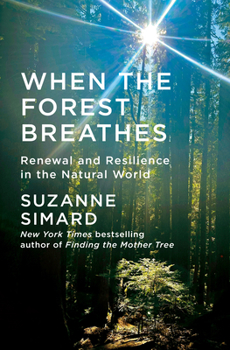
When the Forest Breathes:
Renewal and Resilience in the Natural World
By Suzanne Simard
Alfred A. Knopf, New York, 2026
The focus of When the Forest Breathes is the Mother Tree Project, a long-term research effort to determine the effects of logging practices on forest recovery and resilience. The scale of the project is immense. It spans 9 forest sites in British Columbia across a variety of climates, from arid to temperate rainforest. Each site is divided into sections that were logged in different ways. One section was clearcut, all the trees were removed. In another section, 10% of the trees were left standing. In the next section, 30% were spared. And in the final section, 60% of the tree cover was left untouched. After logging, the sites were replanted with a variety of tree species. It all sounds dry and clinical until Simard explains that the research sites cover an area about the size of Denmark, that it took 8 years to log and replant all the sites and sections, and that 225,000 seedlings were planted.
Then the real work began.
Every couple of years, Simard and her students visit each site to assess how their patches of forest are recovering. They look at how many trees have survived, how much they’ve grown, and what other species have naturally taken root. They also study the soil, looking at how well it has recovered and how much carbon it’s storing. It’s a project designed to carry on long after Simard herself is gone.
When the Forest Breathes tells the story of this work interleaved with a memoir of that time. Simard has spent her whole life in BC forests and her writing gives you a picture of how deeply and intimately she knows them. She writes beautifully about the trees, the soil, the innumerable species of forest plants and animals, and most of all, the intricate connections between them.
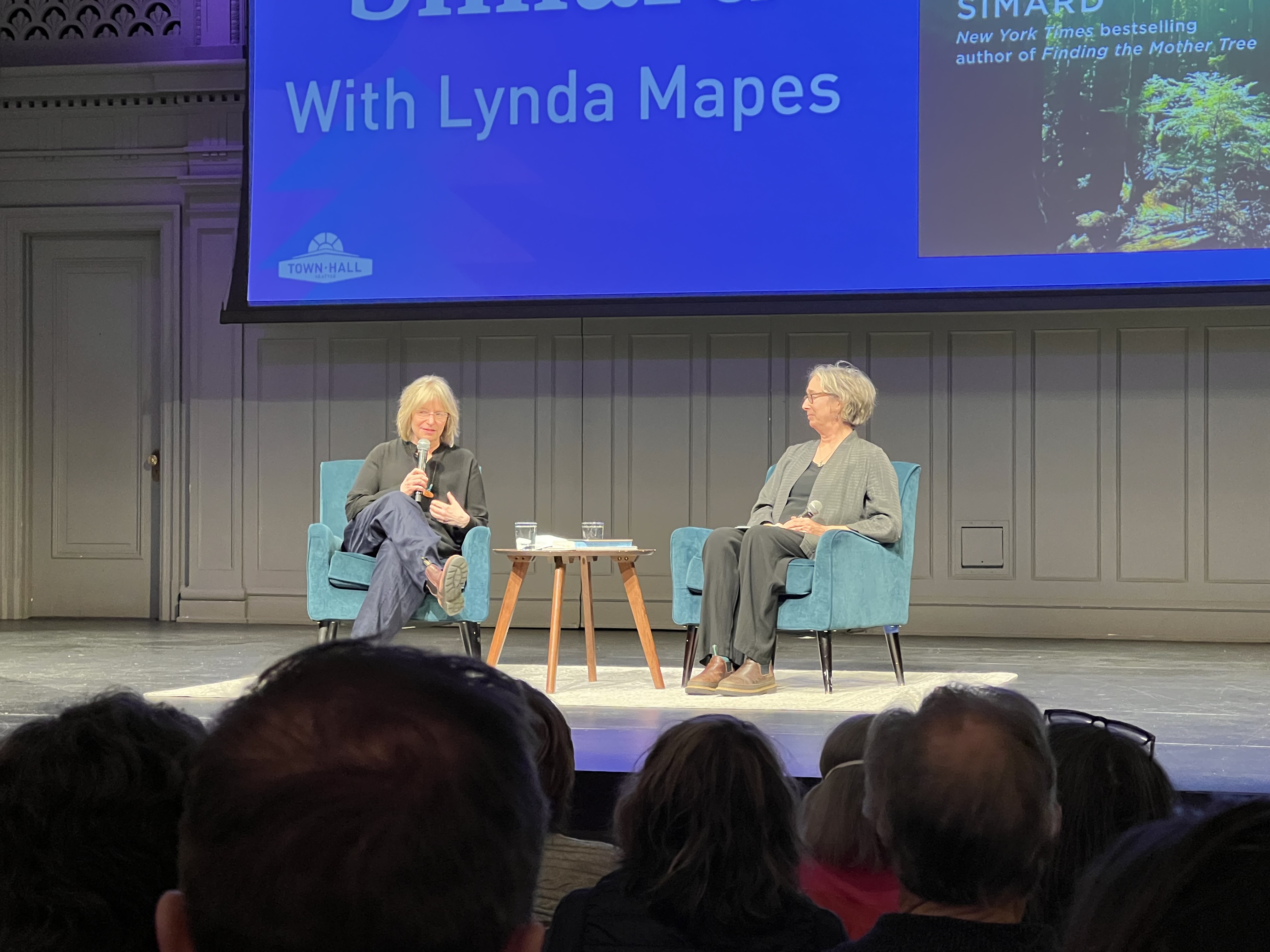
I had the pleasure of seeing Simard talk about her new book in person with Lynda Mapes, author of the fabulous The Trees Are Speaking, at Town Hall Seattle at the end of March. Simard gave some opening remarks about her life and work and then sat down for a discussion with Mapes. In person, Simard is even more passionate than on paper. It was a real treat to see both authors together on the same stage.
Simard recounts her close work with some of the Indigenous Nations of BC, her attempts to learn their methods of forest stewardship and her growing appreciation that Western science isn’t the only way of understanding the world.
“I know some scientists felt I had strayed too far from Western scientific rules and interpretations. But with global change upending our lives and forests dying from fire, drought, and infestation, we needed a transformational shift that embraced holistic stewardship for our collective health and well-being and rejected piecemeal extraction for the benefit of a few.” [p. 193]
When the Forest Breathes is not as revelatory as Finding the Mother Tree since it’s a continuation. But, if anything, it’s even more urgent. Five years have passed since the publication of Finding the Mother Tree and more forests have been cut down, the Earth has become hotter, and forest fires in Canada and elsewhere have become more cataclysmic. Yet forestry practices have barely changed, and it still takes Herculean efforts for Indigenous Nations to regain stewardship of their lands.
These issues come to a head in an emotional chapter about the protests against old-growth logging at Fairy Creek on southwestern Vancouver Island in 2020-21. Apparently, the largest act of civil disobedience in Canadian history, Simard describes the conflicts between environmental activists and loggers, the police and the government of BC which regulates (or doesn’t) logging in the province. The protest exposed divisions among Indigenous Nations too, some of whom depend on revenue from logging on their lands. The horrific destruction of the forest is wrenching to read.
Taking this book together with Mapes’s The Trees Are Speaking, I’m left with the impression that the forestry industry is run by a pack of vicious idiots. For the last few hundred years, industrial scale logging has moved across the North American continent razing forests to the ground, destroying ecosystems, and then moving westward to the next forest. Simard tells us that in British Columbia, 97% of old growth forests have been cut down, mostly clearcut. The practice of whole tree logging, where the entire tree is removed to a staging site, leaves no branches and other woody debris (called “slash”) to rot and replenish the soil. Heavy machinery compacts, crushes and destroys the soil. Flooding and erosion are common once rain falls over clearcut areas. Rivers become clogged with sediment.
I was shocked to learn that Canadian forests became a net carbon source by 2001. Forests and forest soils are normally carbon “sinks” that store carbon, but Canada’s forests now emit more carbon into the atmosphere than they store. This is because of pervasive fires and the destruction of forest soils, which Simard shows, store even more carbon than the trees. (Scientists warn that we are close to a major climate tipping point when the Amazon changes from carbon sink to carbon source.)
When logging companies replant, and in fairness they do replant, they put in just a single tree species in high density. The forest monocultures that grow back don’t have anywhere near the biodiversity and resilience of the old growth forests they replace. They store less carbon, and as Simard tells us, they are less profitable for the forest companies. It’s as if they just can’t help themselves repeating the same destructive pattern over and over again. All in the name of short-term profit. (They’re not the only industry with this problem!) This is in stark contrast to Indigenous approaches to tending the ecosystem for the benefit of both the forest and the people who depend on it. Instead, Simard says, “colonial management systems were leading from abundance to scarcity.” [p. 93]
Through her research, Simard is attempting to show, successfully I think, that better forestry practices, like not clearcutting and instead leaving some trees standing, especially the large mother tress, would result in more resilient forests that recover faster, store more carbon, and are even more profitable over the long term.
Forests breathe by taking in carbon and releasing oxygen. Humans do the opposite. We need each other to survive.
Thanks for reading.
Discover more from Unsolicited Feedback
Subscribe to get the latest posts sent to your email.


Pingback: Braiding Sweetgrass | Unsolicited Feedback