Early in Rebecca Solnit’s latest book, The Beginning Comes After the End: Notes on a World of Change, she paraphrases a famous quote by the Italian Marxist philosopher Antonio Gramsci:
“The old world is dying. The new one is slow in appearing. In this light and shadow, monsters arise.”
The Beginning Comes After the End is about profound social and political changes that have taken place over the last 75 years. It tells how an old world order, based on domination and cruelty, has been dismantled slowly, almost imperceptibly but with enormous impact over time, and replaced by a new order based on equality, inclusion and connection. And it’s about the backlash – the monsters – that seem inevitably to follow change. The focus is mainly but not exclusively on the U.S.
This is one of the most hopeful books I’ve read all year. By taking a longer-term perspective, the book highlighted for me how much progress we’ve made, even while acknowledging that progress has been imperfect and incomplete.
Rebecca Solnit is a climate and human rights activist who has written over 25 books. She holds a master’s degree in journalism from the University of California, Berkeley. The Beginning Comes After the End is the first of her books that I’ve read.
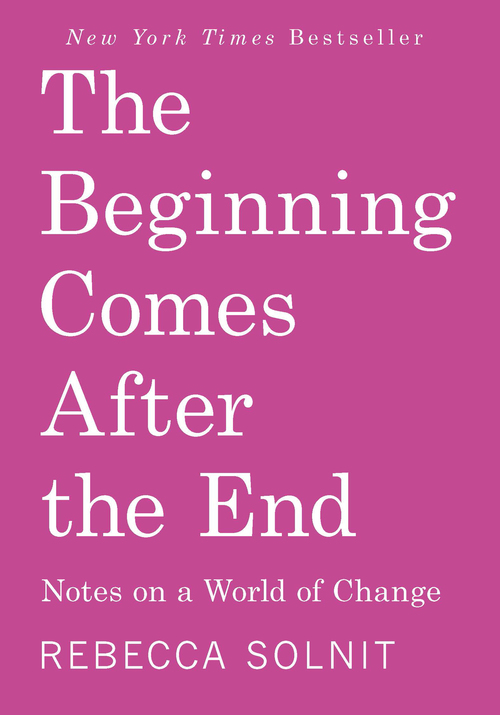
The Beginning Comes After the End:
Notes on a World of Change
By Rebecca Solnit
Haymarket Books, Chicago, 2026
Solnit argues that social and political change happen so slowly we often don’t recognize it until some major milestone is reached, like the election of America’s first Black president, or the legalization of same-sex marriage. These events seem sudden but are often the result of years and decades of painstaking work and small shifts. Over the last six or seven decades, our views about race, gender, Indigenous people, the environment and other issues have changed profoundly, she says.
The old order is based on rigidly enforced categories and hierarchies, Solnit writes. This was one of the most important ideas of the book for me. Categories like race, gender and sexual orientation are used by powerful elites to separate us into isolated little boxes.
“Treated as definitive, final, and absolute, categories affirm a reality in which meanings are fixed, definitions are airtight, and everything has a place from which it should not budge.” [p. 67]
Of course, reality is more complicated. Categories are “leaky,” often ambiguous with blurry boundaries. Yet they are often declared to be innate, something we’re born into.
“The most common authoritarian arrangement claims these categories are inherent and natural but proves they’re not with all the policing done to impose and maintain them and punish those who stray.” [p. 68]
You can look at almost any social issue as a struggle between those who want to enforce categories and those who want to break them down.
“Looking back, it seems most of all a world of division and compartmentalization, of tidy categories to keep us apart, keep us in our place and keep many of us out of many places, framed as natural and inevitable and necessary to maintaining order.” [p. 45]
But the old order wasn’t built on just categories. It put those categories into hierarchies.
“… this world of airtight categories did not just separate people but stacked them up in hierarchies, white over Black, colonizers over the colonized, settler colonists over Indigenous, straight over queer, male over female, bosses over employees, teachers over students, doctors over patients, police over citizens.” [p. 51]
Maintaining this order relied on suppression and oppression. It was inherently cruel, dictating roles and imposing boundaries to maintain power and justify inequality.
One of the key points Solnit makes in the book is that change over the last six decades has been characterized by the breaking down of categories and hierarchies. A Black person can become president. Women can become CEOs. People of the same gender can marry. People can change gender. Some people have even started to recognize that non-humans have rights too, like rivers and forests and other species. Underlying all this change is a recognition that we are all connected to each other and to the planet.
“Not all the changes have been for the better, of course, but those that have been share underlying values of equality, inclusion, empathy, the delegitimization of violence, and beneath those values a belief in interconnection.” [p. 28-9]
The book traces some of these changes and social movements in more detail, particularly the growing recognition of the presence and resilience of Indigenous people and interest in their worldviews.
The beginning comes after the end: the beginning of one era comes after the end of the previous one, even if we haven’t fully recognized it.
But the old order isn’t giving up without a fight. The right-wing backlash has been ferocious because these changes threaten key foundational principles of authoritarianism, namely isolation, division, and the enforcement of rigid categories and hierarchies. Stoking division is central to the authoritarian project, Solnit explains, because division and suspicion keep us apart and isolated.
This is also why there’s such vehement opposition on the right to doing anything about climate change, she points out. Climate change is so offensive to authoritarians and isolationists because climate connects all of us, and all of Nature, into one whole system. It means everything has consequences, and it means individuals cannot have unrestricted freedom to do harm to others or to Nature.
Solnit says the backlash is evidence of successful change – otherwise there wouldn’t be a backlash. Ironically, this puts progressives in the unfamiliar position of being on the defensive.
Further progress isn’t guaranteed, but the seeds have already been sown. It’s our job to show up.
The Beginning Comes After the End is just 131 pages but clearly written and filled with thought-provoking ideas. Many of Solnit’s points echo End Times Fascism by Naomi Klein and Astra Taylor, but it’s a more hopeful book highlighting how much progress has already been made.
I write this about ten days after the November 3, 2026 U.S. midterm elections in which Democrats scored sweeping victories across the country. It was an historic rejection of Trump, his policies and his corruption. Combined with defeats for authoritarian leaders in Hungary, Serbia and Brazil, this has been a bad year for right-wing governments around the world. It gives me hope that the rightward shift of global politics may finally be burning out, that some of the monsters may have been pushed back, and that we may be ready to resume progress once again.
We cannot take anything for granted of course. Solnit herself avoids the trap of claiming progress is somehow inevitable, or even always positive. As she says near the end of the book:
“We have our work cut out for us. It’s good work, and it’s everyone’s work. Countless people are doing it with whatever love, devotion, and brilliance they bring to the task; it needs more of us and more from us.” [p. 130]
Thanks for reading.
Discover more from Unsolicited Feedback
Subscribe to get the latest posts sent to your email.


