Undammed: Freeing Rivers and Bringing Communities to Life is one of the most hopeful books I’ve read in years. Most books about the environment or climate change catalog the disastrous state of our world and then dangle a morsel of hope at the end, usually along the lines of “it’s not too late but we must act now.” Undammed, a book about dam removal in the United States, describes real progress, genuine restoration, actual healing of the land and its people.
In the last 25 years, about 2,200 dams have been removed from US rivers. Undammed tells the stories of the people, many of them Indigenous, who have led dam removal movements and of the amazing transformations they have created. It’s written by Tara Lohan, an environmental journalist and editor. Her work has been published in the Nation, Grist, Salon, High Country News and others. She holds degrees in environmental science and narrative nonfiction.
Each chapter of the book focuses on a specific river. Lohan takes us to the Elwha River on Washington’s Olympic Peninsula, the Kennebec River in Maine, and the Klamath River in Oregon and California where dams have been successfully removed, and to the Colorado and Snake Rivers where dam removal is still hotly debated. Undammed packs a wealth of information and inspiration into just 225 pages. And it has a terrific index too!

Undammed: Freeing Rivers and
Bringing Communities to Life
By Tara Lohan
Island Press, Washington, D.C., 2025
Dam Facts
How many dams do you think there are in the United States? Go ahead, take a guess.
Nope. More.
The US Army Corp of Engineers’ National Inventory of Dams lists 92,000 of the nation’s largest and most critical dams, generally those 25 feet tall or more. There’s another list of 10,000 “low-head” dams with heights between 6 inches and 25 feet. However, many low-head dams are privately owned, unregulated, and not properly inventoried. So the exact number of dams is unknown.
In all, there are over 550,000 water barriers in the US, including dams, weirs, culverts and other water diversions according to the National Aquatic Barrier Inventory.
About 1,450, or less than 3%, of the nation’s 92,000 largest dams are used for utility-scale hydroelectric power generation. Other uses for dams include irrigation, flood control, milling (wood, flour, etc.) and other industrial uses, recreation, and to facilitate urban development.
Many of these dams have outlived their usefulness: the mills and factories they were built to power have long since shut down. Known as “deadbeat dams,” they are dilapidated, not maintained and in danger of failure. Lohan notes that there are hundreds and sometimes thousands of these deadbeat dams in every US state. It’s often cheaper to remove these dams than to upgrade or maintain them.
16,000 US dams are classified as “high hazard” where failure of the dam would result in loss of human life.
Dam Damage
As Lohan tells the story of each dam removal, a pattern starts to emerge. Dams are constructed across the country starting in the 1700s, but the major period of dam building happens in the late 1800’s to the 1950s, from the settlement of the West to postwar industrial expansion. These dams support America’s growth and its prosperity.
But over time, many dams fall into disuse. Their owners close up shop or go bankrupt. They don’t generate enough power to be worth maintaining. Increasingly, climate change means there’s just less water in the rivers, reducing the benefits that dams provide.
Local communities start to realize the high cost of damming rivers. Lohan delves into the enormous environmental damage caused by dams. Migratory fish populations in many US rivers have been decimated; many are endangered and some are on the verge of extinction. This includes salmon, trout, lampreys and even smaller fish such as alewives, a type of herring. The reservoirs behind dams, called impoundments, heat up under the sun, becoming less hospitable to fish and much more hospitable to algae and other parasites. Dams block sediments that help to replenish coastal beaches and estuaries. These sediments are often contaminated with chemicals and metals from upstream agricultural and industrial runoff.
Hydroelectric dams are losing their “clean energy” luster too. Lohan tells how scientists are now able to measure carbon emissions from dam reservoirs, especially methane from decomposing plants and algae. A persistent megadrought in the West is fast drying up reservoirs, especially Lake Mead and Lake Powell on the Colorado River. Water levels are dropping so low there is a real danger that generator turbines will stop spinning and the reservoirs will become stagnant “dead pools.”
But perhaps the greatest damage caused by dams is to local communities, particularly to Tribal Nations. Lohan recounts how dams and their reservoirs have inundated Native villages, sacred sites and traditional hunting and fishing grounds; lands that were supposedly protected by treaties with the US government. Plummeting stocks of salmon and other fish have deprived Indigenous people of staple foods and cultural practices.
“We’re salmon people … To lose fish is to lose your whole life. To lose your culture, your religion,” [p. 198]
says Leaf Hillman, a leader of the Karuk tribe of the Klamath River.
It’s no surprise that Native Americans have become leaders in many dam removal efforts, especially after the 2002 Klamath River fish kill in which low water flows over the Iron Gate dam killed between 34,000 and 70,000 fish, mainly Chinook salmon. Lohan quotes Amy Bowers Cordalis, a lawyer and leader of the Yurok tribe:
“From that moment, that pain and grief, and the loss of all those salmon, which we feel are our family members, came a profound sense of duty to help fix it.” [p. 198]
Dam Removal
Removing dams, even small deadbeat dams that are obviously a danger to the public, is no easy task. In each chapter, Lohan describes how advocates for dam removal had to assemble a broad coalition of stakeholders, complete scientific and technical studies, persuade an alphabet soup of federal, state and local regulators to grant approval, lobby Congress and state legislatures to pass enabling legislation, and cobble together the necessary funding before a single shovelful of earth could be moved. It takes years, often decades.
It took over a century for dams on the Elwha and the Klamath to be removed.
But, oh, how quickly the rivers recover!
The first thing that happens when a dam is breached is the river flushes out the sediment trapped behind the dam. For a large dam, this could be millions of cubic yards of sediment. It’s not pretty. Thick layers of mud get deposited all along the river course. The word “moonscape” comes up frequently in the book. But after a few weeks the water starts to clear up. Then the vegetation begins to recover, aided by restoration work crews planting millions of seeds and seedlings. On the Colorado River, nature isn’t even waiting for the dams to be removed. Lohan describes how vegetation is already starting to regrow at Lake Mead and Lake Powell on soil exposed by shrinking reservoirs.
Over the next few years, insects, birds and other wildlife move in.
But the fish – the fish come back right away. Mere weeks after the last of the four Klamath River dams were removed, fall-run Chinook salmon were seen in Oregon sections of the river, a distance of 230 miles from the river mouth on the California coast. Lohan says these were the first anadromous fish to reach the Oregon portion of the Klamath Basin since 1912.
On the Elwha River in Washington State, where two dams were removed, Lohan reports that biologists spotted Chinook salmon in the former reservoir of the upper Glines Canyon dam just days after removal. Two and a half years later, eight runs of migratory fish were swimming by the site of the Lower Elwha dam.
I had the pleasure of visiting the Elwha River last summer on a field trip for a course I was taking on environmental law. A dozen years after the dams were removed, it’s a stunning wild river.
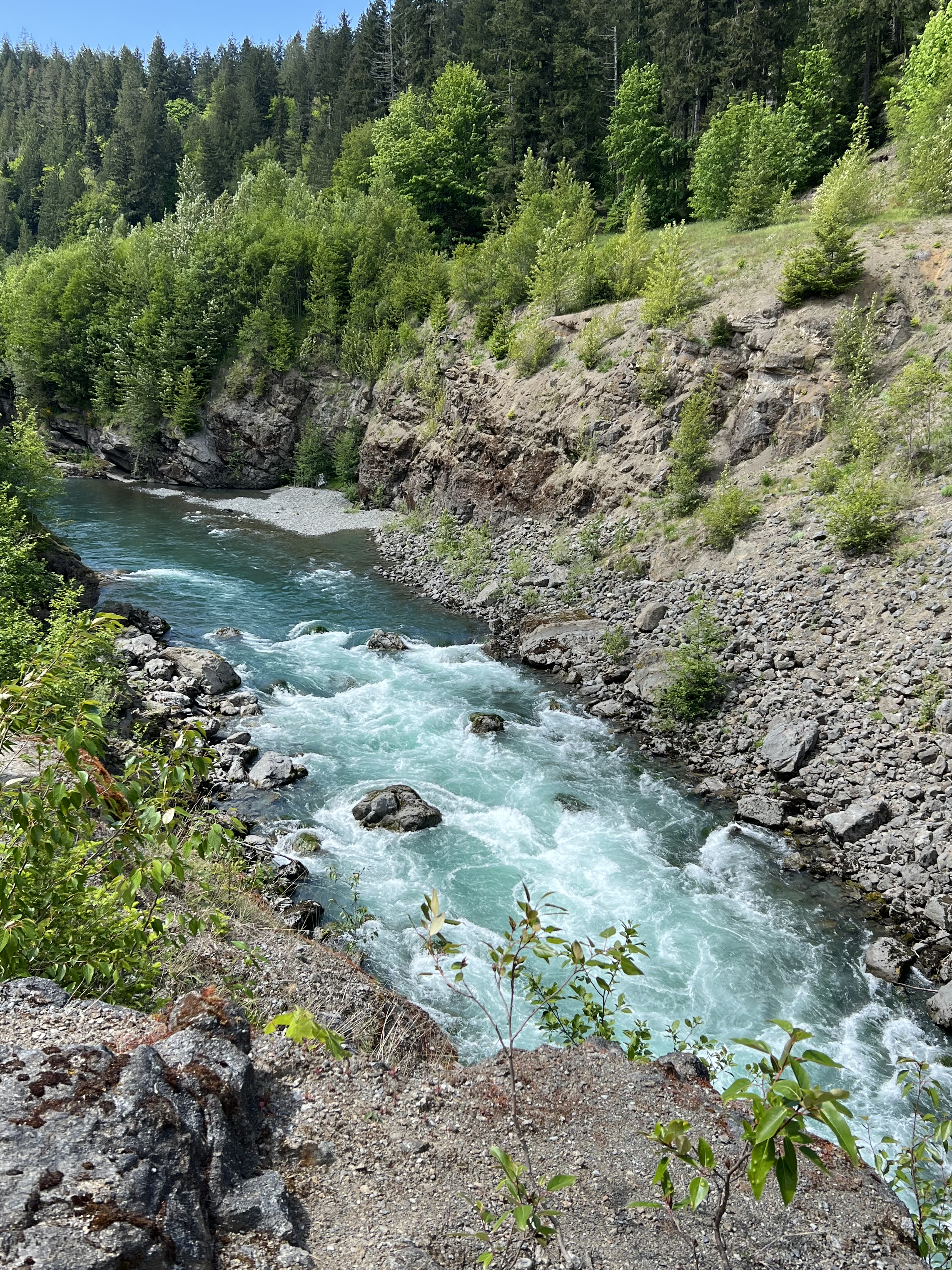
Of course it will take decades for fish populations to recover to pre-dam levels, if they ever do. On the Sebasticook River in Maine, a tributary of the Kennebec, fewer than 800 alewives made the trip upriver from the Atlantic before dam removal. Now, 35 years later, they number 9 million.
We’re not going to get rid of every dam in the United States. Many are still needed and useful. But those that can be removed should be removed. Dam removal is an act of restoration of the kind Robin Wall Kimmerer calls for in Braiding Sweetgrass. As Lohan says near the end of the book:
“Each dam removal is an opportunity to fix something that’s broken, to heal what is out of alignment – both ecologically and socially. I’m grateful for Indigenous communities for maintaining the knowledge of how we do that work.” [p. 224]
Undammed inspired me with proof that restoration is not only possible, it’s happening already.
Thanks for reading.
Related Links
National Inventory of Dams
A searchable map of about 92,000 of the largest or most critical dams in the US. Generally, includes dams 25 feet or more in height. Maintained by the US Army Corps of Engineers.
National Low-Head Dam Inventory
A database of about 10,000 dams with heights between 6 inches and 25 feet.
National Aquatic Barrier Inventory
Inventory of dams, weirs, culverts and other water diversions maintained by the Southeast Aquatic Resources Partnership (SARP).
Inventory of Dams in the State of Washington
Report on dams in Washington State prepared by the Department of Ecology. 15 Jan. 2026.
Hydro Power Plants in the United States
Map of hydroelectric power plants in the US maintained by Cleanvew, a market intelligence company.
Dam Removals
Map of dam removals maintained by American Rivers.
Sydney Cromwell. “Dam Removal Efforts Lead to a Stunning Comeback for Maine’s Alewives.” Inside Climate News, 6 Jul. 2026, https://insideclimatenews.org/news/06072026/maine-dam-removal-efforts-lead-to-fish-comeback.
Cara Buckley. “America the Undammed.” New York Times, 7 May 2026, https://www.nytimes.com/2026/05/07/climate/america-the-undammed.html.
Emma Marris. “The Salmon That Surprised Everyone.” New York Times, 29 Nov. 2025, https://www.nytimes.com/2025/11/29/opinion/salmon-california-oregon-nature-resilience.html?searchResultPosition=1.
Association of State Dam Safety Officials (ASDSO). “$165.2 Billion Needed to Rehabilitate the Nation’s Non-Federal Dams.” 7 Aug. 2025, https://damsafety.org/CostofRehab.
Nika Bartoo-Smith and Isabella Breda. “The Pacific Northwest is Littered with ‘Deadbeat Dams’.” Underscore Native News, 7 Jul. 2024, https://www.underscore.news/land/the-pacific-northwest-is-littered-with-deadbeat-dams/.
Discover more from Unsolicited Feedback
Subscribe to get the latest posts sent to your email.


Pingback: The Water Remembers | Unsolicited Feedback