Can you run a successful global corporation without harming the planet? Few have tried harder than Yvon Chouinard, founder of the outdoor clothing company Patagonia. Dirtbag Billionaire: How Yvon Chouinard Built Patagonia, Made a Fortune, and Gave It All Away by David Gelles tells the story of Chouinard’s life and the company he built.
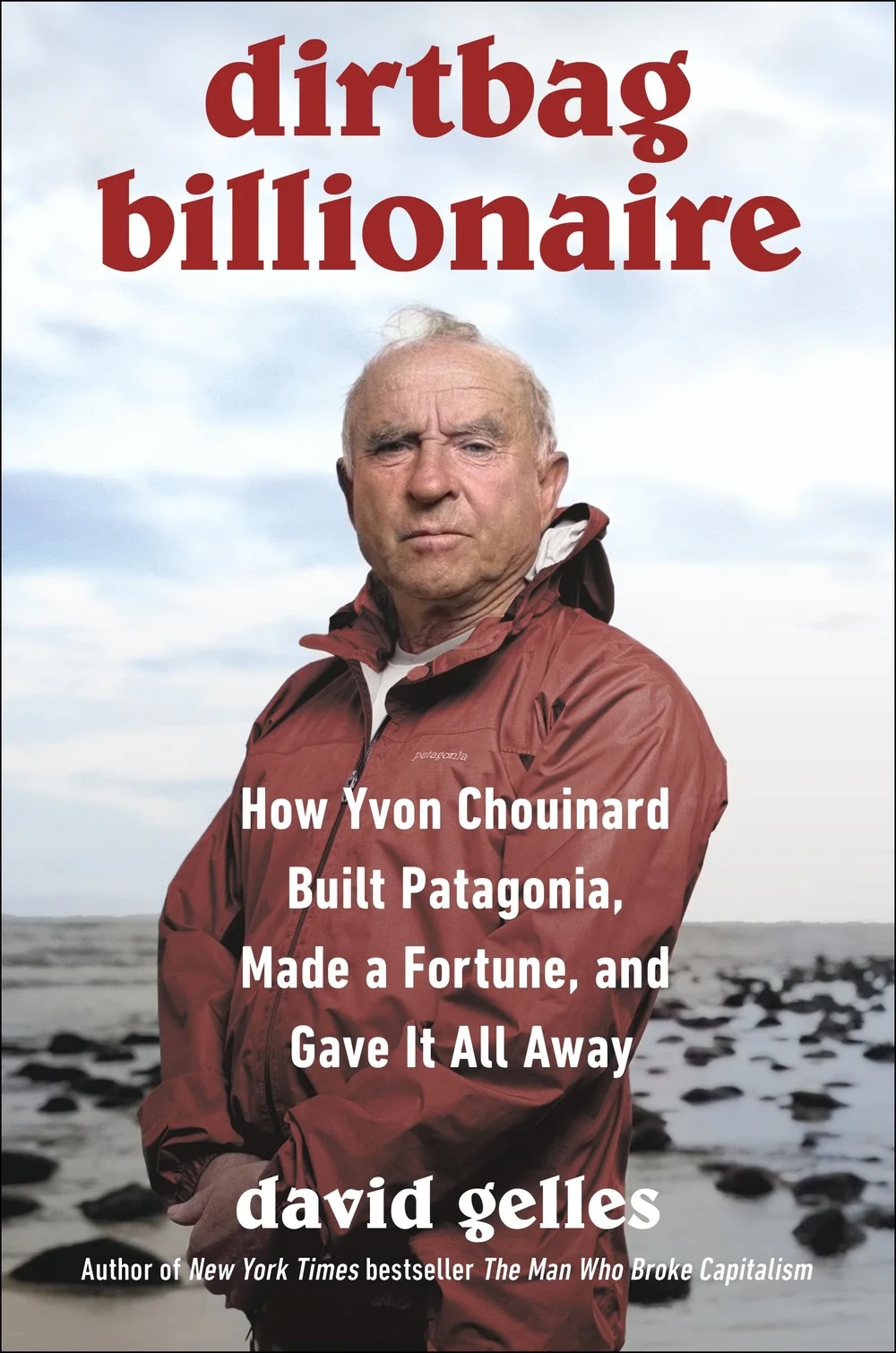
Dirtbag Billionaire:
How Yvon Chouinard Built Patagonia,
Made a Fortune, and Gave It All Away
By David Gelles
Simon and Schuster, New York, 2025
David Gelles is an award-winning climate reporter at the New York Times. Dirtbag Billionaire is his third book.
As Gelles tells it, Chouinard is an accidental capitalist. As a young man, Chouinard became an avid rock climber, but like many young men he had no money. He led a kind of feral life on the fringes of society, sleeping under the stars or under an overhanging rock ledge, hunting and occasionally stealing food. He was, in his own words, a “dirtbag.”
Soon Chouinard began making his own climbing equipment in a makeshift blacksmith shop and selling his wares to other climbers from the trunk of his car. That was the genesis of what eventually became Patagonia.
Chouinard’s early insight was that if he made the very best products that work better and last longer so that people need to buy fewer of them, customers would pay a premium price. That formula seems to have worked well.
Chouinard doesn’t sound like an easy person to work for. He’s a visionary, similar in some ways to Apple’s founder Steve Jobs, with an obsessive focus on quality and craftsmanship. He’s demanding and unconventional. Gelles describes how Chouinard would disappear for weeks or months into some remote part of the world, climbing, kayaking or surfing, and then reappear with a slew of demands for product improvements or ideas for new products altogether.
By testing his own clothing and gear under the harshest of conditions, he gained invaluable insights from these expeditions. (When I worked in the software industry, we called this “eating our own dogfood.”)
Those expeditions not only helped Chouinard improve his products, they also showed the impact they were having on the environment. One of Chouinard’s earliest products were pitons, wedge-shaped spikes that climbers would hammer into rock faces to anchor their ropes. But pitons were damaging the rock faces, causing them to crack and crumble. His own products were harming the pristine environments Chouinard cherished so much. So he switched to making chocks of various sizes that can be wedged into existing cracks and crannies instead of being hammered into place.
Gelles tells how this experience set the pattern for Patagonia refining its products over the years to be less harmful. Patagonia was one of the first major retailers to start using organic cotton. The company developed Synchilla, a double-sided fleece that’s warm and durable and dries quickly but it’s made from polyester. The company has never found a replacement fiber, but it now uses nearly 100% recycled polyester.
Doing all this has meant working with suppliers to clean up their environmental and labor practices too.
Patagonia was the first company in the U.S. to provide on-site daycare for employees’ children. And since 1985 it has donated 1% of its sales to environmental organizations and causes, giving away over $140 million so far.
Gelles doesn’t present Chouinard or Patagonia as perfect. The company makes products that tend to be bought by well-off people. Climbing and other outdoor adventuring aren’t easily accessible or cheap either. The company is essentially serving a privileged customer base. Also the relationship between the Chouinard family and employees hasn’t always been smooth. There’s never been any employee stock ownership program, for example. The family has retained complete control of the company.
A few years ago, Chouinard, now a billionaire in his eighties, signed his company stock over to a set of trusts that are designed to preserve the company’s independence and its values after his death.
So, can you operate a profitable global corporation without harming the planet? Dirtbag Billionaire shows that corporations can definitely reduce the harm they’re causing. I think Chouinard and Patagonia deserve credit for setting an example, here. But getting to zero harm? That’s a long and difficult climb probably not fully achievable. Companies certainly cannot do it alone; they have to clean up their supply chains too, as Patagonia has done. But even that has limits. One company can’t clean up freight shipping or electricity generation.
Overall, Dirtbag Billionaire presents a flattering portrait of Chouinard and Patagonia, but Gelles doesn’t shy away from the inherent tensions and challenges in what they’ve tried to achieve. I think the book serves as a good lesson for each of us too as we try to live our own lives and make our own choices to do less harm to our planet. It’s not easy, we might never fully succeed, but it’s worth the effort.
Thanks for reading.
Related Links
David Gelles. “Billionaire No More: Patagonia Founder Gives Away the Company.” New York Times, 14 Sep 2022, https://www.nytimes.com/2022/09/14/climate/patagonia-climate-philanthropy-chouinard.html.
David Gelles and Kenneth P. Vogel. “Patagonia’s Profits Are Funding Conservation — and Politics.” New York Times, 30 Jan 2024, https://www.nytimes.com/2024/01/30/climate/patagonia-holdfast-philanthropy.html.
Discover more from Unsolicited Feedback
Subscribe to get the latest posts sent to your email.


