Back in September, the United Nations finally announced something climate scientists have been saying for several years: we’re going to miss the Paris Agreement goal of limiting global warming to 1.5°C above pre-industrial levels.
The announcement came in a 139-page report titled Limiting Overshoot: Navigating exceedance of 1.5°C and pathways towards return[1] published on September 2, 2026 by the United Nations Environment Programme. The report made headlines for a day or two and then sunk beneath waves of news about the war with Iran, oil price shocks, the war in Ukraine, the coming AI apocalypse, the data center backlash and the upcoming US midterm elections. Nonetheless, it’s an important report so in this post I’m going to highlight just ten key points.
The United Nations Environment Programme (UNEP) is the UN’s leading authority on the environment. It focuses on the world’s most pressing environmental challenges: climate change, land and biodiversity loss, and pollution.
10 Takeaways
1. We are going to overshoot (exceed) 1.5°C of global warming, probably by the end of this decade.[2] That’s because we are nowhere close to reducing greenhouse gas (GHG) emissions to net zero. The report says that national climate pledges are “nowhere near sufficient” to achieve net zero, and nations are doing a poor job implementing even those insufficient pledges.
No one knows exactly how high global temperatures will rise. The UN’s median estimate is around 2.6°C above pre-industrial levels by 2100 under current policies. Even under the UN’s most optimistic scenario, temperatures rise by 1.8°C.[3]
2. There is no safe temperature rise above 1.5°C. Even 1.5°C is not safe. We are already experiencing the effects of warming: extreme heatwaves, drought, forest fires, sea level rise, coral reef destruction, crop failure and other impacts. We’re starting to feel the consequences for human health, food security, infrastructure, mass migration and international conflict. Climate impacts will continue to get worse as temperatures rise.
3. Climate change will not proceed in a steady, predictable way. We are now at risk of triggering irreversible “tipping points” such as the melting of the Greenland and Antarctic ice sheets, the collapse of the Atlantic Meridional Overturning Circulation (AMOC) (an ocean current system that includes the Gulf Stream), and the Amazon rainforest flipping from a carbon sink to a carbon source. Even if we eventually bring temperatures down, the ice sheets and the Amazon won’t recover, at least not for tens of thousands of years.
4. We must now move onto an “overshoot, peak and decline” pathway. The report urges dramatically cutting GHG emissions now to limit the size and duration of overshoot. In other words, we need to cut emissions to zero so that the eventual peak is as low as possible and reached as quickly as possible. After peak temperature is reached, we must shift our focus to returning to 1.5°C (or lower) by drawing carbon out of the atmosphere. In other words, we’ll need sustained net negative emissions to reduce global temperatures.
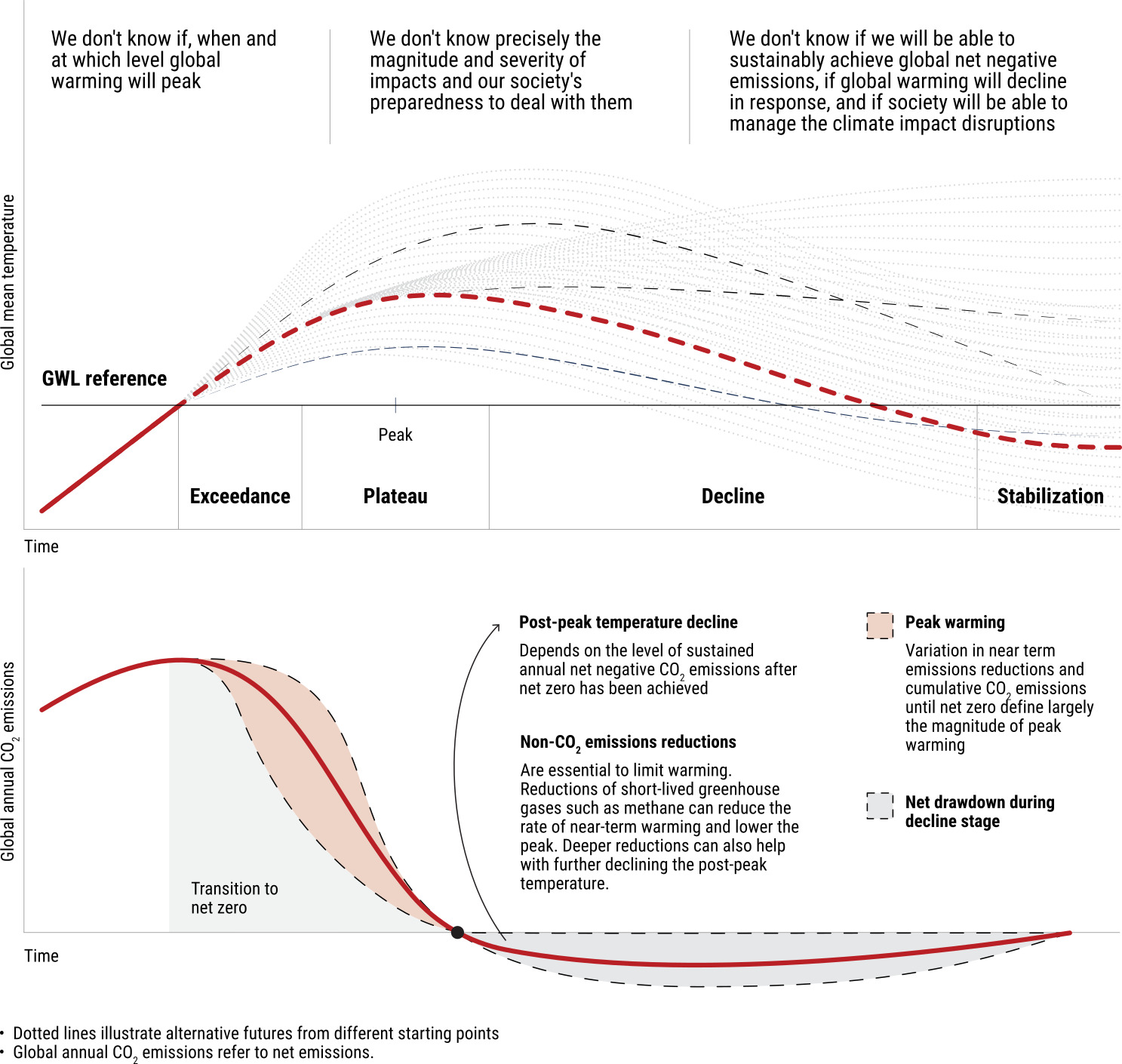
5. Every fraction of a degree matters. The more temperatures rise before peaking, the more difficult and costly it will be to bring them back down, and the longer it will take. Much of the report is focused on actions needed at each stage along this pathway.
6. Carbon dioxide removal (CDR) is an essential element of returning to 1.5°C but its impact this century will be minimal. There are two types of CDR: conventional and novel. Conventional CDR such as tree planting and ecosystem restoration relies on nature to draw carbon dioxide out of the air. Unfortunately, it would take over 100 years of tree planting at current levels to reduce warming by just 0.1°C. Novel CDR approaches such as direct air carbon capture and storage use new, and largely unproven, technologies to do the same thing. Even aggressively scaling up CDR won’t reduce warming by more than a few tenths of a degree this century, and even then only if GHG emissions are sharply reduced.
This reenforces the urgency of keeping peak warming as low as possible.
7. Mitigation and adaptation are both required at all stages of the overshoot, peak and decline pathway. Mitigation refers to reducing emissions by, for example, transitioning to clean energy in electricity generation. Adaptation means adjusting to expected climate and its effects such as building infrastructure to handle higher tides and stormwater surges. The two are complimentary. Mitigation reduces the scope and cost of necessary adaptations. Yet adaptation is also necessary because we’re already feeling the effects of climate change, and because thoughtful adaptation reduces the need for disaster response which drains resources away from mitigation.
8. A key element of mitigation is avoiding “carbon lock-in.” The report says: “Investments in long-lived, high-emission infrastructure, such as fossil-based power plants, transport systems and industrial facilities, can constrain future emissions reductions and lock countries into high-carbon trajectories.”[4] This is bureaucratic language for “building more gas- or coal-fired power plants is insane.”
9. Reducing methane emissions can deliver significant benefits quickly. Methane (CH4) emissions account for about 0.5°C of global warming. Reducing emissions from the oil and gas sector, coal mines, food waste and landfills would result in immediate climate and health benefits. Additional reductions in methane emissions will likely require changes in agriculture and dietary practices. While the report treads softly here, there’s no mistaking the call to reduce meat consumption: “Dietary shifts could significantly cut emissions and free land for carbon sequestration.”[5]
10. Even if we return to 1.5 or below, many parts of the world will face irreversible loss and change. Sea level rise, biodiversity loss, and ecosystem changes will persist long after peak temperatures, affecting lives and livelihoods in many places around the world for generations.
Unsolicited Feedback
There’s no getting away from it, this is a depressing report. None of this would be necessary were it not for “decades of inaction” on climate change.
I felt a sense of unreality reading Limiting Overshoot. The UN calls for dramatic and immediate reductions in GHG emissions. They call for increased resources for mitigation and adaptation programs. Throughout the report, the UN urges greater international cooperation and collaboration and an emphasis on justice and equality at all stages along the overshoot, peak and reduce pathway.
It’s the same thing they’ve been saying for decades. I feel sorry for the authors and scientists who contributed to this report and to many others over the years. They’ve been shouting into the void and most of the world isn’t listening. While there has been some progress, particularly in renewable energy and electric vehicles, that progress hasn’t been nearly fast enough. The US under Trump has become a climate arsonist. It’s tragic and infuriating.
I don’t know why the UN expects anything to change now. Maybe they don’t. Maybe there’s nothing else they can do but lay out the facts and hope the world takes action.
One final thought: The US midterm elections are on November 3, just a few weeks from now. Climate change has barely been mentioned in this cycle. Nonetheless, if you’re a US citizen, the Earth needs your vote.
Thanks for reading.
Related Links
I read the new UN climate report so you don’t have to.
Substack post by Ayana Elizabeth Johnson, author of What If We Get It Right summarizing the Limiting Overshoot report. Sept. 6. 2026.
References
[1] United Nations Environment Programme (2026). Limiting Overshoot: Navigating exceedance of 1.5°C and pathways towards return. Nairobi. https://doi.org/10.59117/20.500.11822/49857.
[2] Ibid. 13.
[3] Ibid. 17.
[4] Ibid. 49.
[5] Ibid. 58.
Discover more from Unsolicited Feedback
Subscribe to get the latest posts sent to your email.


