In September 2024, work crews completed removal of four hydroelectric dams on the Klamath River along the California-Oregon border. The project cost $450-million and opened 420 river miles to migrating salmon and steelhead for the first time in over a century. It is the largest dam removal project in the world.
But for the Yurok Nation and neighboring Tribal Nations of the Klamath River Basin, dam removal represents the culmination of 200 years of struggle to preserve their way of life and their very existence.
The Water Remembers: My Indigenous Family’s Fight to Save a River and a Way of Life by Amy Bowers Cordalis tells the story of her family’s fight against the US government, the California state government and powerful business interests to save the River, the salmon, and themselves. It’s an inspiring multigenerational memoir of tenacious perseverance in the face of injustice, betrayal, violence and genocide.
I previously reviewed Undammed, an informative book about dam removal projects across the United States. The Water Remembers focuses on one river and one family. It’s outstanding.
Amy Bowers Cordalis is a fisherwoman, lawyer and member of the Yurok Nation, California’s largest Indigenous Nation, and its former General Counsel. She holds a Bachelor of Science degree in Political Science from the University of Oregon, and a Juris Doctor (J.D.) from the University of Denver’s Sturm College of Law. In 2024, she was named a UN Champion of the Earth Laureate, the UN’s highest environmental honor, for her work on restoring the Klamath River. She is the cofounder and executive director of Ridges to Riffles Indigenous Conservation Group which helps Indigenous Peoples “protect and restore the natural and cultural resources they rely on to maintain their identity and sovereignty.”
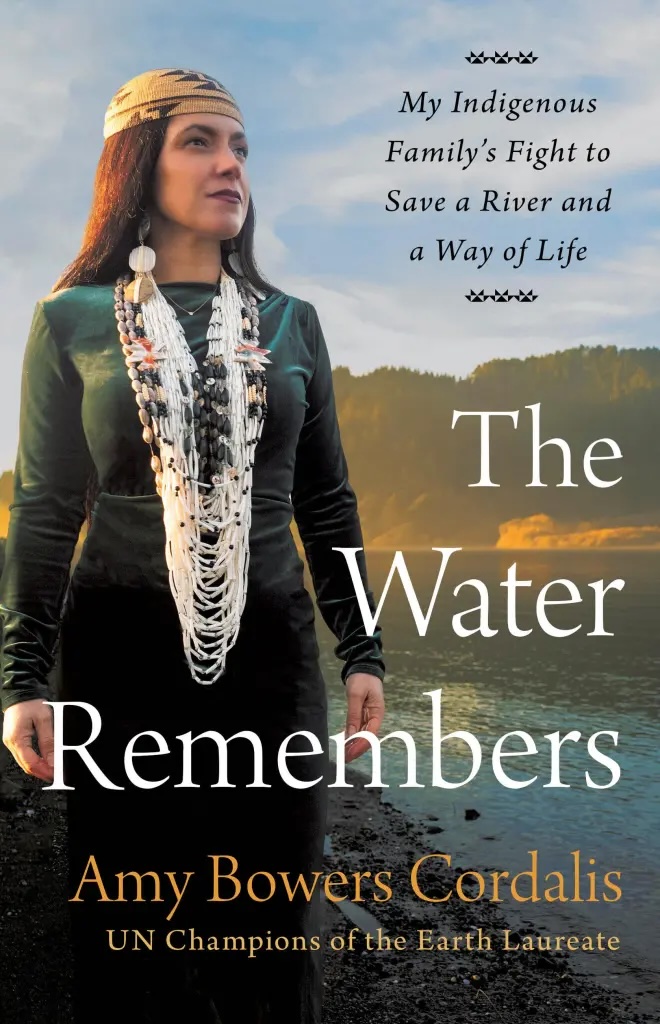
The Water Remembers:
My Indigenous Family’s Fight to
Save a River and a Way of Life
By Amy Bowers Cordalis
Little, Brown and Company, New York, 2025
Cordalis tells her story and the story of her ancestors with power and unflinching courage. It’s a story of harrowing abuse and unimaginable trauma. I’ve read sanitized accounts about the history of Indigenous people’s suffering at the hands of white settlers and governments. But this first-person family memoir personalizes those events and makes them more real and more tragic.
In this review, I’ve sketched out just a few key events in the story to give you some context, but I’ve also used more quotes from the book than I usually do. That’s because I think Cordalis’s eloquent voice deserves to be heard directly.
The barest outline of the story goes like this: Since time immemorial, the Yurok have lived in a deeply interdependent relationship with the Klamath River and its salmon. That relationship, as Cordalis tells us, is based on the Tribe’s “first covenant” with the Creator. It’s a binding set of reciprocal responsibilities. The Yurok agreed to live in balance with Nature and take care of the River, and the Creator promised the River would take care of them ensuring they would never want for anything.
In 1851, with white settlement of the US West well underway, the Yurok signed a treaty with the US government ceding millions of acres of their ancestral territory in return for a reservation consisting of a one mile wide strip of land along both sides of the lower 40 miles of the Klamath River. But the US Senate failed to ratify the treaty so the reservation was created by a Presidential executive order instead. Ever since, the Yurok have had to fight for their rights to fish, hunt and live their way of life on their reservation.
Cordalis tells how the governments of first California and then the United States banned the Yurok from salmon fishing on the River. The State of California claimed that an 1892 piece of federal legislation had “terminated” the Yurok reservation and with it the Tribe’s fishing rights and land title. Eventually Cordalis’s uncle, Ray Mattz, fought the State in court after being arrested 19 times for exercising his rights to fish. It took years, but in 1973 the US Supreme Court ruled unanimously in Mattz v. Arnett that the reservation had not been terminated and that “the land within the boundaries of the reservation is still Indian country.”
Almost immediately after the Yurok had their rights affirmed by the Supreme Court, the US federal government imposed another fishing ban. Ostensibly a conservation measure, but as Cordalis explains, only Yurok fishing was banned, while white sports fishing and commercial fishing were not.
Fish Kill
Meanwhile, in 1905 the Bureau of Reclamation built the Klamath River Reclamation Project, an extensive network of canals and reservoirs that diverts water from the River and Upper Klamath Lake in Oregon to irrigate about 240,000 acres of farmland. In addition, between 1911 and 1964, PacifiCorp built four hydroelectric dams on the upper Klamath River: the J.C. Boyle Dam, Copco 1 and 2, and farthest downstream, Iron Gate Dam, all without fish passage facilities. Competing demands over water for irrigation, hydropower, tribal use, and instream flows needed to sustain fish habitat led to inevitable conflict.
“There were more water demands than water to fulfill them, even in wet years. The basin’s water was overallocated, even without satisfaction of the tribal water rights. In an all-too-common unjust and illegal use of water, the federal government prioritized water for agriculture over tribal water rights and ESA [Endangered Species Act] needs creating an intense battle for limited water that launched farmers and Indigenous nations into litigation beginning in the 1990s. The drought conditions in the summer of 2002 would stress this system of laws and management to a point of ecological disaster no one knew was possible even hours before it was upon us.” [p. 49]
Overallocation of water, drought conditions, and toxic algae blooming in the warm waters of dam reservoirs came to a head in the disastrous 2002 Klamath River fish kill.
“The fish kill lasted just over a week, and we eventually learned the extent of the damage. It was the largest fish kill in American history. It’s estimated between 34,000 and 78,000 adult chinook fall salmon died within the lower twenty miles on the Klamath River in the Yurok Reservation. The salmon were large, ranging from fifteen to thirty pounds. By the end of it, their bodies lined the banks of the River three or four layers deep, rotting in the hot sun. For weeks, the River was like a war zone; carcasses, rotting flesh, and the stench of death moved up and down the River.” [pp. 60-61]
Just in case you needed more reasons to despise Dick Cheney, investigators later alleged that political pressure from the then Vice President caused bureaucrats at the Department of the Interior to override scientific data and grant a full allocation of irrigation water to farmers. This left water levels in the River too low for salmon to migrate to upstream spawning grounds.
“I carried the grief of that moment like a wound that wouldn’t close. Tens of thousands of dead salmon lined my home waters like fallen ancestors. It wasn’t just the death of fish, it was an act of ecocide against my people. The government had opened the irrigation canals, drained the River, and left the salmon to die. Our relatives, our lifeway, our future—left to rot under the sun. The fish kill was not a natural disaster. It was a man-made injustice. A legal failure. A moral crisis.” [p. 166]
The fish kill motivated Cordalis to study the law.
I immediately thought, I need to go to law school to become a lawyer and prevent further destruction of my River and culture. I would fulfill my duty to the Creator by becoming a lawyer. The fish kill was an act of ecocide against my people because we could not live without salmon. … I was experiencing an existential threat to my people’s and family’s very existence, and I would not let it happen again.” [p. 62]
Dam Removal
By the early 2000s, salmon population in the River had fallen dramatically. The Yurok decided that dam removal was the only way to save the River, the salmon, and themselves. They began a long and painstaking process of building a coalition advocating for dam removal.
In 2006, PacifiCorp faced a deadline to apply to the Federal Energy Regulatory Commission (FERC) to renew their operating license for the four dams for another term of fifty years. FERC’s public hearings on the application became the Yurok’s best opportunity to press for dam removal. However, in 2007 FERC recommended license renewal but only if PacifiCorp added fish passage facilities to the four dams. This decision pleased no one. For the Yurok, Cordalis says, it represented a death sentence for the River because even fish passage did not address the environmental degradation of the River caused by the dams. PacifiCorp didn’t like it either: dam removal was actually cheaper than building fish passage. They joined the dam removal coalition.
In 2010, 47 signatories including the Yurok, the neighboring Karak Nation, PacifiCorp, the States of California and Oregon, the United States government and participating NGO’s signed two historic agreements – the Klamath Hydroelectric Settlement Agreement (KHSA) and the Klamath Basin Restoration Agreement (KBRA) – covering dam removal and habitat restoration, originally to be completed by 2020. But Congress again failed to pass the necessary enabling legislation and the KBRA expired after six years.
“In 2016, I arrived home along with a mere 3 to 5 percent of the historic Klamath salmon runs. The River, salmon, and people were all the victims of genocide.” [p. 213]
With salmon population so low, the Klamath Tribal Council asked themselves a simple yet profound question: what do the fish need? After some deliberation they voted to suspend their own commercial fishery.
“Later that same year, the Yurok Tribal Council declared a suicide emergency on the reservation, as seven tribal members between the ages of sixteen and thirty-one committed suicide in an eighteen-month span. My sister Lavina was among them. It was clear our youth were as sick as our River. It was also clear our youth saw no future without salmon.” [p. 215]
Cordalis, now a practicing lawyer and General Council for the Yurok Nation, led complex negotiations among the large coalition of stakeholders to make another application to FERC for dam removal. As she explains it, the Yurok had no choice: if they failed to remove the dams, the salmon would become extinct, and so would the Yurok. Ecocide leading to genocide.
In November 2022, FERC finally approved the plan for dam removal. Cordalis attended the hearing with her son in Washington, D.C. when FERC announced it’s decision.
“I put my hand over my heart, turned to my son, and whispered the dams would be removed. This moment meant that he didn’t have to inherit this fight. He didn’t have to fight for dam removal. He could make another choice. At eleven years old, he didn’t fully appreciate what he had just witnessed, and what it meant for his future. I hope one day he will.” [p. 241]
In September 2023, crews brought down Copco 2. Cordalis was there to watch along with many others who had helped achieve this victory. As soon as the dam was breached, the water began to flow.
“The water remembered where to go and what to do. It filled the River’s bed like a down comforter, the drops of water settling softly around the River’s sides, filling the spaces with what was meant to be there: clean, cold water. The water moved swiftly and gingerly, flowing downriver. The Riverbed and water seemed to be caressing, comforted by their reunion.” [p. 248]
“I thought of my ancestors and of my family, Great-Grandma Geneva, Uncle Ray, Grandma Lavina, my dad, and aunties and uncles. They had fought so hard. Their identity and way of life had been criminalized and the law used against them as a weapon of genocide and ecocide. Their land, water, fish, personal rights, religion, and even their children had been stolen from them. When they fought back, they were beaten, prosecuted, and detained. Even when they won—in the highest court in the land—the colonizer would not allow them to exercise their rights, even though they were legally valid. I wished they were all standing there with me seeing our beloved River beginning to heal.” [p. 248]
On her birthday, in March 2024, Cordalis arranged to be on site for the demolition of the Copco 1 dam. Offered the chance to ignite one of the detonations, she eagerly accepted.
“I slammed my foot down on the detonator with the force of six generations of injustice fueling my action.” [p. 254]
On August 26, 2024, Iron Gate, the last, largest and most downstream dam was breached. By September 30 removal of all four dams was complete.
Recovery
Immediately after the dams were removed, the River began to heal. As Cordalis puts it, the River remembered what to do. So did the salmon. For the first time in over a hundred years, salmon were spotted in the upper reaches of the Klamath in Oregon, hundreds of miles from the ocean, within just a few weeks of dam removal. Of course it may take decades for the salmon runs to recover to their pre-dam levels, if they ever do.
The Yurok people now have the chance to heal too.
“The River water and riparian areas are cleaner than I have ever seen in my lifetime. The River is fierce, stronger than I have ever known it to be. Keeya [a niece], along with my boys, will be the first generation of my family, since the arrival of white people, with the privilege to simply enjoy a healthy River and not have to fight. This is freedom. It may not be the freedom my great-grandmother enjoyed, but it is still a beautiful freedom.” [p. 267]
Dam removal was a great victory in a fight that should never have happened.
“My family and Nation should not have had to fight state and federal governments and power companies for two centuries to protect our rights, which are the supreme law of the land under the US Constitution. … The Creator gave us those rights. Our ancestors secured them in the unratified treaty and then in the executive orders creating the reservation. But the federal government allowed a system to develop that destroyed our resources, criminalized our identity and way of life, and weaponized the law to control and eradicate us. Generations of my family had to sacrifice our lives and our well-being just to continue our way of life. We did it because that is our duty to the Creator. We also did it for future generations.” [p. 265]
The Water Remembers forces us to confront some appalling aspects of US history. It’s also an inspiring story of the incredible perseverance of a people fighting to save their environment, their culture and their way of life. It shouldn’t take nearly so long or be so hard to repair the damage we’ve done to the Earth and to each other. But The Water Remembers proves it can be done.
Thanks for reading.
Related Links
Claire Barber. “20,000 Salmon Return to the Klamath—but Challenging Conditions for Recovery Remain.” Inside Climate News, 27 Aug. 2026, https://insideclimatenews.org/news/27082026/salmon-return-to-klamath-river-after-dam-removals/.
Nika Bartoo-Smith. “Q & A: Amy Bowers Cordalis On Her Debut Memoir, ‘The Water Remembers’.” Underscore Native News, 3 Nov. 2025, https://www.underscore.news/culture/q-a-amy-bowers-cordalis-on-her-debut-memoir-the-water-remembers/.
“Salmon Experts Pressured to Change Findings.” Union of Concerned Scientists, 7 Dec. 2008, https://www.ucs.org/resources/attacks-on-science/experts-pressured-change-findings.
“Federal Report Finds Low Flows a Major Factor in 2002 Klamath Fish Disaster.” EarthJustice, 19 Nov. 2003, https://earthjustice.org/press/2003/federal-report-finds-low-flows-a-major-factor-in-2002-klamath-fish-disaster.
Mattz v. Arnett, 412 U.S. 481 (1973), https://supreme.justia.com/cases/federal/us/412/481/.
Opinion of the United States Supreme Court declaring that the Klamath River Reservation had not been terminated and that the land within the reservation’s boundaries is still Indian country.
Discover more from Unsolicited Feedback
Subscribe to get the latest posts sent to your email.


Pingback: What I added to my wish list in August 2026