Economists are famous for disagreeing with each other. George Bernard Shaw once quipped, “If all economists were laid end to end they would not reach a conclusion.”[1] However, one thing they do agree on, almost unanimously, is that carbon taxes are the best way to reduce greenhouse gas (GHG) emissions.[2]
Carbon taxes, as I’ll explain in more detail below, are a tax on the sale of fossil fuels.
But do they really work?
Daniel Driscoll argues in his book Why Carbon Taxes Failed that “carbon taxes are failing to decarbonize the planet.” Carbon taxes may be seductive in their simplicity, he says, but they are not a silver bullet for decarbonization. They do not free governments from the responsibility of planning and investing in the transition to clean energy. To date, governments have not invested enough in replacements for fossil fuels in important sectors of their economies before implementing carbon taxes. The result has been a failure to build coalitions of industries and communities that support national economic growth based on clean energy. Worse, poorly implemented carbon taxes can hurt low-income groups in society and become politically toxic.
Daniel Driscoll is an Assistant Professor of Sociology at the University of Virginia. He works on understanding how governments and markets can drive a green and just energy transitions, and the obstacles holding them back.
In this review I’ll outline Driscoll’s argument and, as usual, provide my unsolicited feedback on the book and on carbon pricing generally. But first I’ll provide some background information for anyone not familiar with how carbon pricing works. So this will be a longer review than usual.
I’m a volunteer with a non-profit organization called Citizens’ Climate Lobby that advocates for carbon pricing and other climate policies in the U.S. So this is a topic I’m keenly interested in. I hope that by the end of this review you’ll be more interested in it too.
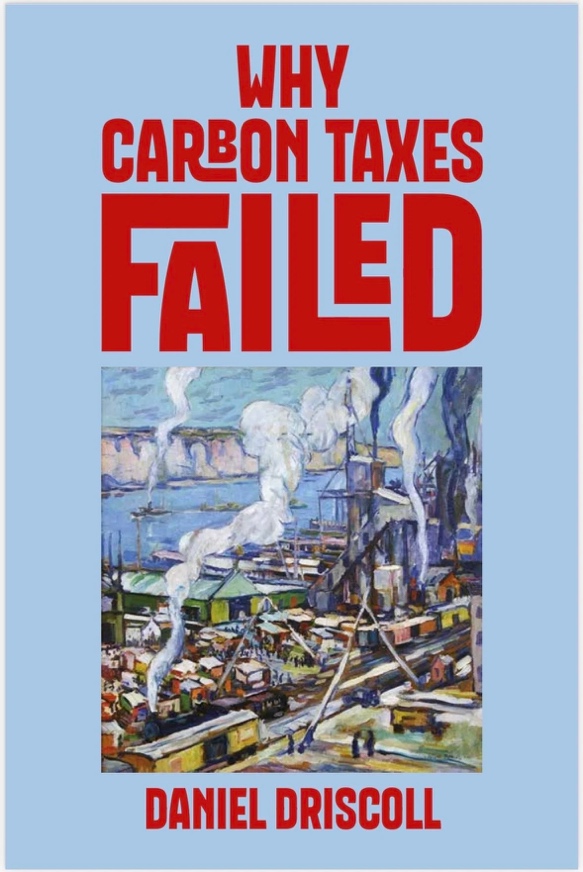
Why Carbon Taxes Failed
By Daniel Driscoll
Oxford University Press, New York, 2026
Carbon Pricing Explained
By now, I think most people are aware that GHG emissions have real costs in the form of damages from climate change. The news is full of reports about property destruction, health impacts and deaths from flooding, forest fires, smoke, and extreme heatwaves.[3] But who pays for all this damage? Well right now it’s us taxpayers and consumers. According to one estimate American households are already paying between $400-$900 per year in higher costs for home insurance, utilities and repairs to infrastructure like roads, bridges and airports caused by climate change.[4]
When the actions of one group cause economic costs that are paid for by another group, economists call it an externality.[5] Nobel Laureate economist William Nordhaus says in his book The Spirit of Green that GHG emissions are examples of extreme externalities because “those who generate the emissions do not pay and those who are harmed are not compensated.”[6] Externalities are an example of market failure because the price of a good or service does not accurately reflect its true cost or value to society. The price of fossil fuels does not reflect the cost of the damage they’re causing to our planet.
Many people – not just economists – believe that to address climate change we must correct this market failure by making polluters pay for their GHG emissions. “Internalize the externality,” they say. Since carbon dioxide (CO2) is the most prevalent GHG, this approach is usually called carbon pricing. Proponents argue that without a price on carbon, polluters have little incentive to reduce GHG emissions. Putting a price on every ton of carbon pollution, the theory goes, sends a strong signal to the market. Higher prices for more carbon-intensive goods and services will encourage consumers to seek cheaper low-carbon alternatives, and they will also encourage firms to develop low-carbon products to stay competitive. Net result: lower GHG emissions.
This market signal is the crux of carbon pricing. It’s also a bit of magical thinking. Economists don’t explain how, or when, the market signal causes low-carbon alternatives to become available and affordable for everyone. It could take years or decades for new technologies and new products to get developed. I’ll come back to this point later in the review.
That’s the theory. Now, how does carbon pricing actually work?
In practice, there are three main carbon pricing schemes. First are carbon taxes – the subject of Driscoll’s book. A carbon tax is a fee levied on the sale of fossil fuels – coal, gasoline, diesel, natural gas, etc. – based on the carbon content of the fuel.[7] Usually the tax is collected from suppliers such as coal mines, oil refineries and natural gas plants. They typically pass on some or all of the tax to consumers in the form of higher prices. Less commonly the tax is collected directly from consumers when we buy gasoline at the pump or pay our utility bills. To effectively reduce emissions a carbon tax must increase over time, providing a growing incentive to switch away from fossil fuels.
Second are Emissions Trading Systems (ETSs), also known as cap-and-trade or cap-and-invest schemes. They’re more complicated than carbon taxes. ETSs impose an upper limit or cap on GHG emissions. Regulated entities must buy allowances for each ton of GHG they emit every year.[8] The cap and the number of allowances gets reduced over time causing the allowance price to increase. That gives entities a growing incentive to reduce their emissions so they need to buy fewer allowances. Driscoll doesn’t discuss ETSs much aside from noting that they are less efficient at driving down GHG emissions than carbon taxes, but they can also be more politically acceptable because they’re more flexible, are not branded as a dreaded “tax” and the costs are little harder for consumers to trace.
A key difference between carbon taxes and ETSs is that carbon taxes set the price of carbon emissions while ETSs regulate the amount of emissions.
Carbon pricing advocates usually propose that revenue collected from the carbon tax or the sale of allowances be returned to taxpayers in the form of a rebate or dividend. This feature improves the fairness of carbon pricing because it supports low-income families who spend a greater portion of their income on energy. Revenues can also be spent on climate mitigation or adaptation programs, on research and development, and on public infrastructure like EV charging networks and public transit.
One major problem with both carbon taxes and ETSs is carbon leakage which happens when firms move their operations, and their carbon emissions, to countries with lower or zero carbon prices. Carbon Border Adjustment Mechanisms (CBAMs) – the third carbon pricing scheme – aim to eliminate carbon leakage by imposing a tariff on imported goods based on their carbon content.[9] CBAMs are not a substitute for carbon taxes or ETSs but could complement them to ensure that roughly similar carbon prices are applied to both imported and domestic goods. Driscoll doesn’t mention CBAMs at all in the book. That’s probably because the European Union just implemented the world’s first and so far only CBAM in 2026.
One last point and then I’ll move on: carbon pricing is solidly in the mainstream of contemporary economic thinking. If you believe economic growth is itself a problem, or that we’re too fixated on GDP as a measure of wellbeing, then carbon pricing won’t help. It also does nothing to move us towards a circular economy or a more ecocentric view of our place in the world. So there’s nothing about this in Why Carbon Taxes Failed.
OK, that’s a summary of carbon pricing.
Have Carbon Taxes Failed?
According to the World Bank, 47 countries, provinces and states have implemented carbon taxes. Another 40 have ETSs.[10] Finland introduced the world’s first carbon tax in 1990, followed by Sweden and Norway in 1991. The EU implemented the first ETS in 2005. So they’ve been around long enough to start having some impact.
Research has found that carbon pricing does result in measurable emissions reductions, ranging from 5% to 21% depending on specific design details.[11] However, these reductions are nowhere near enough to meet national climate commitments let alone Paris Agreement goals.
The United Nations just published a report called Limiting Overshoot in which it admits what most climate scientists have been saying for several years: we’re going to miss (overshoot) the goal of limiting global warming to 1.5°C.[12] In fact, there are no major countries in the world that are on track to meet their Paris Agreement commitments, including countries that have implemented carbon taxes.
So yes, by that measure, carbon taxes have failed.
However, I’ve not found any clear definition of what a successful carbon tax would look like. Perhaps we’d consider carbon taxes a success if countries that adopted them were on track to meet their decarbonization goals. Perhaps a weak carbon tax is better than no carbon tax at all because political or economic conditions might change in future allowing the tax to be strengthened. As far as I’m aware, there’s no consensus on this. Even Driscoll’s ideas about success and failure, which I’ll explore below, are not very precise.
Still, there’s no dispute that carbon taxes are not working as well or as fast as we need them to.
Now let’s turn to Driscoll’s book.
The Growth Model Policy Alignment Framework
The centerpiece of Why Carbon Taxes Failed is Driscoll’s Growth Model Policy Alignment Framework. Essentially, the framework says that for an economic policy such as carbon taxes to succeed, the policy must align with a country’s economic growth model.
Let’s unpack this a little. Any policy, Driscoll says, operates within the context of a country’s economic growth model – how a country makes money. He identifies two main growth models: export-led and domestic demand-led. If a country’s exports account for 40% or more of its GDP, he says the country has an export-led growth model, otherwise it has a domestic demand-led growth model. The US is the world’s premier domestic demand-led economy. That’s why consumer spending is such an important economic indicator here – it accounts for 68% to 70% of US GDP.[13] Germany and many other European countries have export-led economies.
Driscoll says a country’s growth model is implemented through a growth strategy, namely the set of decisions and reforms designed to increase economic growth and job creation. In addition, the growth model gives rise to a particular growth coalition, the organized groups that ensure government policy continues to support the growth model and, consequently, their interests.
Driscoll’s thesis is that carbon taxes fail when they do not align with a country’s growth coalition and its growth strategy. Ultimately, climate policy, regardless of any altruistic motivations, is embedded within the political economy (i.e. the relationships between politics and economics) of a country’s growth model. No policy, and no politician, can survive very long by acting against national economic growth and the interests that support it.
Driscoll illustrates all this in detailed case studies of carbon taxes in France, Norway, Denmark and the United States using his framework, along with a statistical comparison of carbon taxes in 20 countries. He’s deeply sympathetic to the Yellow Vest Movement in France and the mass protests that erupted after the government there significantly increased carbon taxes in 2019. Driscoll tells how France’s governing elites were using carbon taxes in a clumsy attempt to shift its economy from a domestic demand-led to an export-led growth model. After interviewing, and marching with, some of the Yellow Vest protesters, he concludes that France’s carbon tax penalized households – a key growth coalition – while funneling the tax revenues to corporations. The government eventually rolled back the tax increase.
Carbon Pricing in the U.S.
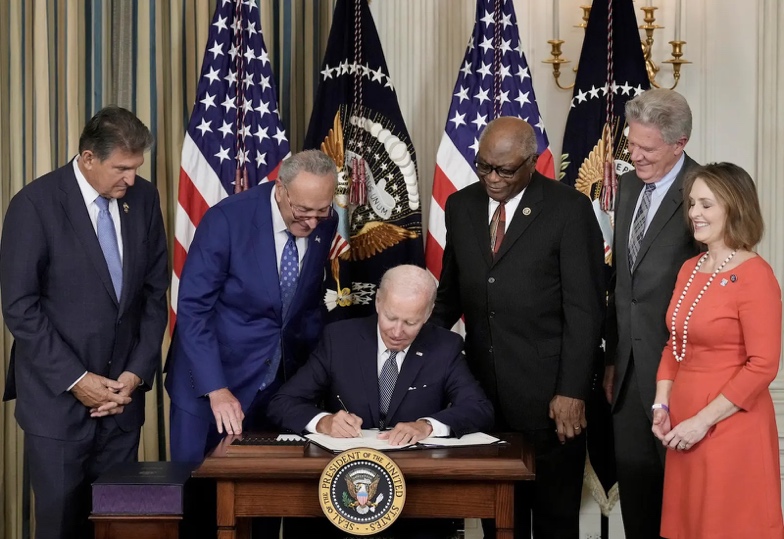
Driscoll’s chapter on U.S. carbon pricing was the most interesting part of the book for me. Although 14 states have implemented some form of ETS, there is currently no national carbon pricing scheme in America. We came close in 2009 when a bill called the American Clean Energy and Security Act (ACES),[14] also known as Waxman-Markey for its key sponsors, passed the House but failed to advance in the Senate. Thirteen years later, the Inflation Reduction Act (IRA), passed by Congress in 2022, did not contain a carbon tax because Senator Joe Manchin of West Virginia (a coal mining state) objected to any form of carbon pricing and the Democrats needed his vote to pass the IRA.[15] Still the IRA is widely regarded as the most significant piece of climate legislation in US history.
Driscoll uses his Growth Model Policy Alignment Framework to explain why ACES failed to pass in 2009 but the IRA succeeded in 2022.
To set the scene, he argues that in the last 50 years the U.S. economy has undergone a remarkable transition. Manufacturing jobs in carbon-intensive sectors such as steel and autos, which were once located in the heartland and south of the country, have declined. Meanwhile employment in less carbon-intensive industries like finance and technology have increased, but those jobs are mostly located in coastal centers such as New York and Silicon Valley. Thus, “carbon economy communities” often in the center of the country tend to reject climate policies (and vote Republican) because they perceive these policies as existential threats to their livelihoods (jobs, house prices, local economies). On the other hand, coastal “knowledge economy communities” have less carbon-intensive industries and tend to support climate policies (and vote Democratic). Side note: almost all of the 14 states that have implemented ETSs are on or near the coasts. No surprise.
In other words, while the U.S. remains a domestic demand-led economy, it now has two competing economic growth strategies and coalitions: fossil growth vs. green growth.
Over the years, the U.S. has resisted carbon taxation because carbon emissions have been so profitable and have driven the country’s economic growth. Fossil fuels have also bolstered American geoeconomic dominance, Driscoll notes. The ACES bill of 2009 would have raised energy prices, penalizing both households and fossil fuel producers without – and this is key — without adequate clean energy alternatives to switch to. Driscoll says this goes beyond just ordinary interest group politics. ACES was misaligned with both the U.S. growth strategy and its major growth coalition. He claims it was doomed from the start, and that if the bill had passed it would have sparked a fierce backlash and protests similar to the Yellow Vest Movement in France.
But by 2022 the U.S. economy had changed. The less carbon intensive technology and finance sectors on the coasts had become more dominant. U.S. growth overall was less carbon intensive. Thus objections to the IRA from carbon economy communities carried less political weight and were easier to overcome. Additionally, technology and finance firms had become important to US geoeconomic power, offsetting the weight of the fossil fuel industry there too.
The IRA was more thoughtfully constructed than ACES. It offered carrots rather than sticks. Driscoll points out the IRA attempted to broaden the green economy coalition by throwing a lifeline (or “bribe”) to manufacturing communities in red states in the center of the country. And it helped support domestic demand through EV tax credits and other consumer subsidies.
In short, the IRA aligned with a key U.S. growth strategy and its coalition, ACES did not. Driscoll calls its passage a resounding success and suggests it could have led over time to a U.S. carbon tax because it would have resulted in a stronger green economy coalition and a relatively diminished fossil fuel sector. He laments that it was not fully implemented during the Biden Administration and views the 2024 reelection of Donald Trump as “see-sawing” between competing growth strategies.
“Is it really surprising that decarbonization would be volatile for a country so tied to fossil fuels in its growth model … ?” [p. 80]
He describes the Trump Administration’s weakening of the IRA with the One Big Beautiful Bill Act as:
“… a simple case of bad political ideas winning over sound national industrial strategy. Echoes of legacy growth models can still be powerful even if they do not mathematically compute anymore.” [p. 80-1]
Can Carbon Taxes Succeed?
How Carbon Taxes Failed contains important lessons for anyone who wants to implement successful carbon taxes.
First and foremost, carbon taxes are not a silver bullet that policymakers can aim at GHG emissions. Carbon taxes can be an important policy tool, but they must be part of a well planned and carefully executed clean energy transition that combines both carrots (investments and subsidies) and sticks (taxes and regulations).
“… carbon taxes, while seductive and simple on the surface, do not solve the planning or investment problem. At their worst, if they are imposed without foresight, they can hit the most vulnerable parts of an economy and can be politically explosive.” [p. 126]
Carbon taxes have a much greater chance of success when they align with a country’s growth model and are supported by key growth coalitions. Economic growth is always a top national priority. Jobs and the economy are always higher priorities for voters than climate and the environment. Governments ignore this political reality at their peril.
Carrots should generally come before sticks, Driscoll says. Carbon taxes must be preceded by, or coincide with, major investments in making clean alternatives to high-carbon products available and affordable. Without clean alternatives, carbon taxes are just “green austerity.” So, if I understand Driscoll’s theory correctly, putting a carbon tax on aviation fuel makes no sense today because there is no green alternative yet. A carbon tax might provide some incentive to develop green aviation fuel, but that could take years or decades. Meanwhile the public would be burdened with higher travel costs indefinitely with no obvious benefit.
Similarly, EVs are still more expensive than internal combustion engine (ICE) cars, so a carbon tax on gasoline just penalizes consumers who cannot afford to switch. Here, I think we still need a combination of carrots and sticks to accelerate the transition to EVs. A carbon tax should be paired with EV subsidies and investment in charging infrastructure, as Norway has done, and as the IRA tried to do, so they’re affordable for everyone. We should consider a carbon surcharge on the sale of new ICE cars, especially gas-guzzling SUVs and luxury sedans. Some European countries already do this. People who can afford these higher-end cars can certainly afford EVs. If they still choose to buy ICE cars, fine, but they should pay a price for their emissions. Tougher fuel efficiency standards would also help.
On the other hand, I think carbon taxes on coal-fired power plants do make sense now because there are cheaper, cleaner alternatives for electricity generation. In addition the coal industry is not a driver of U.S. economic growth and it has diminished political influence.
This leads to another key point Driscoll makes: carrots and sticks should be targeted to specific sectors of the economy in accordance with the country’s growth model. Carrots should be offered to important growth sectors and their coalitions, while carbon taxes should be targeted at less economically important sectors. A broad, economy-wide carbon tax might be simpler, but will more likely fail because it does not distinguish between different growth strategies or coalitions. Similarly, revenues from carbon taxes can be used to fund green investments that help important growth coalitions or be returned to taxpayers as a dividend or refund. Even the refunds can be targeted to help groups who spend a larger portion of their incomes on energy, including low- and middle- income earners and rural residents who must drive longer distances. Driscoll says France’s failure to provide this kind of support contributed to the Yellow Vest protests.
“… carbon taxes do not have to be blunt instruments; they can be targeted and customized to national growth models.” [p. 133]
Unsolicited Feedback
Why Carbon Taxes Failed is an academic work that won’t interest everyone. But for those concerned about climate policy, the book is a sobering and timely critique of carbon taxes as they’ve been implemented so far.
Conventional explanations for why carbon taxes fail include the nefarious influence of vested interests, sinister misinformation campaigns, and bungled implementation and communication by bureaucrats and politicians. And there is some truth to all of these. But I like how Driscoll’s Growth Model Policy Alignment Framework provides a more fundamental explanation grounded in real-world political economy.
The framework also shows how even within the same economic growth model, different strategies and coalitions may be competing with each other. It’s government’s job to plan and implement policies, like carbon taxes, that support the growth strategies which meet national objectives. I guess that’s what industrial policy is all about.
Carbon taxes have so far failed to generate emission reductions anywhere close to the amounts needed to reach net zero. I think that’s largely due to the lack of available and affordable low-carbon replacement products. So I strongly agree with Driscoll on the need for governments to invest in alternatives before carbon taxes are implemented, or at least alongside them.
I also agree with targeting both carrots and sticks. The elegant simplicity of a broad based carbon tax shouldn’t blind us to the reality that some sectors are farther along in terms of green alternatives than others, or that some groups are more vulnerable to regressive taxation than others. Targeting both carrots and sticks also allows time to build new growth coalitions among sectors that support green economic growth.
Even so, carbon taxes are an enormous political lift. To work properly carbon taxes must be both high and wide. That means they must be high enough to motivate companies and consumers to switch to low-carbon alternatives, and they must be wide enough to cover all the GHG emissions in each country. But in practice, fossil fuel companies, heavy industries, labor unions and consumer advocates all lobby for exemptions and lower tax rates. As a result, carbon taxes are often “riddled with loopholes.”[16] Writing in 2020, Leah Stokes and Matto Mildenberger put it plainly:
“Climate policy is a repeated game unfolding over decades. Any meaningful approach must build political allies as it weakens the fossil fuel industry. To cultivate the advocates necessary for more ambitious action, we need to grow our clean energy industries—and fast. If we want 100 percent clean electricity by 2035 in the United States, we need to deploy clean energy technologies around 4 times faster than we have in the past. This speed cannot be achieved through carbon pricing alone.”[17]
In the U.S., there’s a depressing lack of political will around carbon taxes and climate policy generally. A majority of people are worried about climate change, but most don’t want to pay anything to address it. Polling from the Yale Program on Climate Change Communication shows that 63% of US adults were worried about climate change in 2025.[18] But another 2025 study, sponsored by the Associated Press and the University of Chicago found that only 38% of Americans support a carbon fee of just $1/month.[19]
Right now, carbon taxes look dead in the water in the U.S. It’s not clear they would be much more popular with a dividend or rebate.
Yet we still have an enormous challenge in front of us:
“We are now, to put it bluntly, cooking the planet. To halt climate change, human society must do nothing less than transform itself.” [p. 3]
Vaclav Smil, in his book How the World Really Works, goes into great detail about how fossil fuels are deeply embedded in our world, and how long and difficult the transition away from them will be.
As Driscoll implies, it’s absurd to think we’re going to save the world with just a tax.
We’re going to need every tool at our disposal, including carbon taxes.
Why Carbon Taxes Failed tackles this head on. It provides a solid framework for understanding carbon tax failures and important lessons for how to make them more effective.
Thanks for reading.
References
[1] Segal, David. “The X Factor of Economics: People.” New York Times, 16 Oct. 2010, https://www.nytimes.com/2010/10/17/weekinreview/17segal.html.
[2] In 2019, a group of 3649 US economists, including 28 Nobel laureates, advocated for carbon taxes and related measures. See Climate Leadership Council. “Economists’ Statement on Carbon Dividends.” 17 Jan. 2019, https://clcouncil.org/economists-statement/.
[3] These costs are known as the social cost of carbon. It’s usually defined as the cost of the long-term damage caused by emitting a metric ton of carbon dioxide or equivalent into the atmosphere. See EPA. “The Social Cost of Carbon.” 9 Jan. 2017, 19january2017snapshot.epa.gov/climatechange/social-cost-carbon_.html. One metric ton (or tonne) equals 1000 kilograms (kg) or about 2204 pounds. For more on how GHG emissions are measured, see my infographic Measuring Greenhouse Gas Emissions.
[4] MIT Sloan Office of Communications. “Why Climate Change Is Costing U.S. Households Hundreds of Dollars a Year.” MIT Sloan School of Management, 7 Apr. 2026, https://mitsloan.mit.edu/press/why-climate-change-costing-u-s-households-hundreds-dollars-a-year.
[5] Kenton, Will. “Externality: What It Means in Economics, With Positive and Negative Examples.” Investopedia, 18 June 2024, www.investopedia.com/terms/e/externality.asp.
[6] Nordhaus, William H. The Spirit of Green: The Economics of Collisions and Contagions in a Crowded World. Princeton University Press, 2021, p. 278.
[7] Parry Ian. “What is carbon taxation?” Finance and Development Magazine, International Monetary Fund, June 2019, https://www.imf.org/en/Publications/fandd/issues/2019/06/what-is-carbon-taxation-basics.
[8] EPA. “What is emissions trading?” 20 Nov. 2024, https://www.epa.gov/emissions-trading/what-emissions-trading, accessed 27 Feb. 2025.
[9] Boocker, Sam and Wessel, David. “What is a Carbon Border Adjustment Mechanism?” The Brookings Institution, 8 July 2024, https://www.brookings.edu/articles/what-is-a-carbon-border-adjustment-mechanism/.
[10] World Bank. State and Trends of Carbon Pricing Dashboard. https://carbonpricingdashboard.worldbank.org/, accessed 14 Sep. 2026.
[11] Döbbeling-Hildebrandt, Niklas, et al. “Systematic Review and Meta-Analysis of Ex-Post Evaluations on the Effectiveness of Carbon Pricing.” Nature Communications, vol. 15, no. 1, May 2024, p. 4147. http://www.nature.com, https://doi.org/10.1038/s41467-024-48512-w.
[12] United Nations Environment Programme (2026). Limiting Overshoot: Navigating exceedance of 1.5°C and pathways towards return. Nairobi. https://doi.org/10.59117/20.500.11822/49857.
[13] “Shares of Gross Domestic Product: Personal Consumption Expenditures.” Federal Reserve Bank of St. Louis, 30 July 2026, https://fred.stlouisfed.org/series/DPCERE1Q156NBEA.
[15] Lavelle, Marianne. “After 25 Years of Futility, Democrats Finally Jettison Carbon Pricing in Favor of Incentives to Counter Climate Change.” Inside Climate News, 12 Aug. 2022, https://insideclimatenews.org/news/12082022/after-25-years-of-futility-democrats-finally-jettison-carbon-pricing-in-favor-of-incentives-to-counter-climate-change/.
[16] Stokes, Leah C., and Matto Mildenberger. “The Trouble with Carbon Pricing.” Boston Review, 24 Sept. 2020. Boston Review, https://www.bostonreview.net/articles/trouble-carbon-pricing/.
[17] Id.
[18] Marlon, Jennifer, et al. “Yale Climate Opinion Maps 2025.” Yale Program on Climate Change Communication, 4 May 2026, https://climatecommunication.yale.edu/visualizations-data/ycom-us/.
[19] Stripp, Mia. “Public Attitudes toward Climate Policy, Technology, and the Environment.” AP-NORC, 23 Oct. 2025, https://apnorc.org/projects/epic-climate-change-2025/.
Discover more from Unsolicited Feedback
Subscribe to get the latest posts sent to your email.


Thank you for writing such a thorough, detailed, and well thought out review! This is, indeed, an interesting framework in which to think about the problems–and potential solutions. I’m left wondering how we might take these ideas and apply them to the current conversations concerning PSE and WA’s CCA. Also, it seems hopeful that federal permitting reform could allow us to start building more clean alternatives to fossil fuels, thus paving the way for a nationwide carbon tax in the future. I’d been thinking of them as two separate policies, but, of course, they’re intimately linked. Despite the book’s rather depressing title, your analysis leaves me feeling much more optimistic! 🙂
LikeLiked by 1 person
Thanks, Laurie. I agree that permitting reform and carbon pricing go hand in hand. I’m glad this review made you feel more optimistic!
LikeLike