Have you ever sat down and read the whole U.S. Constitution, if you’re American, that is? For all its power and significance, it’s a remarkably brief document. The original Constitution contains just seven Articles and a mere 4,543 words, 7,591 if you include the 27 amendments, which you should. You can easily read the whole thing in under an hour. Of course, what it says and what it means, or what it has come to mean, can be very different things.
The U.S. Constitution: A Comprehensive and Annotated Guide for the Modern Reader, by Melissa Murray, is an article by article, clause by clause walk through the Constitution. It’s thorough and very informative yet done in a manageable length of about 330 pages.
Melissa Murray is the Frederick I. and Grace Stokes Professor of Law at New York University where she focuses on constitutional law, family law and reproductive rights. She holds a J.D. from Yale Law School and a B.A. from the University of Virginia. Murray is also a co-host, with Leah Litman and Kate Shaw, of the excellent podcast Strict Scrutiny about the Supreme Court and the legal culture that surrounds it.
For each Article or Amendment, Murray presents the Constitutional text, a nutshell summary of what it means, the origin story of that part, and – the heart of the book – Murray’s clause-by-clause commentary. The commentaries typically describe historical and contemporary debates about each provision, the extent and the limitations of the power or right being provided for, and how the Supreme Court’s interpretation of that Article or Amendment has evolved over time.
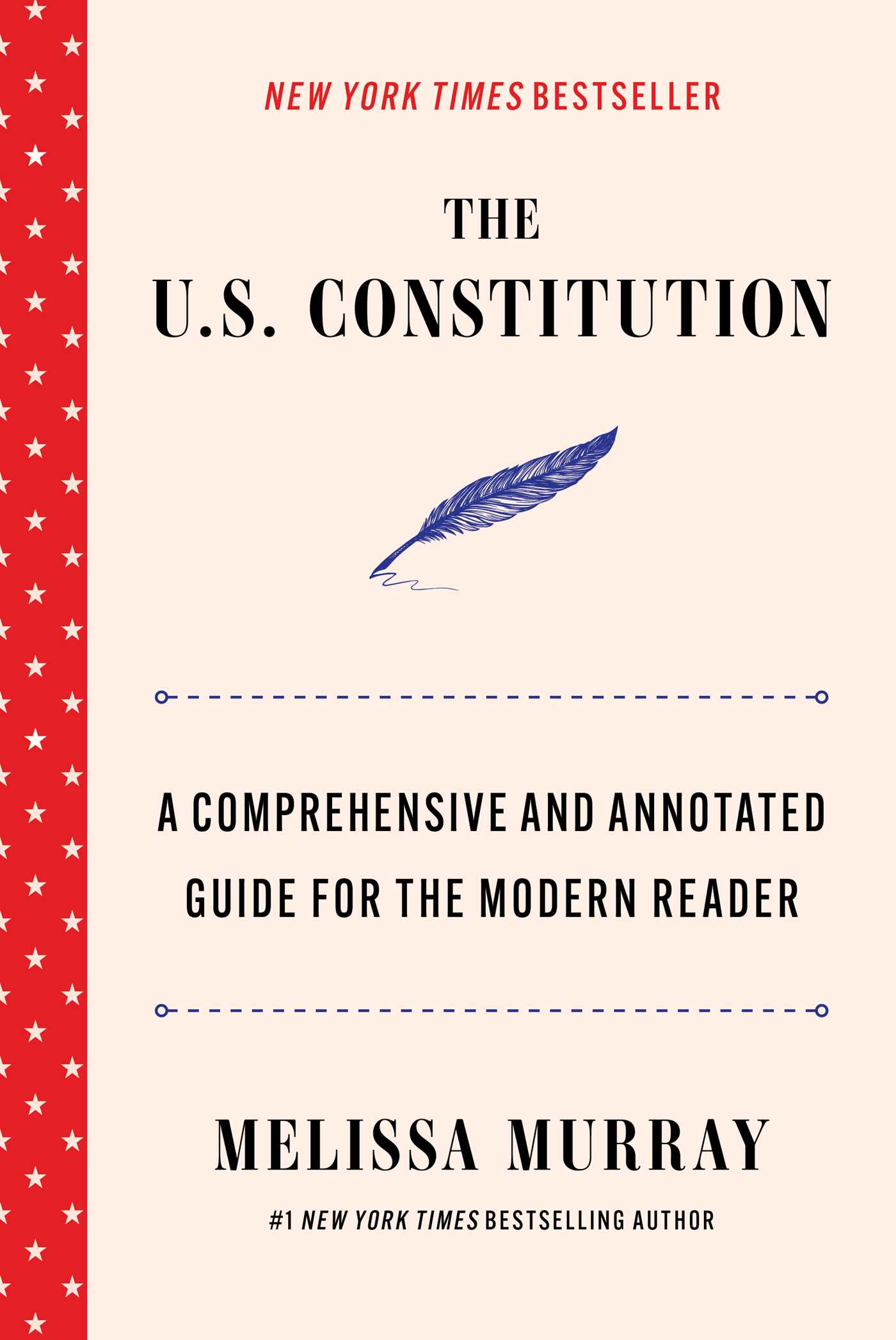
The U.S. Constitution: A Comprehensive and
Annotated Guide for the Modern Reader
By Melissa Murray
Simon & Schuster, New York, 2026
As a fan of Strict Scrutiny, I was a little disappointed at first by Murray’s seemingly neutral, academic writing in The U.S. Constitution. I much prefer her edgy voice on the podcast where she’s often sharply critical of the Supreme Court and especially its conservative justices. But as I got further into the book, I realized she hadn’t entirely muted her criticism. For example, she describes how in 1873 the Supreme Court “strangled the Privileges or Immunities clause in its cradle.” This clause is part of Section 1 of the Fourteenth Amendment ratified in 1868 during the Reconstruction period after the US Civil War. It was intended to prevent state governments from infringing on the rights of their citizens. The Court had other ideas.
This is just one illustration that Murray provides of the Court’s persistent reactionary tendencies throughout most of its history. Another example: Murray recounts how, under Chief Justice John Roberts, the Supreme Court has systematically demolished the Voting Rights Act of 1965, enabling states to enact all manner of laws restricting the right to vote.
I don’t know if this was Murray’s intent, but I think the book also serves as a clear refutation of originalism, a theory of constitutional interpretation that says the Constitution should be interpreted to mean what its original authors, the Framers, understood it to mean at the time of its adoption. It’s completely backward looking, locking in the views (i.e. prejudices) and interests of long dead Framers who were all white, male, property owners, many of whom were also enslavers. Originalism dominates the Supreme Court today.
Without ever mentioning originalism, Murray shows again and again in The U.S. Constitution how the Supreme Court’s interpretation of different parts of the Constitution has changed over time and continues to evolve today. Examples include abortion rights, gun rights, the right to privacy, the federal government’s power to regulate interstate commerce, and many other provisions. Originalism might be today’s fad, but as a practical matter, the Constitution and its interpretation do evolve.
Murray also does a great job conveying the history and motivations behind the provisions of the Constitution. When we think about the Constitution today, we’re mostly thinking in terms of how it should be applied to contemporary problems. So were the Framers, but their contemporary problems were British colonial rule and the failure of America’s first constitution, the Articles of Confederation which were adopted in 1777 and in force until the Constitution we know today came into effect in 1789. Many of the Constitution’s provisions were motivated by the desire to prevent the tyranny experienced under colonial rule and the ineffectual central government of the Articles of Confederation.
A depressing number of provisions were also motivated by the compromise that allowed southern states to perpetuate slavery.
In 1787, when Benjamin Framklin was asked outside the Constitutional Convention in Philadelphia what kind of government the convention had adopted, he famously warned, “A republic, if you can keep it.”
Well, we have kept it. The US Constitution has endured long enough to secure its place as the oldest written constitution in the world. These days, though, I wonder if can keep the republic much longer.
I won’t pretend The U.S. Constitution is a gripping page-turner, but it does move along at a decent pace. And reading it will definitely help you better understand the Constitution: what it says, how it’s been interpreted, and what it’s strengths as well as it’s gaps and weaknesses are. That’s a great step towards keeping the republic it defines.
Thanks for reading.
Discover more from Unsolicited Feedback
Subscribe to get the latest posts sent to your email.


