Carbon dioxide makes up a miniscule portion of Earth’s atmosphere – about 0.043% – an amount so small you can think of it as a tiny impurity in the air. But it plays an outsized role on our planet and in our lives. Peter Brannen puts it like this in his latest book The Story of CO2 Is the Story of Everything: How Carbon Dioxide Made Our World:
“CO2 is the ultimate source of carbon for all life, it’s the primary knob of Earth’s temperature, and it’s the thing that humans make more of than any other product.” [p. 16]
The Story of CO2 Is the Story of Everything is about how CO2 cycles through living organisms like us and through the Earth’s geology – really a single giant biogeochemical carbon cycle. And it’s about how our burning fossil fuels for the last 200 years has knocked this cycle out of its normal range into territory uncharted in Earth’s entire 4.5 billion year history. It really is the story of everything: geology, biology, chemistry, paleontology, history, and more.
However, the book is quite long, about 450 pages, and unfortunately it started getting repetitive. I also found Brannen’s writing style made it harder for me to understand what he was trying to say. I got just over halfway through before deciding not to finish it.
Peter Brannen is a science journalist whose work has appeared in The Atlantic, The New York Times, The New Yorker, Scientific American and other publications. I previously reviewed and enjoyed his 2017 book about mass extinctions, The Ends of the World.
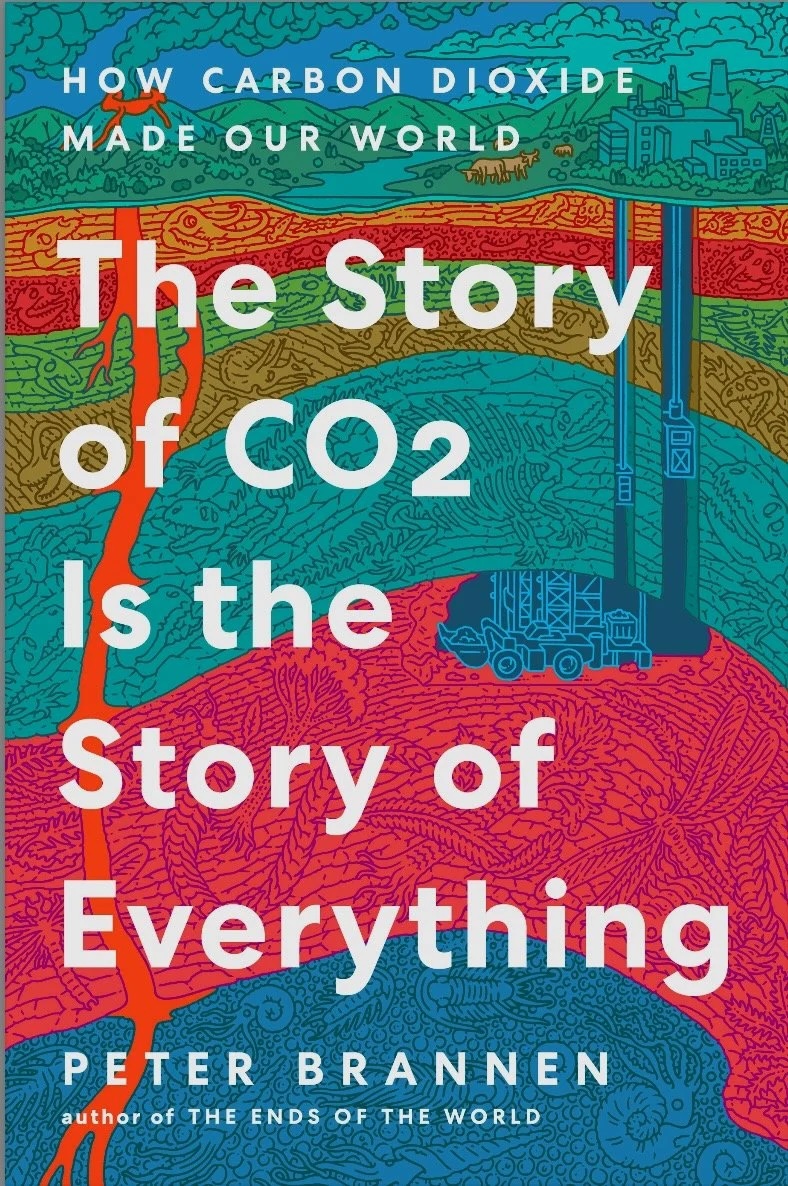
The Story of CO2 Is the Story of Everything:
How Carbon Dioxide Made Our World
By Peter Brannen
ECCO, New York, 2025
Although I didn’t finish the book, it does provide an in-depth look at Earth’s carbon cycle. If you’re not familiar with this, it’s worth understanding even at a high level because it’s the reason scientists are so concerned about global warming.
Brannen describes how carbon moves through the Earth’s atmosphere, oceans, land and crust over millions of years. It all starts with volcanos. When they erupt, they belch enormous quantities of CO2 into the atmosphere. CO2 combines with rainwater to form carbonic acid (H2CO3) which falls onto rocks and starts to break them down. This process is called rock weathering. Storm runoff carries acidic rainwater and the calcium it has etched out of the rocks downhill and downstream into the oceans. There, plankton and coral and mollusks combine this material into calcium carbonate (CaCO3), or limestone, to build their bodies. When they die, they fall to the seafloor forming limestone layers which gradually sink into the Earth’s crust. Eventually, tectonic activity and volcanos eject the CO2 back into the atmosphere once more, completing the cycle.
Brannen explains how, over tens of millions of years, the cycle stays in balance, keeping the Earth habitable, though not necessarily habitable for humans. Sometimes, the cycle goes haywire leaving too much or too little CO2 in the atmosphere. In earlier geologic periods, volcanos were much more active than they are today and the amount of CO2 they dumped into the atmosphere was correspondingly larger – so large that they’ve caused multiple mass extinction events over billions of years of Earth’s history.
CO2, the most prevalent greenhouse gas, traps heat in the atmosphere. When there’s too much of it, the Earth turns into a hothouse. Tropical forests grow at the poles. When there’s too little, when rock weathering draws down too much CO2 out of the atmosphere, the result is an ice age. In extreme cases, glaciers extend towards the equator, and the world goes into a deep freeze known as Snowball Earth. That’s why Brannen calls CO2 the “primary knob” controlling Earth’s temperature.
For about the last 12,000 years, since the end of the last ice age, we’ve been living in an unusually stable and habitable climate. All of recoded human history has occurred in this period.
One of the strongest impressions I got from the book is how utterly alien Earth has been though most of its 4.5 billion year history. For most of that time, humans couldn’t have breathed, let alone flourished, because there was almost no oxygen in the atmosphere, or because the temperatures were so extreme or because “life” was mostly one-celled slime coating the rocks.
There’s a second carbon cycle, Brannen explains, operating within, and connected to, the larger geologic carbon cycle. That’s the biochemical carbon cycle that uses CO2 as the building block of life. It starts with photosynthesis. Photosynthesis, an almost miraculous chemical process, combines CO2, water and energy from the sun to produce methanol (CH2O) – one of the simplest organic compounds – and oxygen. Plants use the methanol to form other organic compounds to build leaves and stems and tree trunks and fruit.
In the other direction, when organic material gets used up, in respiration, digestion, decomposition or combustion, oxygen gets combined with methanol to form water, CO2 again, and energy, this time in the form of waste heat. I found it fascinating to realize that breathing and burning are essentially the same chemical process: combining oxygen with organic matter. Brannen quotes one scientist who says:
“… in the end, respiration and burning are equivalent; the slight delay in the middle is what we know as life.” [p. 11]
At various times in Earth’s history, the second half of the biochemical carbon cycle has been postponed, sometimes by millions of years. Brannen explains how a few hundred million years ago, dense forests died but did not decompose. Instead they were buried in the Earth’s crust. The carbon dioxide embodied in these plants did not get released back into the atmosphere; it got sequestered underground in the form of coal, oil and natural gas.
Until about 200 years ago when we started digging it up and burning it.
Now we’re taking all that fossil carbon that would be been released slowly over millions of years and dumping it into the air in an eyeblink.
“The two threads of CO2’s role in fashioning the Earth have catastrophically merged: the energy of all life has always flowed through the chemistry of carbon, at the same time that its delicate balance in the oceans and atmosphere has kept the planet habitable.” [p. 15]
But now we’ve “colossally provoked” the carbon cycle, threatening to “terminate this strange civilizational project all on its own, if we don’t relent.”
This is a critically important message. While The Story of CO2 Is the Story of Everything is by no means the only book to send it, the book does go into more depth about the role of CO2 in our world than anything else I’ve read.
Unfortunately, I found Brannen’s writing hard to get through, and sometimes even hard to parse, filled as it was with overly long, complex sentences that I often needed to double back on to really understand. Plus everything in the book is outrageous, outlandish, cataclysmic, catastrophic, supercharged or superhot – a surfeit of superlatives. In moderation, this style is fine. It can liven up otherwise dry, scientific material. But there was too much of it for me in a book that was long to begin with. A shame. I don’t remember Brannen’s previous book, The Ends of the World, being like this.
Thanks for reading.
Discover more from Unsolicited Feedback
Subscribe to get the latest posts sent to your email.


