OK, this is one of my periodic excursions into the history of mathematics and science. I know it’s an esoteric topic that might not interest many people. Bear with me, I’ll try to make this as interesting and painless as possible.
A Madman Dreams of Turing Machines is a novel about the parallel lives of two of the 20th Century’s greatest mathematicians, Kurt Gödel and Alan Turing.
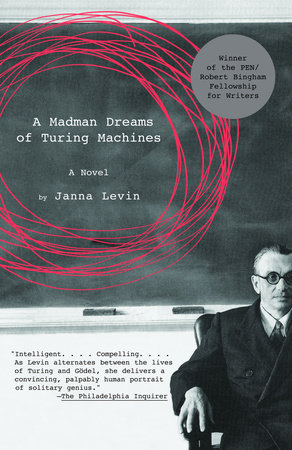
A Madman Dreams of Turing Machines
By Janna Levin
Alfred A. Knopf, New York, 2006
Of the two, you’re more likely to have heard of Alan Turing. He’s the code breaker who helped crack the German enigma machine during World War II. His life and career are dramatized in the movie The Imitation Game. (Excellent movie!) Equally important, he’s widely seen as the father of computer science and artificial intelligence. As a thought experiment, Turing designed an abstract computing device, minimal yet capable of implementing any computational procedure or algorithm. This model device is now called a Turing machine. Turing used his machine in a 1936 paper called On Computable Numbers, With An Application To The Entscheidungsproblem where he proved that there are numbers which we know exist but which cannot be computed. Sound bizarre? Yeah, it is.
Kurt Gödel, on the other hand, is perhaps less well-known although his work forms a major part of the book Gödel, Escher, Bach: An Eternal Golden Braid by Douglas Hofstadter. Gödel was a mathematician and logician working in Vienna at a time when leading thinkers were concerned about the completeness of mathematics. Completeness is the idea that within the formal system of mathematics – its basic axioms and rules of operation – you can always prove any statement or proposition as either true or false. In other words, mathematicians wanted to be sure there were no gaps in math, no undecidable propositions. Gödel put an end to this quest with his now-famous Incompleteness Theorem published in a paper titled On Formally Undecidable Propositions of Principia Mathematica and Related Systems in 1931 when he was just 25. Gödel proved that there are indeed true statements in mathematics that cannot be proven using the standard method of step-by-step deduction from basic axioms. A proof about proofs. Make your head spin? Yeah, me too.
So why would anyone write a book, let alone a novel, about these two guys? (Are you also wondering why anyone would read a novel about these two guys?)
Well, the author, Janna Levin, is the Claire Tow Professor of Physics and Astronomy at Columbia University’s Barnard College. She does research on black holes, gravitational waves and the structure of spacetime. According to a talk she gave about the book at the Perimeter Institute in Waterloo, Ontario in 2006, Levin was fascinated by the similarities between the two men, and about the implications of their work for her own field of physics.
You see, Gödel and Turing both grappled with the same questions: What is truth? How do we know something is true? What are the limitations of knowledge? They both showed, in remarkably similar ways, that there are limitations to what we can know through logical systems. They proved what Spock said: “Logic is the beginning of wisdom, not the end of it.”
A Madman Dreams of Turing Machines is a fictionalized account of their lives based on extensive historical research. Levin takes key biographical events and imagines how they might have unfolded, bringing us along as witnesses.
Levin takes us inside their heads too. Both men were highly eccentric. Gödel was a paranoid hypochondriac who ate very little because he thought people were trying to poison him. Turing was probably autistic; he had difficulty picking up the ordinary social cues that help most of us relate to each other. He was also homosexual at a time when homosexuality was a crime in Britain.
Both men committed suicide: Gödel starved himself to death, Turing ate a poisoned apple.
Levin gives us a view into their day-to-day lives. We see Gödel putting on multiple layers of sweaters and overcoats to keep his thin body warm as he heads out to a Vienna coffee shop for the weekly philosophical discussions where he first reveals his theories on incompleteness. In later years, we see him descend into increasingly paranoid madness and self-starvation. She shows us Turing burying silver bullion in the woods during World War II, and then getting covered in mud trying, and failing, to find it again after the war. She imagines the humiliation he feels after his body has been transformed by the massive injections of estrogen he is forced to undergo after a judge sentenced him to chemical castration for gross indecency.
Along the way, Levin presents the work of these two men at a general, non-technical level. You don’t need advanced math or physics to understand the book.
Although the book is a novel, it doesn’t have a conventional plot or narrative. It proceeds on parallel tracks that never meet, just as Gödel and Turing never met in real life.
The book’s cover is based on a portrait of Kurt Gödel taken at Princeton by the photographer Arnold Newman. Here’s a reproduction of the original.
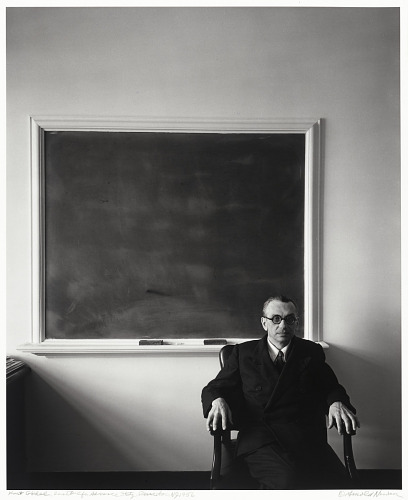
I’ve always loved this portrait. I first saw it many years ago in a book of Newman’s photographs called One Mind’s Eye that my father owned. It’s a little creepy, isn’t it? Gödel sits stiffly in a chair that seems too big for him. His face is half in shadow, and his eyes are partially obscured behind thick-rimmed glasses. But it’s the blackboard I find most striking. It’s the center of the picture and it occupies most of the frame. In a typical portrait of a mathematician or scientist, you’d expect the blackboard to be covered in equations. But Gödel’s blackboard is blank. More precisely, it has been erased. I think Newman must have understood something about the impact of Gödel’s work.
A Madman Dreams of Turing Machines explores the power of genius and the price it sometimes exacts. It reminded me of When We Cease to Understand the World by Benjamin Labatut. Both books explore through fiction how genius and madness often go together.
How accurate, how true, are Levin’s imaginings? We can never know, of course. After all, she reminds us, fiction is a lie. But fiction is also a path to truth. Oblique, indirect and not provable, but a path nonetheless. Levin says:
“There are faint stars in the night sky that you can see, but only if you look to the side of where they shine. They burn too weakly or are too far away to be seen directly, even if you stare. But you can see them out of the corner of your eye because the cells on the periphery of your retina are more sensitive to light. Maybe truth is just like that. You can see it, but only out of the corner of your eye.” [p. 12]
Thanks for reading.
If you enjoyed this review, please subscribe to Unsolicited Feedback.
Click here for more posts on mathematics.
Related Links
The Joy of Why
Podcast hosted by Janna Levin and Steven Strogatz exploring “great scientific and mathematical questions of our time.”
Levin Janna. “Janna Levin On Madman Dreams of Turing Machines.” tvo today, season 6, episode 54, 4 Oct. 2006, https://www.tvo.org/video/archive/janna-levin-on-madman-dreams-of-turing-machines.
Discover more from Unsolicited Feedback
Subscribe to get the latest posts sent to your email.


Sometimes we can learn just as much from fiction as we can nonfiction. This book sounds as if it is one of those sources of truth found in unexpected places. You are correct that I have heard of Turing (although I couldn’t place where, until you explained it) but I have not heard of Gödel. How fascinating that the author created a novel of the two without their paths crossing.
LikeLiked by 1 person
Pingback: 2024 Reading Wrap-Up | Unsolicited Feedback