Wild Law: A Manifesto for Earth Justice, by Cormac Cullinan, is a radical rethinking of law, governance, and humanity’s place in the natural world. It challenges assumptions that have shaped centuries of environmental destruction.
The book caught my interest because it’s one of the foundation texts for the “rights of Nature” movement. The rights of Nature movement seeks to improve protection of the environment by recognizing the legal rights and legal personhood of natural objects like rivers, forests, non-human species and even Nature as a whole. You can read more about it here. It might sound like a crazy idea, but if non-human entities like corporations can have rights, why not ecosystems too?
Wild Law is about a new way of governing ourselves, one that recognizes our dependence on a healthy planet and aligns with Earth’s own systems of ecological self-governance.
Cormac Cullinan is an environmental lawyer based in Cape Town, South Africa. He is a director of the Wild Law Institute and a member of the Executive Committee of the Global Alliance for the Rights of Nature. He led the drafting of the Universal Declaration of the Rights of Mother Earth.
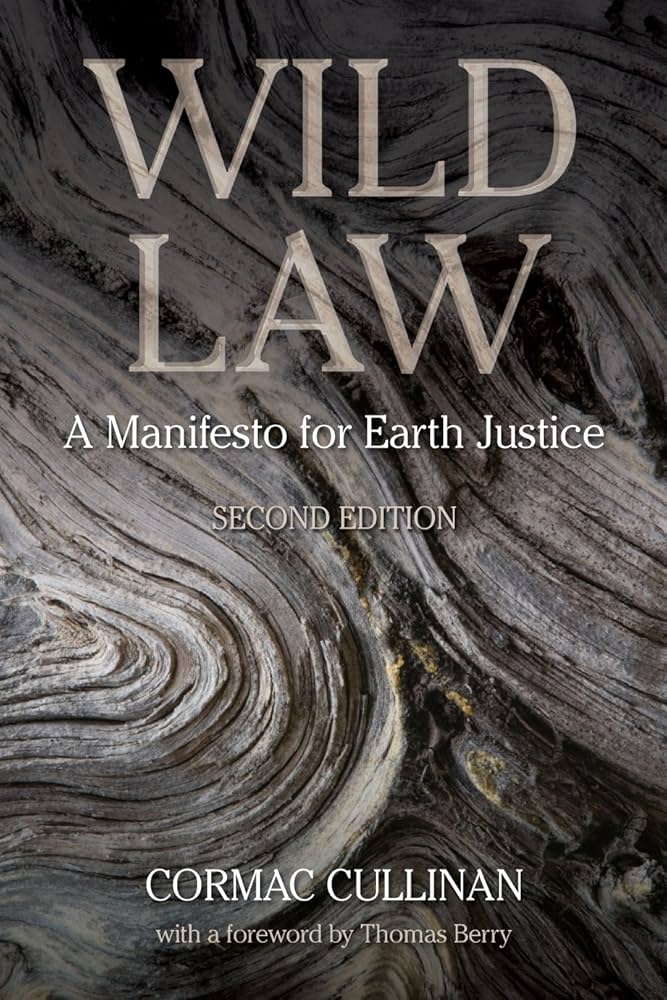
Wild Law: A Manifesto for Earth Justice, 2nd Ed.
By Cormac Cullinan
Chelsea Green Publishing, White River Junction, Vermont, 2011
Wild Law presents a philosophy called “Earth Jurisprudence” that underpins the rights of Nature. Cullinan defines Earth Jurisprudence as:
“… a philosophy of law and human governance that is based on the idea that humans are only one part of a wider community of beings and that the welfare of each member of that community is dependent on the welfare of the Earth as a whole.”1
Earth Jurisprudence starts by acknowledging that humans are not separate from the natural environment, that we are part of it and depend upon it for our very existence. This shouldn’t be radical idea. But that’s not how we’ve built our societies, at least not in westernized countries. Since the Industrial Revolution, we’ve looked at the natural world as property, as “resources” to be extracted, exploited and commodified. And long before that, western religions placed humans at the pinnacle of creation with “dominion” over everything else. The result has been the devastation and degradation of Nature, and consequently of ourselves.
Earth Jurisprudence, in contrast, places the survival, health and flourishing of the Earth and of the Earth Community at its center, as its top priority. It says that human laws and governance must promote human behavior so it contributes to the health of the wider ecological community and of Earth itself, not just human society. It’s a shift from anthropocentrism to ecocentrism.
Cullinan builds on the work of another philosopher, Thomas Berry, who wrote a Foreword for the book. He quotes Berry throughout. One of Berry’s key ideas is that “the universe is a communion of subjects, not a collection of objects.” I think he means our division of the world into people (subjects) and property (objects) is wrong, factually and morally. It also means that all members of the “communion” inherently have rights. He says specifically:
“Every component of the Earth Community has three rights: the right to exist, the right to habitat, and the right to fulfill its role in the ever-renewing processes of the earth community.” [p. 101]
Cullinan writes that wild law is an approach to implementing Earth Jurisprudence. Now “wild law” might seem like an oxymoron, a contradiction in terms. But in some of the most eloquent passages of the book, Cullinan argues that it’s no contradiction at all.
“Much of what is best in us is contained within our wild hearts. Wildness is associated with creativity and passion, with that part of us that is most connected with nature. It can also be understood as a metaphor for the life force that flows through us all and drives the evolutionary process.” [p. 30]
“Wildness is inherent in all people and organisms. It can even be understood as another name for the creative life force inherent in the universe.” [p. 31]
Wild law opens spaces where creative and unconventional approaches can be experimented with. Some will fail and some will succeed. That’s OK. Cullinan argues for diversity in law, and especially for making space in the law for Indigenous worldviews and practices.
Clearly, what we’re doing now isn’t working. We need new ways of governing ourselves that change how we relate to the natural world.
“Now at the beginning of the 21st century, we desperately need a new vision of how to govern ourselves. The rapid deterioration of our beautiful planet and the mounting evidence that we are in the early stages of the sixth major period of extinction tells us that something is dreadfully wrong with how humans are behaving.” [p. 122]
Laws that are supposed to protect the environment, like the Clean Air Act and the Endangered Species Act, have failed to do so because, Cullinan points out, they are actually designed to preserve the dominant economic model that sees Nature as property.
Instead, Cullinan says, what we need are laws and governance that are “of the people, by the people, for the Earth.”
Some of Wild Law, particularly the portions taken from Thomas Berry’s work, have quasi-religious overtones that I think are unnecessary. I’m not interested in making a god out of Nature. Still Wild Law is trying to do for the law what Doughnut Economics does for economics: to place human society within, rather than apart from, the environment, and to make sure that law and governance contribute to a healthy society within a healthy environment. It’s a different conception of law that is becoming more necessary every day.
Thanks for reading
For more posts on the rights of Nature, click here.
References
1. Cormac Cullinan. “The History of Wild Law,” in Exploring Wild Law: The philosophy of earth jurisprudence, edited by Peter Burdon, Wakefield Press, 2011. ProQuest Ebook Central, https://www.wakefieldpress.com.au/product/exploring-wild-law/.
Related Links
The late Christopher Stone, a law professor at the University of Southern California, is generally credited with inspiring the rights of Nature movement, at least in the US, back in 1972 when he published a paper called Should Trees Have Standing? – Towards Legal Rights for Natural Objects.
Discover more from Unsolicited Feedback
Subscribe to get the latest posts sent to your email.


 Unsolicited Feedback