Is a River Alive? by Robert Macfarlane begins with a beautiful description of the birth of a river near the author’s home in Cambridge, England. In it, he refers to “the river who winds.” Not the river that winds, the river who winds. I felt a little jolt of excitement at his unusual choice of pronoun. I knew instantly this was going to be a great book. It is.
Robert Macfarlane is an award-winning author and Professor of Literature and the Environmental Humanities at the University of Cambridge. He writes about nature, climate, people and place. Is a River Alive? is his eleventh book.
Is a River Alive? is a journey into an idea that Macfarlane says changes the world, the idea that rivers are alive. The book explores what it might mean for our relationship with nature, for our laws, economies and societies if we took this idea seriously. What it might mean for our language too.
“In English, pronouns for natural features are ‘which’ and ‘that’, not ‘who’: the river that flows; the forest that grows. I prefer to speak of rivers who flow and forests who grow. In English, we speak of a river in the singular. But ‘river’ is one of the great group nouns, containing multitudes. In English, there is no verb ‘to river’. But what could be more of a verb than a river?” [p. 22]
Is a River Alive? is organized around three journeys Macfarlane took to explore rivers in three very different landscapes: the Rio Los Cedros (River of the Cedars) located in the Los Cedros cloud-forest in Ecuador; the rivers and lagoons of the Indian city of Chennai; and the Mutehekau Shipu or Magpie River in the Nitassinan region of northern Quebec, homeland of the Innu people. The rivers in each of these locations are threatened in different ways: by mining, pollution, and hydroelectric dams. Each have vibrant, dedicated communities of activists trying to save them. And they each teach different lessons about whether and how a river is alive.
Macfarlane states at the outset that the rivers aren’t just his subjects, they are his co-authors.
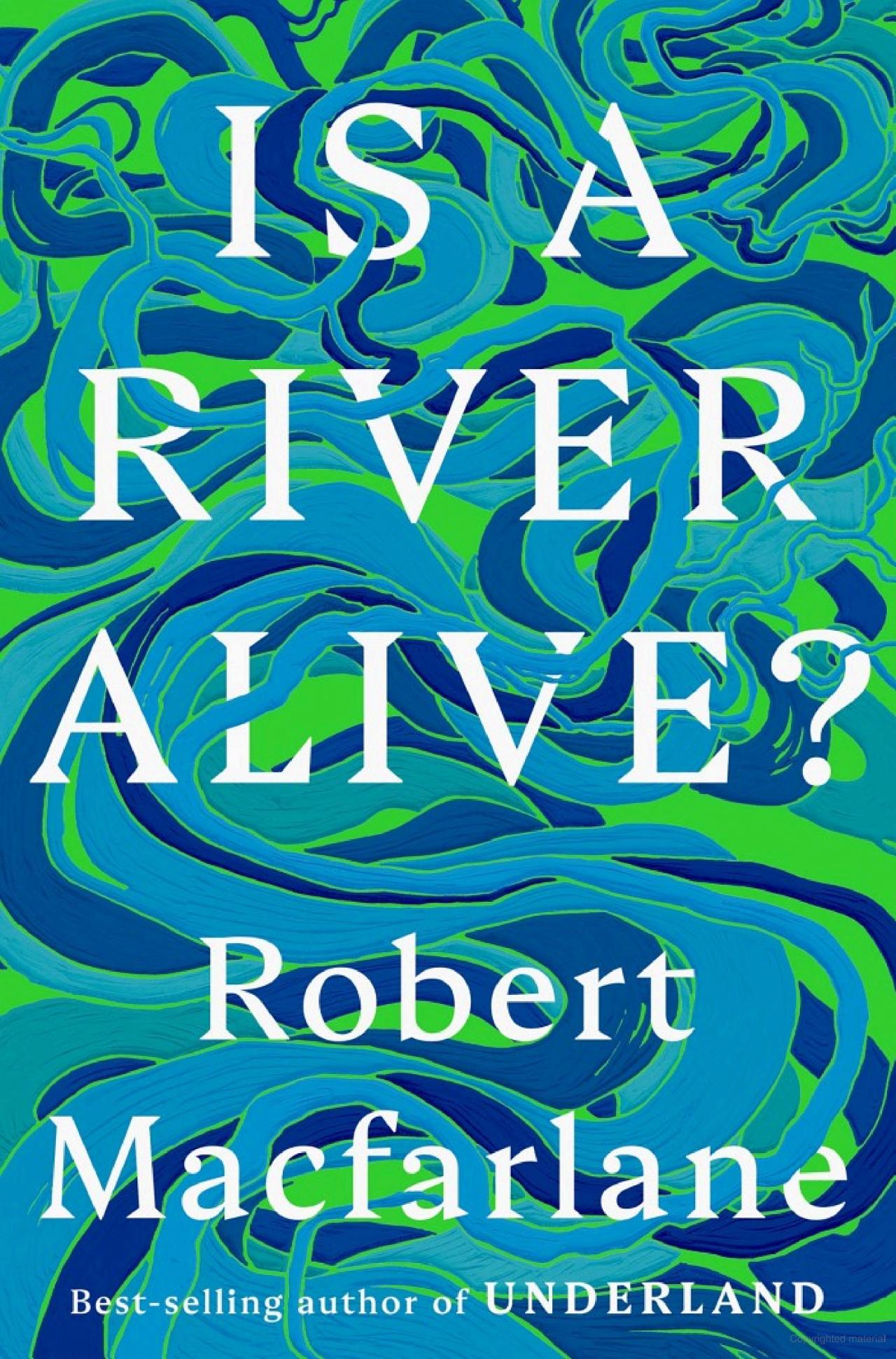
Is a River Alive?
By Robert Macfarlane
W. W. Norton & Company, New York, 2025
This question, is a river alive, might seem easy to decide at first. On the one hand, you might think, well duh! of course a river is alive. Just look at all the life it supports in and around itself. Look at how it moves and flows, rises and falls, weaves and meanders. Listen to it speak. On the other hand, you might argue that rivers are just a combination of water, weather and gravity. They’re the result of physics, not biology. You can’t think of a river being alive in the same way that a human or a wolf or even a tree is alive. What an absurd idea!
These two diametrically opposed and equally plausible answers show that it’s not a simple question at all.
But take it a step further. If we decide that a river, or other natural objects, are alive, what does that imply? For people in the “rights of nature” movement, it means that rivers, trees, non-human species and even nature itself should be recognized as legal persons and endowed with legal rights such as the rights to exist, flourish and regenerate. There’s even a Universal Declaration of the Rights of Rivers.
This might seem like a crazy idea, but we already grant abstract, human-made entities like corporations the rights to sue, to exercise free speech and even freedom of religion. So why shouldn’t a river have the right to exist?
Over the course of the book, Macfarlane traces the history of the rights of nature movement and grapples with some of the questions it raises.
It seems to have started in 1972 with the publication of a paper called “Should Trees Have Standing? – Towards Legal Rights for Natural Objects” by the late Christopher D. Stone, a Professor of Law at the University of Southern California. About 40 years later, Jacinta Ruru, a Māori legal scholar, and her student James Morris argued in a 2010 paper titled “Giving Voice to Rivers: Legal Personality as a Vehicle for Recognising Indigenous Peoples’ Relationships to Water?” that Stone’s ideas should be applied to New Zealand’s rivers. Seven years later, the Parliament of New Zealand passed the Te Awa Tupua (Whanganui River Claims Settlement) Act 2017 which granted legal personhood and legal rights to the Whanganui River.
Just ten days after that, the High Court in Uttarakhand, India, inspired by New Zealand’s legislation, decreed that the Ganges and Yamuna Rivers, both long considered sacred, should be recognized as “living entities” with legal rights.
The impact of New Zealand’s law continues to ripple around the world. The Los Cedros region of Ecuador in under constant threat from mining companies who want to extract copper and gold. But in 2021, Ecuador’s Constitutional Court ruled that mining in Los Cedros would violate the rights of its forest and rivers. Macfarlane quotes the chief judge in the case, Agustín Grijalva Jiménez:
“’A river [or] a forest,’ wrote Agustín, are ‘life systems whose existence and biological processes merit the greatest possible legal protection that a constitution can grant: the recognition of rights inherent to a subject.’” [p. 65]
One thing is certain: thinking about the aliveness of rivers forces to us broaden our concept of life itself. At the end of his journey into Los Cedros, Macfarlane concludes:
“I’ve never more strongly than here – in the seethe and ooze of the forest, in the flow of the river – perceived the error of understanding life as contained within a skin-sealed singleton. Life, here, stands clear as process, not possession. Life is as much undergone as done. We are constitutionally in the midst. This forest, this river – they enliven.” [p. 107]
If we do consider rivers and forests and nature to be alive, then Macfarlane suggests we must also recognize that they are alive in ways that are very different, even alien, from ourselves.
The rights of nature might be an idea whose time has come. That doesn’t mean it’s straightforward. If natural objects have legal rights, then presumably someone, some human, has to speak for them in court. Who? If a river is a legal person, how do we know what the river “wants?” How do we ensure the rights of nature don’t get used as just “a disguised form of political manoeuvering between and among us humans.”
Macfarlane wrestles with these questions throughout the book without really coming to firm conclusions.
I must say I’ve been fascinated by the rights of nature idea ever since I heard of New Zealand’s legislation on the Whanganui River a few years ago. Last year I read a book of that title, The Rights of Nature, by Robert Boyd. Is a River Alive? explores the complexities of the issue with care and depth and great sensitivity.
The bulk of the book, though, tells the stories of Macfarlane’s travels through those three locations, and how he is transformed by his experiences, especially on the Mutehekau Shipu in Quebec. Macfarlane’s writing is fantastic. His words transport you to the places he visits and bring to life the people he meets. His turns of phrase are wonderful and evocative. After describing the process of open pit mining for gold and copper in the Andes Mountains, he writes:
“Thus the marrow of the mountain is cracked open, slurped out and sold; thus the cloud-forest and its rivers are poisoned and killed.” [p. 56]
Watching the bird life on the Bay of Bengal north of Chennai:
“In Pulicat Lagoon, several hundred flamingoes stand in their own reflections, doubled like playing-card queens, blushing the water pink.” [p. 186]
Is a River Alive? is also about the people working to save the rivers, and the mostly voiceless people harmed when the rivers are harmed. Macfarlane recounts how Yuvan Aves, the activist who guides him around Chennai, once held a meeting where he asked members of the community near an especially polluted stream called Enmore Creek what they would want for the future.
“… a villager replied, ‘We’re all getting cancer. It would be nice if we just got asthma.’ That was her dream. Asthma rather than cancer.” [p. 169]
These days, especially in the US, it’s easy to feel hopeless and despondent about the direction we’re heading. So many wrong turns, so many opportunities squandered, so much cruel and vicious harm. It feels futile to dream. Is a River Alive? shows us a new approach for seeing, understanding and interacting with the Earth and with life itself. It offers a new way to hope.
As Macfarlane says, “hope is the thing with rivers.”
Thanks for reading.
Related Links
LNL Summer: Is a river alive?
Interview with Robert Macfarlane on Late Night Live, presented by David Marr, Australian Broadcasting Corporation, 7 Jan. 2026.
Robert Macfarlane, Is a River Alive?
29 U. Denv. Water L. Rev. 113 (2026).
Book note on Is a River Alive? in University of Denver Water Law Review, Spring 2026.
What Are the Rights of Nature?
Katie Surma. Inside Climate News. 2 Apr. 2025. A great article summarizing the rights of nature movement.
The Rights of Nature — Can an Ecosystem Bear Legal Rights?
Tiffany Challe. State of the Planet, Columbia Climate School, 22 Apr. 2021.
The Most Environmentally Imaginative Country on Earth Is Under Assault.
César Rodríguez-Garavito and Robert Macfarlane. New York Times, August 15, 2025. Article detailing threats to Ecuador’s environment, including the Los Cedros cloud forest, from its newly elected populist president.
Empowering Nature
Susan Fleming, et al. PBS Broadcasting Service, 2025. Video about the Magpie River and efforts to grant it legal personhood.
Christopher D. Stone. “Should Trees Have Standing? – Towards Legal Rights for Natural Objects.” Southern California Law Review, vol. 45, 1972, pp. 450-501, https://southerncalifornialawreview.com/wp-content/uploads/2022/03/Christopher-D.-Stone-Should-Trees-Have-Standing_%E2%80%94Toward-Legal-Rights-for-Natural-Objects-45-S.-CAL.-L.-REV.-450-1972..pdf
Morris, J. D., & Ruru, J. (2010). Giving Voice to Rivers: Legal Personality as a Vehicle for Recognising Indigenous Peoples’ Relationships to Water? Australian Indigenous Law Review, 14(2), pp. 49–62, https://search.informit.org/doi/10.3316/informit.144512620502485.
Rod Barnett. “Utu in the Anthropocene.” Places Journal, Aug. 2021, https://placesjournal.org/article/redesigning-colonial-landscapes/. A more critical look at the rights of nature movement in New Zealand.
Te Awa Tupua (Whanganui River Claims Settlement) Act 2017, New Zealand, Public Act 2017 No 7, 20 March 2017, https://www.legislation.govt.nz/act/public/2017/0007/latest/whole.html.
Discover more from Unsolicited Feedback
Subscribe to get the latest posts sent to your email.


 Unsolicited Feedback
I love that choice of who as the pronoun too! Isn’t it amazing how it can set the tone? Sounds like an intriguing book….
LikeLiked by 1 person
Pingback: Nonfiction November 2025 Week 1: Your Year in Nonfiction | Unsolicited Feedback
This sounds wonderful and inspiring and thoughtful – thank you for highlighting on your November post. Adding this to my wishlist.
LikeLiked by 1 person
It’s all of those things! I hope you enjoy it.
LikeLiked by 1 person
Pingback: Nonfiction November 2025 Week 4: Diverse Perspectives | Unsolicited Feedback
Pingback: Non-Fiction November – New to My TBR – This Reading Life
Pingback: 2025 Reading Wrap-Up | Unsolicited Feedback
Pingback: Braiding Sweetgrass | Unsolicited Feedback