Patrick Bringley spent ten years working as a security guard at the Metropolitan Museum of Art in New York. It was a job that gave him time and space to contemplate the beauty and meaning of art and to grieve for the death of his elder brother, Tom, from cancer.
All the Beauty in the World: The Metropolitan Museum of Art and Me is a heartfelt memoir of his time at the Met. It’s mostly about art, about individual works and about Art generally. It’s also about grief and suffering and how art depicts those experiences and helps us see them and understand them better. It’s a wonderful book, both sad and joyful.
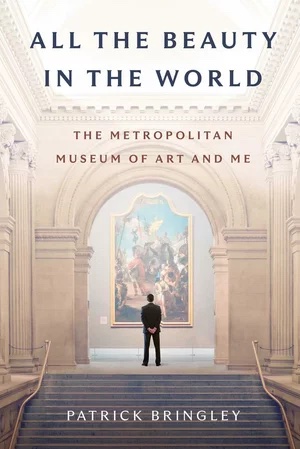
All the Beauty in the World:
The Metropolitan Museum of Art and Me
By Patrick Bringley
Simon & Schuster, New York, 2023
After his brother died, Bringley needed to escape the rushing torrent of his career and his life. He needed to linger, to stop. But how?
“I had noticed the men and women who worked inside New York’s great art museum. Not the curators hidden away in offices – the guards standing watchfully in every corner. Might I join them? Could it be as simple as that? Could there really be this loophole by which I could drop out of the forward-marching world and spend all day tarrying in an entirely beautiful one?” [p. 35]
The idea of stopping or stepping outside of time was the most important theme of the book for me. It’s a constant motif in Bringley’s rich explorations of individual works of art, the museum as a whole, and the job of guarding it all.
The present is always surging forward like the bow wave of a ship into a future that’s yet to be born while the past is forever receding deeper into our memories. But Bringley says that art helps preserve the past, even the ordinary and the mundane, and tells us that it was and is real.
“Much of the greatest art, I find, seeks to remind us of the obvious. This is real, is all it says. Take the time to stop and imagine more fully the things you already know.” [p. 22]
Bringley writes eloquently about how art captures moments and scenes that no longer exist, that maybe never existed at all, but which reflect life in all its suffering and glory back to us.
“Art often derives from those moments when we would wish the world to stand still. We perceive something so beautiful, so true, or majestic, or sad, that we can’t simply take it in stride. Artists create records of transitory moments, appearing to stop their clocks. They help us believe that some things aren’t transitory at all but rather remain beautiful, true, majestic, sad, or joyful over many lifetimes – and here is the proof, painted in oils, carved in marble, stitched into quilts.” [p. 178]
One such moment occurs while Bringley and his mother are sitting together in a hospital room watching over his dying brother Tom.
“It was a moment like this one – actually, the early dawn – when I sat with my mother at the bedside and watched her take everything in as though for the first time. She looked at her sleeping son. Looked at me. Saw the light, and the body, and the horror and the grace. ‘Look at us,’ she told me, ‘Look. We’re a fucking old master painting.’” [p. 30]
Over the course of the book, Bringley takes us with him as he watches over different section of the museum. In each area, he picks one or two representative pieces to explore more deeply. All the Beauty in the World isn’t an art appreciation book, but Bringley does give us his method of approaching each new piece. As time goes on, he learns more and more about the art he’s there to protect. Yet it’s the museum itself that’s the center of the book and of Bringley’s own reflection and growth.
“As with geological time or astronomical space, we can glimpse the staggering breadth of our ancestry when we devote energy to doing so, but the moment we fall back on our heels, we forget these realities. I experience a rush of gratitude for museums as places to return to and remember.” [p. 42]
We also see him work through his grieving. Gradually, the pain begins to subside (except, perhaps, in his feet). He even starts to become a little restless. Grief comes to an end, he observes, yet there’s sadness too in finally letting it go.
Time can’t be stopped forever, even at the Met.
I wouldn’t call myself a great art lover, but over the years I’ve been to art museums in Paris, London, Amsterdam, Toronto, San Francisco and a few other places. Somehow I’ve never been to the Met. All the Beauty in the World, a beautiful and thoughtful memoir, makes me want to visit as soon as I can.
Thanks for reading.
Thanks to Frances @ Volatile Rune for recommending this book.
If you enjoyed this review, please subscribe to Unsolicited Feedback.
Discover more from Unsolicited Feedback
Subscribe to get the latest posts sent to your email.


 Unsolicited Feedback
Pingback: Nonfiction November 2023 Week 5: New To My TBR | Unsolicited Feedback
I thought this title sounded familiar. I looked at my “wishlist’, where I keep a list of books I want to read based on blog posts, and yes, it was there, from Volatile Rune’s post last year 🙂 Good on you for acting on it!
LikeLiked by 1 person
Thanks. I put it on my list during Nonfiction November last year. Trouble with all those lists is they never seem to get shorter! 🙂
LikeLike
Thanks Harry! Added to my ever growing list.
LikeLiked by 1 person
Pingback: Nonfiction November 2024 Week 1: Your Year in Nonfiction | Unsolicited Feedback
Pingback: 2024 Reading Wrap-Up | Unsolicited Feedback