These days I often feel utterly helpless in the face of so much political turmoil and rising oppression around the world. Especially living here in the US where we seem to be sliding into autocracy. How can one person possibly make a difference against these overwhelming forces? Do you ever feel the same way?
Well, Srdja Popovic has some answers. Popovic is a Serbian political activist. He was a leader in the nonviolent student organization Otpor! (Resistance) which helped topple the regime of Slobodan Milošević in 2000. In 2003, he co-founded the Centre for Applied Nonviolent Action and Strategies (CANVAS) where he teaches nonviolent strategies and tactics to activists all around the world. Popovic lives in Belgrade.
His 2015 book, Blueprint for Revolution: How to Use Rice Pudding, Lego Men, and Other Nonviolent Techniques to Galvanize Communities, Overthrow Dictators or Simply Change the World, is a handbook for achieving political change through nonviolent – and often humorous – civil activism.
Even though the book is ten years old, it’s still relevant.
“But if you look past the advertising and the propaganda posters, all dictatorships are baked from the same basic ingredients: corruption, mismanagement, nepotism, social injustice, violence, and fear.” [p.20]
That rings true even today.
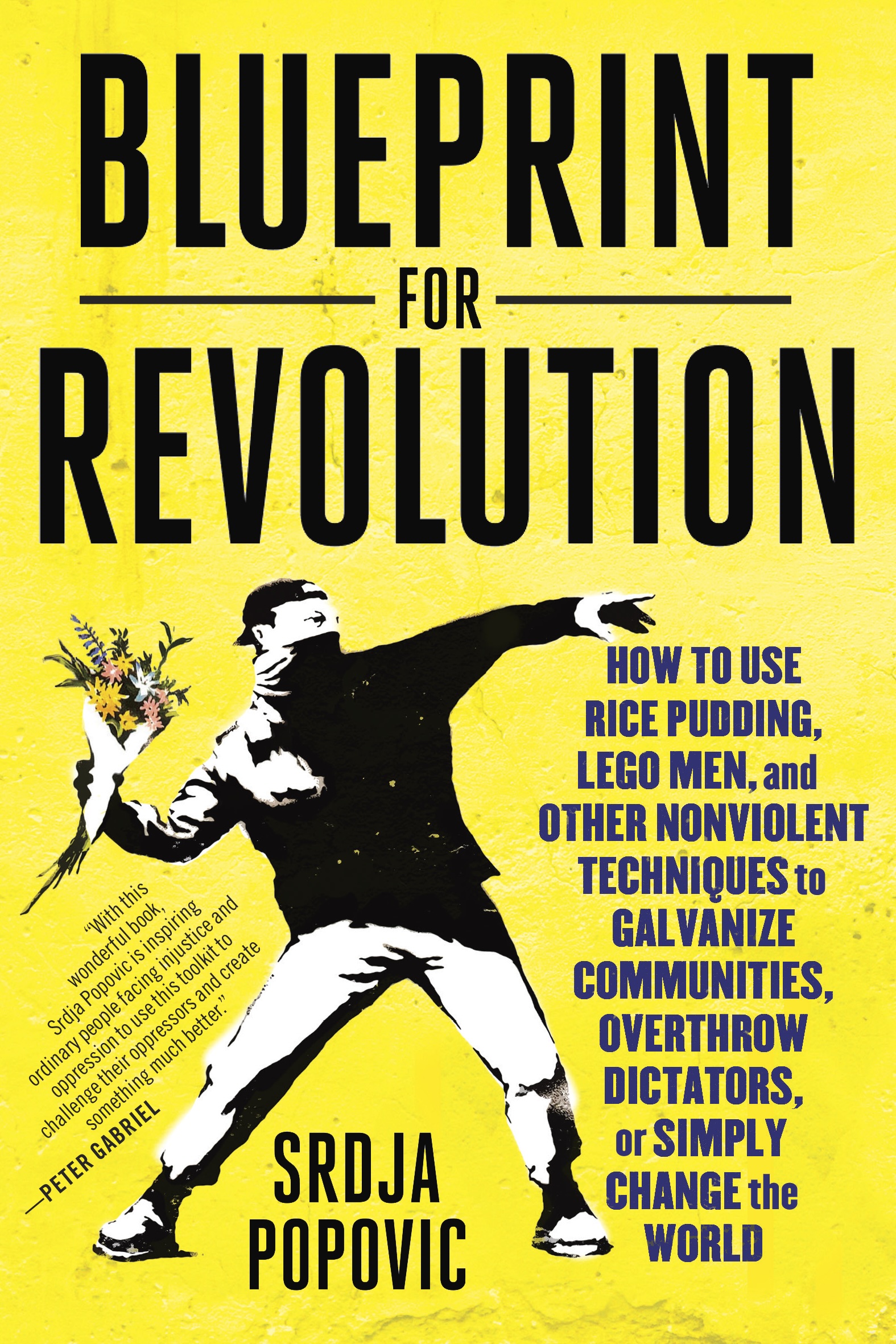
Blueprint for Revolution:
How to Use Rice Pudding, Lego Men,
and Other Nonviolent Techniques to
Galvanize Communities, Overthrow Dictators or Simply Change the World
By Srdja Popovic
Random House, New York, 2015
Blueprint for Revolution isn’t a step-by-step recipe book because every political struggle is different. Instead, Popovic sets out a few broad principles and a wide array of tactics. He illustrates them with plentiful examples from his own experience in Serbia and from other nonviolent activists around the world.
The core principles of nonviolent revolution, Popovic calls them the holy trinity, are unity, planning, and nonviolent discipline.
Unity is hard. You need to bring together people from many different groups in society, cutting across race, religion, class, gender, sexual orientation, and urban/rural fault lines. He says you want to draw a “line of division” with as many people as possible on your side, and only “a handful of evil bastards” on the other. So you need to develop a unified message and a unified group identity. That’s why so many movements adopt a single color or a striking logo.
Planning is crucial too. The most important part of any plan is the goal. Are you aiming to topple a dictator or establish democracy? These are vastly different goals and require different strategies. If you focus only on getting rid of a dictator, that’s fine but understand you’ll probably have no influence on what comes after. So be very clear about your goal. It might be something local too, like saving a park from being turned into a highway interchange. Whatever your goal, imagine your desired future state in as much detail as possible. Work backwards from that vision and figure out what you need to get there and what you need to build along the way.
Popovic suggests starting small. Pick a small, concrete goal that people care about rather than something abstract and lofty. Pick something you can win. Build credibility and a track record. Do the painstaking work to develop an organization that can deliver change. He says this is what Dr. Martin Luther King Jr. and the US civil rights movement did well in the 1960’s, while the Occupy movement skipped these steps in the 2010s and failed.
“Proper revolutions are not cataclysmic explosions; they are long controlled burns.” [p. 80]
Resorting to violence is an ever-present temptation for protest movements, especially when the authorities use violence to suppress them. But Popovic urges nonviolence. In the first place, when you use violence, you’re attacking the regime at its strongest point. That’s not just poor tactics, it can be fatal.
Nonviolent tactics, including humor or “laughtivism,” are more likely to succeed. He cites statistics from Harvard political scientist Erica Chenoweth showing that nonviolent revolutions succeed 53% of the time, while violent campaigns have only a 26% success rate. Popovic says this is because,
“Violence scares people, and when people are scared, they look for a strong leader to protect them.” [p. 203]
Violence makes it harder to tell the good guys from the bad guys, and it turns off people who might otherwise support you. Nonviolence, on the other hand, attracts more people, and makes everyone feel like they’re one of the good guys.
By the way, Chenoweth also came up with the “3.5% rule.” They found that you need just 3.5% of the population actively participating in political protests to achieve significant change.
The most important idea from Blueprint for Revolution is that we can make a difference. Popovic, a big Lord of the Rings fan, quotes Galadriel’s words to Frodo: “even the smallest creature can change the course of the future.” We’re all hobbits, he says, and in the beginning, “everybody is a nobody.” But even hobbits can change the world.
Unsolicited Feedback
Blueprint for Revolution is written in a light, conversational style, in contrast to its very serious subject. Popovic is a constant presence through the book. He uses his own experiences in Serbia as prime examples for many of the points he makes, often with self-deprecating humor. He comes across as a regular guy you could meet at the pub for beer and a chat about … fighting global tyranny.
Blueprint for Revolution echoes some ideas I’d read previously in Zeynep Tufekci’s 2017 book, Twitter and Tear Gas, especially the idea that social movements must take the time and do the hard, painstaking work of building a robust organization. This includes agreeing on processes for making decisions and changing tactics when necessary. It sounds dull and bureaucratic, but you can’t like and tweet your way to meaningful change.
I enjoyed reading this book, and it left me feeling more hopeful about the possibility of change.
Yet I also felt there was something missing. What happens after the struggle is over, after the fight is won? How do you secure lasting change? How do you make sure there’s a second election following the first, euphoric election after the dictator is gone? Popovic touches on this a little when he talks about aiming to establish democracy rather than just pushing out an autocrat. It’s about setting the right goal.
Take Popovic’s own country, Serbia. He and others helped push out Milošević in 2000. Twenty-five years later, Serbian democracy is once again under threat. Freedom House rates Serbia as only “partly free” and reports that the ruling party is eroding civil liberties and political rights, and pressuring independent media and opposition parties.
The work never ends.
Whether you’re fighting a dictator or just trying to improve your neighborhood, Blueprint for Revolution is a worthwhile, helpful, even inspiring book. It will teach you how to organize and carry out nonviolent action to achieve political change.
But, damn, it’s hard.
Thanks for reading.
Related Links
The Politics of Nonviolent Action
This 3-volume 1973 book by Gene Sharp, sometimes called the “Machiavelli of Nonviolence,” contains a list of 198 nonviolent tactics.
Discover more from Unsolicited Feedback
Subscribe to get the latest posts sent to your email.


 Unsolicited Feedback
Thanks Harry for bringing some hope and inspiration to my day! I’m always grateful to people who share their experiences that can later help people, and collectively, societies, that find themselves in similar situations.
LikeLiked by 1 person
Okay, you’ve convinced me again to add another book to my to-read list. I need something hopeful. I like the things you shared. I keep hearing about the importance of 3.5%. I wonder how close (or far?) we are from it…
LikeLiked by 1 person
Thanks, Lisa. The 3.5% number is interesting – makes change seem more do-able. For the US it probably means 10-11 million people.
LikeLiked by 1 person
Pingback: Nonfiction November 2025 Week 1: Your Year in Nonfiction | Unsolicited Feedback
Pingback: This Is an Uprising | Unsolicited Feedback