Over the last 100,000 years, humans have accumulated enormous amounts of information and power, but it doesn’t seem like we’re getting any wiser. We have a tendency towards self-destruction (atomic bombs, climate change, and maybe AI) and despite all our accomplishments we are no closer to answering meaningful questions like what is a good life and how should we live it.
“Why are we so good at accumulating more information and power, but far less successful at acquiring wisdom?” [p. xii]
This is the question Yuval Noah Harari tries to answer in his latest book Nexus: A Brief History of Information Networks from the Stone Age to AI. Now, a 400-page book about information networks might sound dull and daunting, but Nexus is fascinating and well-worth reading. In this book, Harari presents a powerful framework for understanding the role of information networks in shaping human history, culture and politics and how AI could fundamentally affect them all.
Yuval Noah Harari is a bestselling author, historian and philosopher and one of the world’s leading public intellectuals.* He lectures on world history at the Hebrew University of Jerusalem. Harari earned a PhD in history from the University of Oxford. Nexus is his fifth book. I’ve reviewed two of his earlier works, Sapiens, and 21 Lessons for the 21st Century.
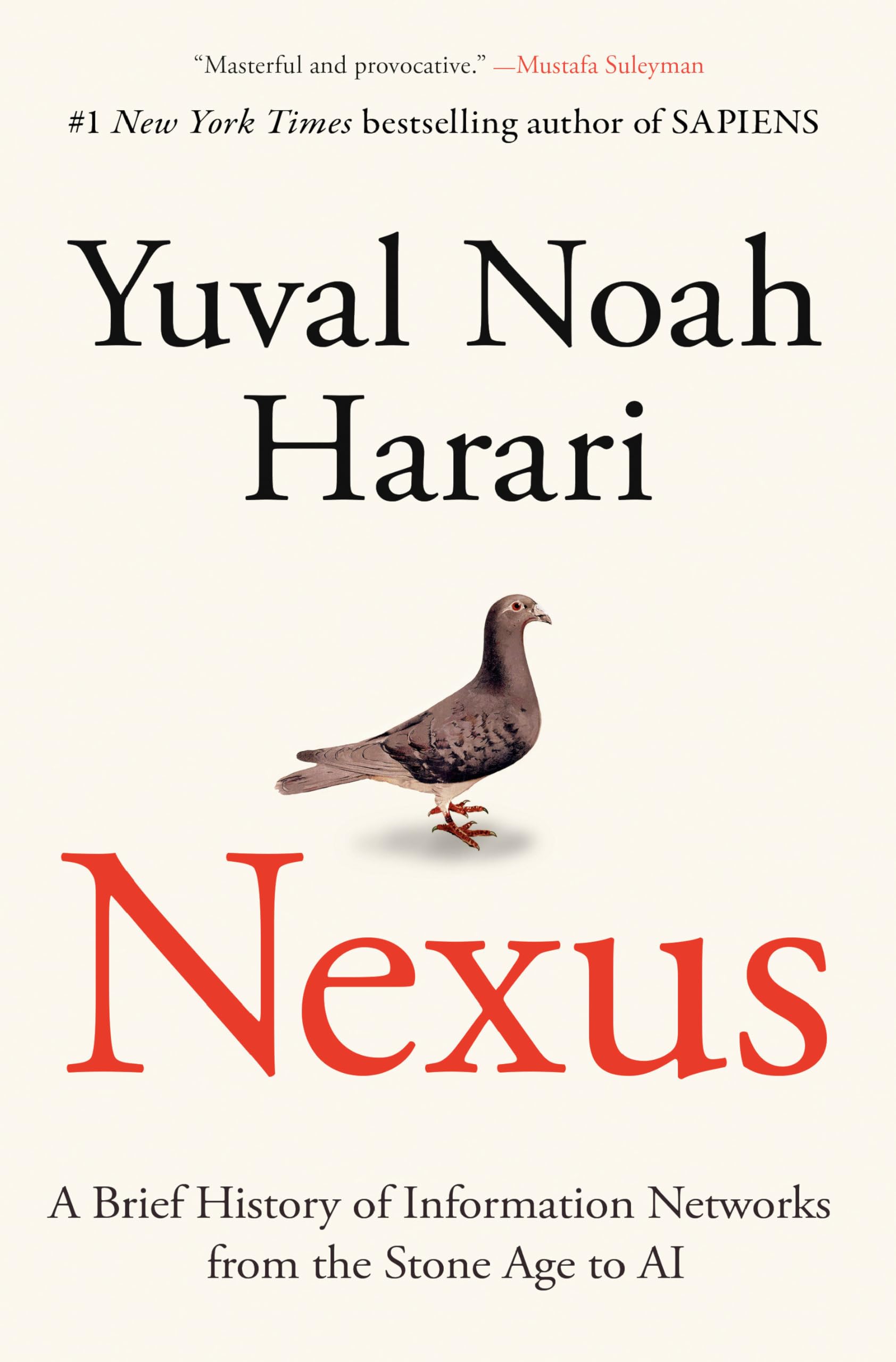
Nexus: A Brief History of Information Networks
from the Stone Age to AI
By Yuval Noah Harari
Random House, New York, 2024
Nexus is organized into three parts. The first part deals with the nature and history of human information networks. The second describes how artificial intelligence is creating new and radically different kinds of information networks and the third explores how AI might transform human society and politics. The first part was most interesting to me, possibly because I already have some familiarity with AI through my work, so I’m going to focus more on that part in this review.
Information: Not Just Truth
“Information” is one of those fundamental concepts like energy that’s really hard to define. You probably think of information in terms of words and numbers, maybe bits and bytes. Harari starts Nexus by presenting a view of information that’s way broader than most of us are used to. First of all, he says that in the right context almost anything can be information. The flight of birds might inform you about the change of seasons or the presence of a predator. Most of us see information as a representation of reality or some part of it. When that representation succeeds, we call it “truth.” In this view, information is good and more information is better because it leads to more truth. Harari calls this the “naïve view” of information.
A different, more cynical view is that information is a weapon used by elites to control the people. Populist politicians claim they, and they alone, understand the people and promise they will use information to benefit them. (Of course, the inherent contradiction here is that populists just want to replace one elite with another, often a single ruler.)
But Harari makes the case that most information doesn’t represent anything at all and is certainly not truth. Errors, lies, fantasies, conspiracy theories and fiction are also information, he says, even though they have no relation whatsoever to truth.
More importantly, he argues the purpose of information is not representation but connection. Information connects people and things together into networks. It creates new realities by tying together disparate things. For example, music brings people together: it causes us to sing, dance or march into battle. DNA creates new realities by making evolution possible. Shared stories and myths enable large groups of people who don’t know each other to connect, work and live together. Technologies like writing, books, the printing press and the internet enable people to access the same stories and myths no matter how far apart they are.
Harari writes that Homo sapiens have become the dominant species on the planet because of our ability to cooperate in larger numbers and over greater distances than any other species.
“The clearest pattern we observe in the long history of humanity isn’t the constancy of conflict, but rather the increasing scale of cooperation.” [p. 389]
That cooperation is enabled by our ever more sophisticated ability to build information networks that connect and hold groups together, from clans to tribes to nations to civilizations.
Order and Truth
Contrary to both the naïve and populist views of information,
“… to survive and flourish every human information network needs to do two things simultaneously: discover truth and create order.” [p. 37]
For “order” you can substitute “rule of law” or “social harmony” or “control” or “domination.” All societies require some degree of order to function. They also need truth. They need to know when to plant crops, when to prepare for an enemy attack and when to correct policies that aren’t working properly.
Harari observes that human history is characterized by a rise in connectivity without a simultaneous rise in wisdom or truthfulness. That’s because as our information networks have grown more powerful, they’ve often been used to emphasize order over truth. Neglecting truth causes leaders to use power unwisely. Occasionally, it leads to catastrophic delusions like Nazism and Stalinism.
“Instead of a march of progress, the history of human information networks is a tightrope walk trying to balance truth with order. In the twenty-first century we aren’t much better at finding the right balance than our ancestors were in the Stone Age.” [p. 39]
In this framework, dictatorships and democracies are not competing ethical or political systems. Instead, they are different types of information networks that exist on a continuum defined by the balance between order and truth. Dictatorships are centralized information networks primarily focused on maintaining order. They are not at all interested in truth. In fact, they usually perceive truth to be a threat. In Harari’s terms, they lack strong “self-correction mechanisms” like free elections or peer review. Democracies must maintain order too, but they place more emphasis on truth. They are decentralized information networks with strong self-correction mechanisms in which governments make a limited number of decisions, leaving the rest to individuals, families, corporations, communities and other civil society groups, sometimes at the expense of order.
AI: Amplifying Truth or Order?
Like information itself, the technologies we’ve invented to build our information networks do not necessarily lead to greater truth or wisdom. Conspiracy theories didn’t originate with QAnon and the internet. Harari recounts the terrible toll of witch hunts in Europe in the late 1400s and 15oos spurred by the printing press and the publication of completely baseless material about so-called witches.
However, the invention of new information technologies has always catalyzed major historical changes because these technologies create or expand information networks, connecting more people together.
AI is a qualitatively different type of information technology, Harari says, because of its ability to create and act autonomously. A printing press can reproduce books but it cannot decide what books to print let alone what words should go into the books. An atomic bomb is a weapon of terrible destruction but it cannot decide whom to attack, or when, or where. AI can do all these things. AI is not just a new way of connecting humans, it has become a peer to humans in our information networks. (In graph theory terms, AIs are nodes not edges.)
More ominously, Harari warns that AI is starting to dominate information networks. This is most obvious if you look at social media. (Note: I used to work at Meta.) Inscrutable god-like algorithms are designed by their corporate owners to maximize engagement, basically the amount of time you and I spend on social media apps. At some point, these algorithms discovered that the most effective way to increase engagement is to promote content that generates outrage. This has had an undeniable polarizing effect on our politics.
Harari worries that increasingly powerful AIs will be used to amplify the power of autocrats. See, for example, China’s terrifying social credit system. Even worse, AIs could take control of governments. Harari gives the example of a dictator asking his AI whether he can trust his Minister of Defense. If the AI says no, the dictator is likely to arrest the Minister and replace him with someone else, possibly someone recommended by the same AI. If the AI says yes, this could give the defense minister breathing room to carry out a coup, possibly under the guidance of the AI. Who or what is actually in control here? Who knows for sure what the AI’s biases or motivations really are?
A More Perfect Balance
Throughout the book, Harari cautions against two extremes. First the naïve view of information is overly optimistic because information isn’t always truth and, in any case, its main task is to connect rather than represent. The cynical or populist view is also wrong because it assumes that people are interested only in power and not truth. This has never been true, historically, he asserts.
“However, since humans are interested in truth, there is a chance to resolve at least some conflict peacefully, by talking to one another, acknowledging mistakes, embracing new ideas, and revising the stories we believe. That is the basic assumption of democratic networks and scientific institutions.” [p. 401]
Because they often privilege order over truth, our information networks have created a lot of power but little wisdom. Therefore, Harari suggests that as information networks become more powerful, our self-correcting mechanism are even more important.
“Rather, to create wiser networks, we must abandon both the naïve and the populist views of information, put aside our fantasies of infallibility and commit ourselves to the hard and rather mundane work of building institutions with strong self-correcting mechanisms.” [p. 404]
In Nexus, Harari explores, and advocates for, a more hopeful and balanced middle ground between truth and order.
“Information isn’t the raw material of truth, but it isn’t a mere weapon, either. There is space between these two extremes for a more nuanced and hopeful view of human information networks and of our ability to handle power wisely.” [p. xxviii]
Unsolicited Feedback
No one could ever accuse Yuval Harari of thinking small. Like his other books, Nexus is full big ideas and sweeping perspectives. Although he explores complex topics, his writing is clear and engaging (minus the outrage). He recaps ideas often enough to reinforce them without becoming tedious.
I particularly like his idea that institutions and societies are often defined by the balance they strike between order and truth. It helped me better understand some important trends happening in the world today. Why are right wing populists gaining power in so many places around the world? Perhaps it’s because disruptive changes like globalization, AI, climate change, immigration and other elements of our polycrisis lead people to crave order over truth in this moment. This increases the appeal of autocrats or “illiberal democrats,” and the order they promise.
Why is Donald Trump attacking universities? Universities have brought immeasurable scientific, economic, cultural and other benefits to the US. So on the surface Trump’s attacks make no sense at all, and in the long run they’re suicidal for America. Harari’s truth/order balancing framework gives us a way to understand what’s going on here. Universities are institutions specifically focused on discovering truth. And if they occasionally falter, which they do, they have very strong built-in self-correction mechanisms. All of which pose a direct threat to a would-be dictator like Trump.
I don’t yet know whether Harari’s warnings about AI are valid, but he’s certainly right to call attention to the possibilities. Almost no one in a position of authority, least of all in the US government, is thinking about these issues. No doubt the tech billionaires who slithered into Trump’s camp in recent years want to keep it that way.
I’d like to be as hopeful as Harari about the possibility of humans striking a better, wiser balance between truth and order, but I see little evidence of it today. In fact, we seem to be moving in the opposite direction. Still, Nexus is an excellent book that clarifies the issues we face.
Thanks for reading.
* I’m not exactly sure what a “public intellectual” is, or how you get to be one, but the term seems to apply to people, often academics but not always, who engage with the public and attempt to influence how we think about important issues. You might say a public intellectual is an influencer with brains. I think I’d like that job.
If you enjoyed this review, please subscribe to Unsolicited Feedback.
Discover more from Unsolicited Feedback
Subscribe to get the latest posts sent to your email.


Pingback: The Coming Wave | Unsolicited Feedback
I’m catching up on blog reading tonight…and just in time to read this review because just this week I’ve been looking back over the notes I wrote down about Nexus from when I read it in March. I’d forgotten how much I liked it. And seeing your review makes me think I need to schedule it as a reread in the next year or two. I appreciate that Harari can make a difficult topic such an engaging read. He went places with this book that I wouldn’t have connected the dots on. Thanks for the review!
LikeLiked by 1 person
Thanks, Lisa. Nexus had been on my list for a while and your review earlier in the year prompted me to bump it up to the top.
LikeLike