“Just before sunset on April 5, 1815, a massive explosion shook the volcanic island of Sumbawa in the Indonesian archipelago. For two hours, a stream of lava erupted from Mount Tambora, the highest peak in the region, sending a plume of ash eighteen miles into the sky.”
That’s the beginning of The Year Without Summer: 1816 and the Volcano That Darkened the World and Changed History, a book about the Tambora eruption and the devastation it caused by William and Nicholas Klingaman.
Tambora is the largest known volcano eruption of the last 2,000 years. The initial eruption on April 5 and a second one on April 10 released about 100 cubic kilometers of molten rock, in the form of ash and pumice, into the atmosphere. Villages 100 miles away were blanketed in 8-10 inches of ash. Clouds of ash darkened the skies and blocked out the sun, causing temperatures to drop by as much as 20ºF. An estimated 90,000 people were killed by the eruption and its aftermath.
Within weeks, rain washed the ash and pumice out of the air. But as the Klingamans explain, the lasting impact of Tambora was caused by the release of an estimated 55 million tons (mt) of sulfur dioxide (SO2). The SO2 combined with water vapor to form about 100 mt of tiny aerosol droplets of sulfuric acid (H2SO4) high up in the stratosphere. Over the next few months, this stratospheric aerosol cloud dispersed all over the world, forming a thin veil that reflected sunlight back into space, cooling the Earth and disrupting the climate. The aerosol droplets were so small it took the better part of 18 months before gravity pulled them down out of the sky.
That’s why, even though Tambora erupted in April 1815, it was 1816 that became the year without summer.
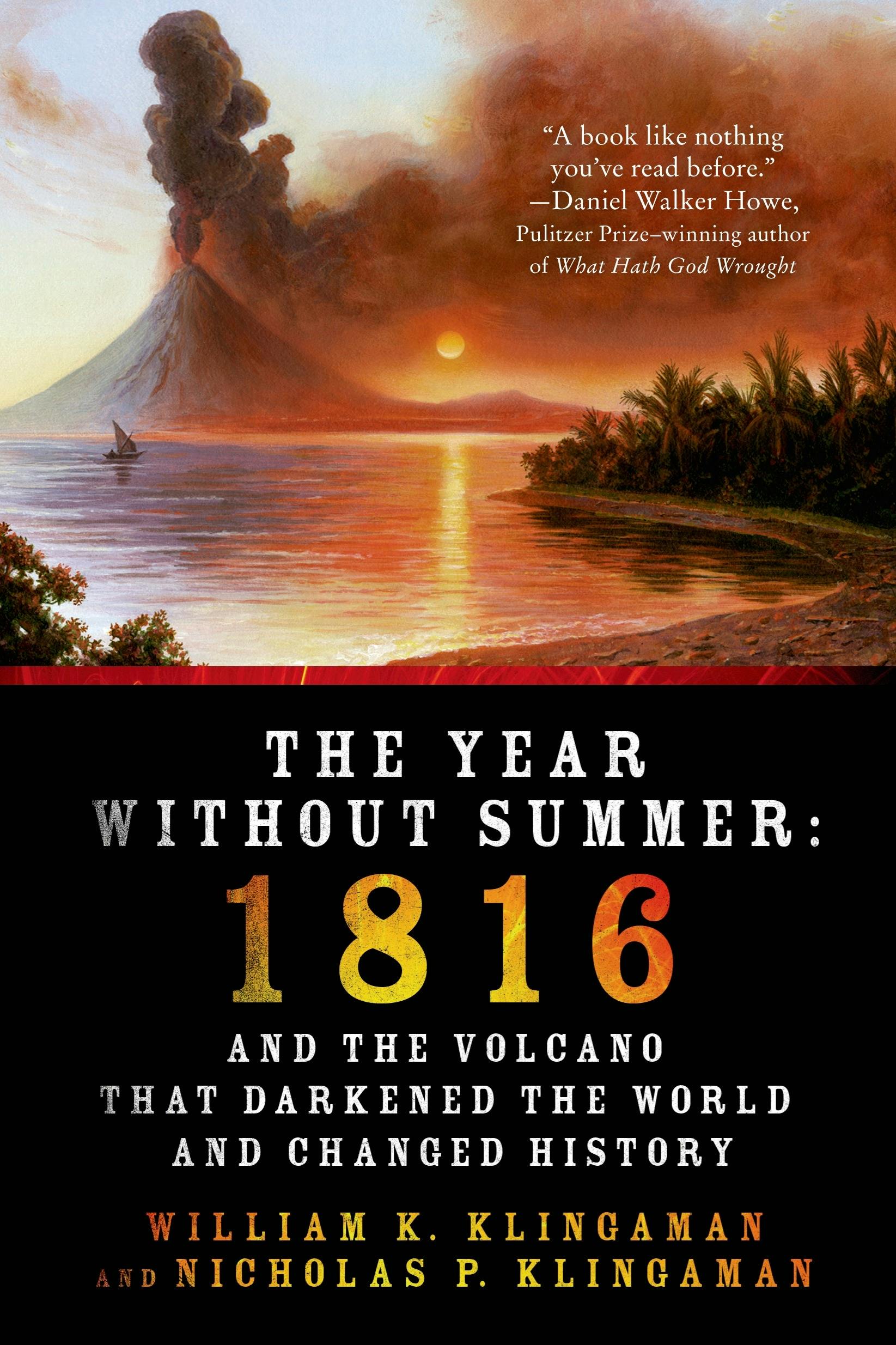
The Year Without Summer: 1816 and the Volcano That
Darkened the World and Changed History
By William K. Klingaman and Nicholas P. Klingaman
St. Martin’s Press, New York, 2013
The Year Without Summer details the impact of the Tambora eruption on the climate, people, economy and politics of the time. However, after the first couple of chapters, I found it pretty disappointing. Much of the book consists of minutely detailed accounts of local daily weather across Europe and the eastern United States in 1816 and ‘17. Since there were no centralized weather databases at the time, the Klingamans must have scoured through hundreds of newspapers, journals, diaries, reports and other sources to amass all this material. A prodigious feat of research! Unfortunately, it didn’t make for very interesting reading. I skimmed over a lot of it.
There’s no doubt that in the years immediately after the eruption, Tambora had major impacts all over the world, but I’m not sure how much it really “changed history” as the book’s subtitle claims.
Tambora did cause Earth’s average temperature to drop by about 1ºF. In North America, temperatures fell by about 3ºF. Weather patterns across Europe and the eastern United States were knocked out of kilter. Summer snowstorms and frost destroyed many crops causing widespread food shortages and, in some places, famine.
Crop failures drove up the price of bread causing protests and riots in England and other parts of Europe. This in turn led governments to take repressive measures to quell unrest. Eventually, though, governments had to import food from other less-affected countries.
Crop failures also sparked migration out of areas with marginal farmland like parts of Maine and New England to locations with better prospects such as the newly opened territories of Ohio and Indiana.
Perhaps Tambora’s most lasting effect occurred in Britain, which was simultaneously dealing with high unemployment due to military demobilization following the end of the Napoleonic Wars. In 1817, the government passed the Poor Employment Act which provided loans for projects that would employ large numbers of workers. The Act,
“… provided funds that would be used directly for the relief of unemployment and poverty, and in that sense provided critical momentum to the notion that the government bore a responsibility to improve the life of the ordinary British citizen.” [p. 253]
Or maybe Tambora’s biggest impact was cultural: Mary Shelley, holed up in a villa in Switzerland, passed the cold and stormy season writing Frankenstein.
If you can wade through all the weather reports, The Year Without Summer also describes what life was like back in the early 1800’s. America was overwhelmingly agrarian: about 90% of people earned their living off the land. Urbanization and industrialization were a bit farther ahead in parts of Europe, but even there 60-75% of people worked in agriculture.
The book is exclusively focused on Europe and the eastern United States. In an epilogue, the authors gloss over India and China in about a page and a half, claiming a lack of detailed records. This feels like a lame excuse to me. I wonder if the information just wasn’t available in English. Not that I needed more weather reports, mind you.
Unsolicited Feedback
For me, the most important thing about The Year Without Summer is something the book does not discuss at all: the lessons Tambora can teach us about the effects of climate change happening right now.
We have a hard time thinking about climate change because it occurs so slowly. The changes are only perceptible on a scale of decades. But if we look at Tambora as a climate event as well as a volcanic event, we get a snapshot of how climate change might affect us. Now, Tambora cooled the Earth for a couple of years and we’re warming it for centuries, but we’re already starting to see similar effects: disrupted and unpredictable weather patterns, crop failures, large scale migrations, social unrest and government repression, even the emergence of cultural phenomena like cli-fi literature.
Mount Tambora’s climate shock gives us a preview of what could happen, what’s already happening, in our own time.
Thanks for reading.
And thanks to Katherine @ Simple Tricks and Nonsense for recommending this book.
If you enjoyed this review, please subscribe to Unsolicited Feedback.
Discover more from Unsolicited Feedback
Subscribe to get the latest posts sent to your email.


 Unsolicited Feedback
Pingback: Nonfiction November 2024 Week 5: New to My TBR | Unsolicited Feedback
Sounds like this book did not live up to the title?
Anne
Sent from my iPhone
LikeLike
Not to me anyway. Unfortunately, it’s one of those books that would have been better if it was shorter.
LikeLike
This was my thought too: “For me, the most important thing about The Year Without Summer is something the book does not discuss at all: the lessons Tambora can teach us about the effects of climate change happening right now.” And how have I not heard about Tambora before? It seems like something that should be in my mental archives.
LikeLiked by 1 person
Well, it’s not exactly a household name. 🙂
LikeLike
Too bad this wasn’t more interesting! The title and subtitle definitely caught my eye.
LikeLiked by 1 person
Pingback: The Fifth Season | Unsolicited Feedback
Pingback: Nonfiction November 2025 Week 3: Book Pairings | Unsolicited Feedback