I’m a strong advocate for science, for the scientific method and for all the benefits science has brought humanity over the last few hundred years. But I also have to admit that science has its problems and its limits. There are other types of knowledge and other ways of understanding the world. Maybe we and our planet would be better off if we gave some consideration and some respect to these other approaches.
Medicine Wheel for the Planet: A Journey Towards Personal and Ecological Healing is the first book I’ve ever read about Indigenous knowledge. It’s written by Jennifer Grenz, an Indigenous ecologist from the Nlaka’pamux First Nation of British Columbia, Canada. Grenz tells the deeply personal story of her struggle to reconcile her Indigenous ancestry and knowledge with her Western scientific training, and to get her ideas accepted by government bureaucrats and academic colleagues. The book is equal parts autobiography and ecology organized as a journey around the four directions of a Native American medicine wheel.
Grenz is an assistant professor in the Faculty of Forestry and the Faculty of Land and Food Systems at the University of British Columbia. She holds a PhD in Integrated Studies in Land and Food Systems from UBC.
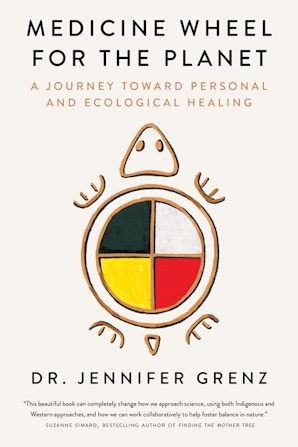
Medicine Wheel for the Planet:
A Journey Towards Personal and Ecological Healing
By Jennifer Grenz
University of Minnesota Press, Minneapolis, 2024
Out of Eden
Grenz specializes in the management of invasive species, where “management” typically means “removal.” But she has become frustrated with this work, partly because it’s largely futile, and partly because it conflicts with her growing understanding of the worldview of her Indigenous ancestors.
Removal of invasive species, and ecosystem restoration more generally, means “putting something back to the way it was.” It’s an attempt to return to some idealized state, a perfect past. Grenz calls this “Eden ecology” and she calls out the colonial and Biblical perspective it imposes on the natural world. Eden ecology ignores the dynamic nature of ecologies. After all, who’s to say which species are “invasive”? How long does a species have to be present in order to be considered “native”? Plus, climate change is causing many species all over the world to migrate to higher latitudes and higher altitudes. Should we consider these climate refugees to be invasive too?
Even worse, Grenz points out, Eden ecology ignores and denies the presence, the work, and the impact of Indigenous people on the land for thousands of years. It is yet another example of Indigenous erasure.
When you think about it, you quickly realize there’s no going back. The genie is out of the bottle. The damage has been done. Rather than attempting to return to some previous context that no longer exists, it’s better, Grenz argues, to ask ourselves and to ask nature, what do we need? How can we establish a new, healthier balance that meets our present and future needs?
I think this applies to climate change too. Even if we reach net zero carbon emissions a couple of decades from now, and even if we then draw down the carbon we’re already dumped into the atmosphere, Earth’s climate won’t return to some pre-industrial state. Tragically, neither the Amazon rainforest nor the Great Barrier Reef will magically be restored to their former glory. What we should be aiming for is a new equilibrium where we can live and flourish in a sustainable balance with the environment.
Grenz ends up planting some invasive species in her own garden, to harvest for food and medicine, to attract pollinators to her orchard, to attract Monarch butterflies because they’re endangered. She feels gratitude to the weeds, her former enemies, even the Himalayan blackberries.
An Indigenous Worldview
Medicine Wheel for the Planet presents a of view of knowledge and research that’s very different from the Western scientific method I’m familiar with. Western science is fundamentally reductionist. It breaks everything down into smaller and smaller pieces. We seek explanations about ecology by looking at biology, and then at chemistry, and then at physics. From forests to quarks. It’s a powerful approach, but it makes it more difficult to understand the relationships within and between complex systems.
And, as Grenz points out, Western science is protected by an entrenched culture that claims both objectivity and universality. It’s a culture that rejects and often denigrates other forms of knowledge, other ways of knowing the world.
What then is the Indigenous worldview? To start with, there isn’t just one. Grenz repeatedly used the word “knowledges” – plural – to describe Indigenous ways of understanding the world. She gives us her own perspective which is deeply rooted in the shared knowledge and culture of her people and the Elders she has learned from. She makes no claims for universality. After reading Medicine Wheel for the Planet, it now seems to me that the very idea of universality is a Western scientific and religious construct that often gets in the way of understanding.
Grenz uses a UNESCO definition of Indigenous knowledge:
“Indigenous knowledge is the local knowledge that is unique to a culture or society. [It] encompass[es] sophisticated arrays of information, understandings and interpretations that guide human societies around the globe in their innumerable interactions with the natural milieu: in agriculture and animal husbandry; hunting, fishing and gathering; struggles against disease and injury; naming and explanation of natural phenomena; and strategies to cope with fluctuating environments.” [p. 89]
What strikes me about this definition is that it’s highly localized and rooted in a particular society and that it’s fluid and adaptive to changing conditions.
She goes on to define Indigenous ecology as:
“Relationally guided healing of our lands, waters and relations through intentional shaping of ecosystems by humans to bring a desired balance that meets the fluid needs of communities while respecting and honoring our mutual dependence through reciprocity.” [p. 138]
As I understand it, the word “relations” here is not limited to families and other humans. It extends to animals, trees, plants – to all living things. For Grenz, the key principles of Indigenous ecology are respect, relationality and reciprocity.
This doesn’t mean we should just let invasive species run riot in a particular area or ecosystem. But if we remove something invasive like Himalayan blackberries that birds and pollinators have come to depend on, then we have a responsibility to replace them with something else that provides similar benefits.
Grenz argues, I think convincingly, that Indigenous and Western knowledges can co-exist and complement each other. To bridge between Western and Indigenous worldviews, she proposes adopting some new vocabulary. For example, instead of ecological restoration, she suggests healing. The scientists, volunteers and government employees who do this work are healers and balancers.
One thing is for sure, the way we do ecological restoration now doesn’t work.
“The whole system of attempting to do ecological restoration with government agencies dooms us to fail. The money will run out; the budgets for environmental projects will be the first to be cut; the volunteers will burn out. Deliverables for funding always have to be sexy – but long-term care isn’t sexy. The work of relationships isn’t sexy.” [p. 213]
Grenz suggests we need a different approach, one that deeply connects people with their local environments over the long term, one that doesn’t depend on government budgets or the shifting political priorities of elected officials. It’s an approach that would get more people, ideally all of us, more deeply connected to and involved with the natural world.
As her journey around the medicine wheel comes full circle, we learn as Grenz herself learns, that maybe the most important aspect of Indigenous ecological research is listening. Listening to the trees, the plants, and the animals to understand how they relate to each other and what they need. Listening to the stories of Elders and knowledge-keepers to understand how Indigenous peoples lived and helped keep their world in balance in the past. Going forward, we need to create new stories of our own so we can teach ourselves and our children how to do those things too.
In this way, Grenz suggests, restoring becomes re-storying.
Unsolicited Feedback
Medicine Wheel for the Planet is the eloquently-told story of Jennifer Grenz’s personal and professional journey. While it’s mostly about ecology, there is unavoidable history too. She tells us about the horrific treatment her Indigenous ancestors suffered at the hands of European settlers and the terrible legacy of genocide and discrimination that persists to this day. The environment has suffered too, as Indigenous healers and balancers were driven off the lands they once took care of.
This book is aimed squarely at “settler” people like me. I won’t claim that reading this one book has given me a clear understanding of Indigenous ways of understanding the world. That would be absurd. But I learned a lot from Medicine Wheel for the Planet. It’s a start.
Thanks for reading.
And thanks to Linda @ Shoe’s Seeds and Stories for recommending this book
If you enjoyed this review, please subscribe to Unsolicited Feedback.
Related Links
Douglas Nakashima et al. “Tapping into the World’s Wisdom.” UNESCO Sources, No. 125, July-August 2000, pp. 11-12, https://unesdoc.unesco.org/ark:/48223/pf0000120208.
Discover more from Unsolicited Feedback
Subscribe to get the latest posts sent to your email.


 Unsolicited Feedback
Pingback: Nonfiction November 2024 Week 5: New to My TBR | Unsolicited Feedback
Thanks so much for highlighting this book, my top nonfiction pick of the year. It’s an excellent review–you included so many important points!
LikeLiked by 1 person
Thanks Linda. And thanks again for recommending the book.
LikeLiked by 1 person
Pingback: Nonfiction November 2025 Week 2: Choosing Nonfiction | Unsolicited Feedback
Pingback: In the Spirit of Right and Respectful Relations | Unsolicited Feedback