It’s no secret that American society is deeply polarized. It’s got to the point where constructive debate on most issues is almost impossible especially on social media. Is there any way to fix this? Or at least tone down the animosity? What about the widespread epidemic of loneliness in the country? How do we address that? And will we ever recover from the disconnection and isolation brought on by the COVID-19 pandemic?
Scott Shigeoka thinks curiosity might be a big part of the answer. His book SEEK: How Curiosity Can Transform Your Life and Change the World is about how to develop the habits of effective curiosity. The main idea of the book is that, used properly, curiosity can lead to greater connection and transformation. The core of the book is about his four-step “DIVE” method for doing this.
Shigeoka is the Bridging Differences fellow for the Greater Good Science Center at the University of California, Berkeley. He’s taught at the University of Texas at Austin and his work has appeared in Harvard Business Review, The Guardian, NPR and MSNBC.
And in case you’re wondering, I have no idea why he put the title of his book in all-caps, but he did, so I’m just following along.
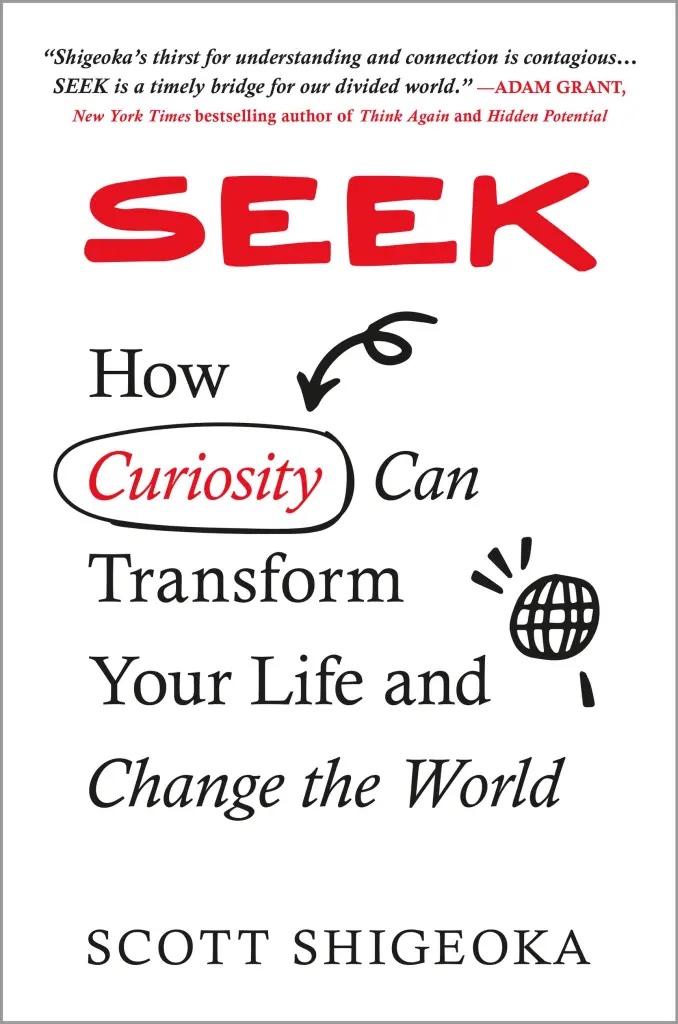
SEEK: How Curiosity Can Transform Your Life
and Change the World
By Scott Shigeoka
Balance, New York, 2023
Deep curiosity
At one level, curiosity isn’t something we have to learn or practice. Shigeoka cites research showing that curiosity is hard-wired into the reward centers of our brain. It’s a fundamental drive like hunger and sex. We get a little dopamine hit whenever we’re in a state of curiosity. You’ve probably experienced this yourself: a thrill when you learn something new. This makes intuitive sense. After all, for our prehistoric ancestors, curiosity would have been a driver to explore the surrounding terrain, find shelter, edible plants, likely hiding spots for predators, etc. In other words, curiosity helps us survive. Shigeoka calls this shallow curiosity.
SEEK is mainly about deep curiosity, “… a search for understanding that leads to connection and transformation.” [p. 39] Deep curiosity is about more than mere survival. It’s about thriving and living fully. Deep curiosity has three directions according to Shigeoka: inward, directed towards the self; outward, directed towards the world and others; and beyond, directed to philosophy, religion and transcendence. SEEK focuses mostly on outward curiosity towards others, and somewhat on inward curiosity towards yourself.
A dive into DIVE
Shigeoka calls his approach to deep curiosity the DIVE model. DIVE stands for Detach, Intend, Value, Embrace. (Which came first, the chicken or the acronym?)
Detach: The first step is to detach from your “ABC’s,” your assumptions, biases, and certainties. Before we can get truly curious, Shigeoka says we need to recognize and test our assumptions – those beliefs we hold to be true without proof. He recommends asking questions to gather evidence that either backs up or disproves our assumptions. Also, avoid generalizing from individuals to whole groups. Just because a few supporters of a visiting football team were loud and obnoxious at your local sports bar doesn’t mean they all are. On this point, I’ve always liked the quote from Oliver Wendell Holmes, Jr.:
“No generalization is worth a damn, including this one.”
We also need to let go of our biases. Shigeoka says biases are collections of assumptions that influence how we behave towards each other. I think of it like this:
Biases = assumptions + value judgements
Here too, he suggests asking questions, this time to individuate people from their groups. Ask people what they like to eat or how they spend their holidays or any other topic that’s unrelated to their political views, for example. Get to know them as individual human beings.
Shigeoka argues that certainty kills curiosity. After all, if you’re certain about something, if you think you already have the answer, why be curious? Why risk learning something that might challenge or even contradict your view? But that’s exactly what we need to do. Uncertainty, he says, is the birthplace of change and growth. Shigeoka urges us to adopt “intellectual humility,” to prioritize learning and growth over being right. It’s as simple as asking, “tell me more.”
Our assumptions, biases and certainties form our mental representation of the world. They’re shortcuts to faster decision-making, like identifying a friend or foe. Shigeoka seems to be advocating for something like “strong opinions, loosely held,” a principle from Amazon founder Jeff Bezos. In other words, it’s OK to have opinions but be prepared to admit you’re wrong, especially when you’re presented with new data.
Intend: Conversations involving deep curiosity require some preparation, some intention. Basically, Shigeoka advises preparing a list of open-ended questions that are appropriate for the stage of your relationship with the other person. Also, set commitments or ground rules with them for how you’ll conduct your curious conversation.
Value: This step is about seeing the inherent dignity, humanity and worth of all humans, including ourselves. Dehumanizing others puts an end to curiosity and replaces it with prejudice and stereotyping. We should start by valuing ourselves. Shigeoka says,
“No matter who you are, you deserve dignity, respect, curiosity from others and curiosity from yourself – you deserve to be valued. Your stories, experiences, perspectives, and journey are all important.” [p., 144]
He has some advice here for dealing with your inner critic through inward curiosity. Then, move to valuing others despite their views, political or otherwise. Valuing doesn’t mean agreeing, he says, but you may find your perspective changing.
Embrace: The last step of the DIVE model is to embrace: embrace the hard times we’re experiencing, the painful times. Pain cuts us off from curiosity, Shigeoka says, so we should try to cultivate the courage to be curious about what we’re going through and how we’re feeling about it. He suggests some mindfulness exercises and movement to stay centered in our bodies. I found this step less clear than the others. First, I don’t really know what “embrace” means in this context. I assume it means something like “accept” but Shigeoka doesn’t define it. He also talks about getting “grounded” and “centered.” Maybe I’m too literal-minded, but these are vague terms for me, and I have no idea what they’re supposed to mean in any concrete way.
I think the DIVE model boils down to something very simple: ask questions. Ask them carefully, respectfully, with forethought and without pre-conceptions.
Two-way curiosity?
I give Shigeoka full marks for courage. This self-described “city-dwelling liberal Asian American spiritually queer professor” quit his job in San Francisco to drive around the country interviewing conservatives, even attending one of Donald Trump’s MAGA rallies. He learned a lot. He got scared too. But there’s no indication the curiosity went the other way. No one seemed to want to know more about him and his perspectives, or if they did, he didn’t include it in the book.
Similarly, he describes a meeting between “nuns and nones,” a group of Catholic nuns discussing their views with a small group of women who are spiritual seekers not affiliated with any established religion. Here too the curiosity seemed to be all one way with the nones seeking to better understand the nuns. Nothing in the book suggests that the nuns wanted to learn more about the nones.
It’s tempting and comforting to stay inside our own little bubbles, to say “those people are sheep,” or “you can’t fix stupid.” But that just keeps us trapped in our current dysfunctional state. If we want to make things better, somehow we have to step outside our bubbles and talk to each other. So, I’m all for curiosity and seeking to understand others better. But shouldn’t this learning be a two-way effort?
Use responsibly
Shigeoka cautions against what he calls predatory curiosity. This is curiosity that is “… attached to an agenda or judgement – such as trying to change someone’s beliefs or behaviors …” [pp. 44-45] As he puts it:
“… while deep curiosity says I want to understand you, predatory curiosity says I want to change you.” [p. 45]
This is an important and valid warning, but it also brings with it some tension. I think there’s almost always some purpose to our curiosity (to avoid the loaded word “agenda”) otherwise why bother? It could be relatively benign, like trying to get to know someone on a first date. Or maybe you’re trying to understand people on opposite sides of some political issue so that you can learn how to counter their arguments, even if you’re not trying to sway them right now. Still, I agree with Shigeoka when he says,
“Deep curiosity isn’t a superpower for you to use to change others; it’s a path to help you grow into a new version of yourself.” [p. 52]
Unsolicited Feedback
SEEK is mainly aimed at structured conversations or at least pre-arranged ones, where there’s some lead time for preparation. In this way, it shares some common ground with the 2012 book Crucial Conversations by Kerry Patterson and colleagues, and it reminds me of the idea of “rumbling with vulnerability” from Brené Brown’s Dare to Lead.
Still, I think many of the ideas in SEEK apply equally well to unplanned or spontaneous occasions for curiosity, although the book doesn’t focus on them. When preparation isn’t possible – like when you strike up a conversation with someone at a party or on a plane – then I think you probably need to be especially mindful of the direction and content of the questions you’re asking. It’s rare that impromptu conversations with strangers lead to moments of deep curiosity, but when it happens it can be very rewarding.
I didn’t need much convincing about the power of curiosity. Curiosity is one of my core personal values. It’s how I learn and why I read so much. But I admit to living inside my own little bubble, just like anyone else. SEEK poses a challenge: it says going out and meeting actual real people, especially people you might disagree with, talking to them, connecting with them, is an important element of curiosity too, and maybe a more constructive one. It’s something I should do more of. Maybe something many of us should do more of.
Thanks to Lisa @ Lisa Notes for recommending this book.
And thanks for reading.
If you enjoyed this review, and are curious to read more, please subscribe to Unsolicited Feedback.
Discover more from Unsolicited Feedback
Subscribe to get the latest posts sent to your email.


 Unsolicited Feedback
The point you make under “Two-way curiosity?” was the first that came to my mind as I read your description about this book. That is, it often seems like only one ‘side’ is curious, and how can a book or ideas like this actually reach and influence the other ‘side’. For example, I’ve read a few books about left-wing folks visiting, learning about, and engaging with right-wing communities in a sincere attempt to understand. Perhaps there are books or experiences that go in the other direction and I’ve just not come across them because that’s not a perspective I look for (ie right wing trying to sincerely understand left wing), but I’m not sure… definitely a topic with lots to think about.
LikeLiked by 1 person
Yes! This is exactly the concern I have too.
LikeLiked by 1 person
Such a great review! I’m glad you were able to get this one. I got a lot from it. I didn’t remember what all the acronyms were for, but I hope that the heart of the message sticks with me for quite awhile. Curiosity is a great core value to have!
And I agree with you and the commenter: ideally curiosity should go both ways. I don’t always see that happening either, but I wish it would. Maybe I just haven’t looked in the right places yet…
LikeLiked by 1 person
Thanks again for recommending this one.
LikeLike