I don’t make New Year’s resolutions. In fact, I resolve not to resolve. Even so, at this time of year it’s natural to reflect a bit, to think about how our lives are going and what we might want to accomplish in the coming year. It’s also a good time to remember that we are finite human beings with limited time and limited control over the time we have. So whatever your goals, be they large or small, the time to work on them is right now.
That’s the key message of Oliver Burkeman’s latest book Meditations for Mortals: Four Weeks to Embrace Your Limitations and Make Time for What Counts. The book is a guide to what Burkeman calls “imperfectionism:” leading a meaningful and fulfilling life right now with full acceptance of our limitations.
“… one main tenet of imperfectionism is that the day is never coming when all the other stuff will be ‘out of the way’ so you can turn at last to building a life of meaning and accomplishment that hums with vitality. For finite humans, the time for that has to be now.” [p. xvi]
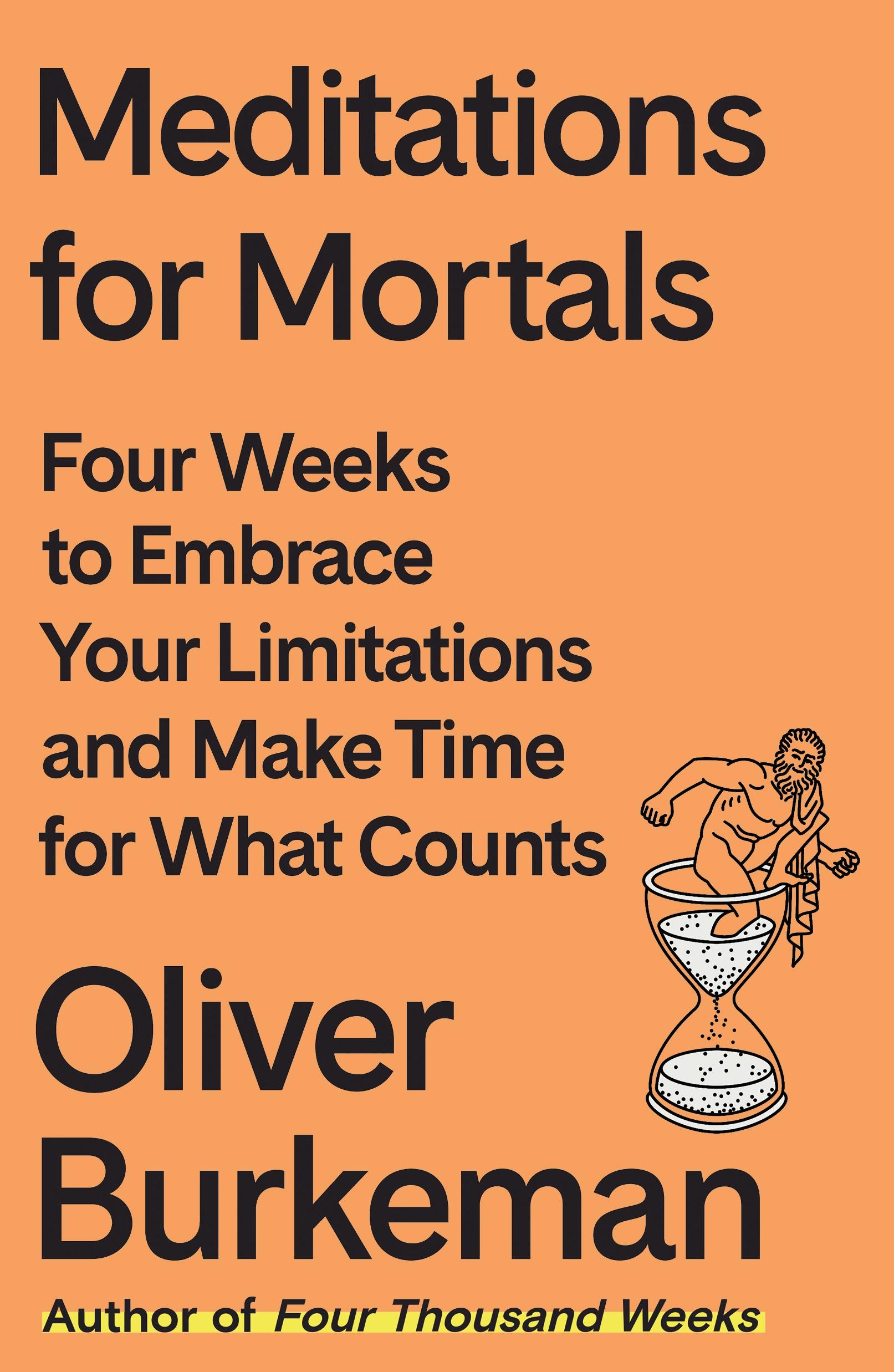
Meditations for Mortals:
Four Weeks to Embrace Your Limitations and Make Time for What Counts
By Oliver Burkeman
Farrar, Straus and Giroux, New York, 2024
Meditations for Mortals consists of 28 short chapters arranged into four weeklong themes. The theme of Week 1 is accepting that we’re finite with limited time and limited control. Rather than becoming demoralized about this, Burkeman encourages us to feel liberated. Once you are freed from striving for the impossible – responding to every email, reading every book, pleasing everyone, whatever – you’re now free to devote your energies to the things that really matter. You can stop trying to justify your existence by overachieving. You don’t need to justify your existence at all.
We’re not alone in this either. Burkeman points out that none of us is in control. We’re all paddling through the rapids of life as best we can in our own little kayaks. No one is piloting radar-equipped super-yachts that can see the hidden obstacles ahead or power through heavy currents.
Week 2 is about taking action. Now. It’s about building the habits of action and completion, even if it’s only small tasks. Burkeman provides helpful tricks and hacks to get into the habit of acting and not waiting for some perfect time in the future when the decks are cleared. Because they will never be cleared.
Yet Burkeman recognizes no one can perform at their peak all the time. He suggests limiting intense, creative work to no more than 3-4 hours per day. Find the time of day when you’re at your peak – for me it’s the morning – and ringfence that time as best you can, reserving it for the meaningful work you want to do. Similarly, while it’s important to have daily routines, they should serve you, not the other way around. Burkeman says to make your routines “dailyish.” That way you can relax about skipping them occasionally.
In Week 3 the theme is letting go of control, control of events, of others, even of yourself. It’s OK not to be completely disciplined every day. Rather than berating ourselves, Burkeman suggests using the “reverse golden rule:” don’t treat yourself in “punishing and poisonous ways in which you would never dream of treating someone else.” [p. 91]
Still, Burkeman acknowledges that it’s an immense privilege to spend the day doing what you feel like doing.
“… almost everyone’s situation will impose certain limits on their freedom to follow their desires, and it’s much worse for some than for others.” [p. 90]
But he urges us to take advantage of what freedom we do have
And when things don’t go according to your carefully laid plans – your flight gets delayed, you get interrupted – don’t freak out. Instead, embrace the unpredictability. The result, Burkeman suggests will either be a good time, or a good story.
Finally, in Week 4 the focus in on showing up. This is it! This is your real life. Don’t wait for it to start at some vague future time once you’ve figured everything out. You might never be able to completely figure out what’s happening to you or around you, but that shouldn’t stop you from acting. Take the next step, even if it’s just a little one. Take it now.
Burkeman reminds us that everything ever done was done by people just as flawed and just as finite as you.
“You might easily never have been born, but fate granted you the opportunity to get stuck into the mess you see around you, whatever it is. You are here. This is it. You don’t much matter – yet you matter as much as anyone ever did. The river of time flows inexorably on; amazingly, confoundingly, marvelously, we get the brief chance to go kayaking in it.” [p. 158]
Oliver Burkeman is the author of the fabulous 2021 book Four Thousand Weeks: Time Management for Mortals. Meditations for Mortals contains many of the ideas in Four Thousand Weeks but I found there was enough new material to make it worthwhile – or maybe I just needed another chance to get the ideas through my think skull. Meditations for Mortals seemed to have more practical tips and tools than Four Thousand Weeks though neither of them are traditional time management or productivity books. I also appreciated the emphasis on self-compassion in Meditations for Mortals. Accept your finitude, Burkeman says, and find ways to take little steps forward … dailyish.
Burkeman suggests reading the book over four weeks, one meditation per day. Of course, I didn’t do that, but I think I’ll re-read it that way starting in January. It’s good to be reminded that by accepting our limitations we can be liberated from “the unwinnable struggle to do everything,” freeing ourselves to act even in small steps towards our goals, towards living a meaningful life, whatever we define that to be, however imperfect we may be.
As always, thanks for reading.
And congratulations on making it through 2024. This was a tough year for many and it feels like next year won’t be any easier. Best wishes to you and your family for a happy, healthy and peaceful 2025.
If you enjoyed this post, please subscribe to Unsolicited Feedback.
Related Links
Burned Out? Start Here
Interview with Oliver Burkeman on The Ezra Klein Show podcast, Jan. 7, 2025.
Discover more from Unsolicited Feedback
Subscribe to get the latest posts sent to your email.


 Unsolicited Feedback
Hmm, I’ve been wondering whether I should pick this up as I read Four Thousand Weeks a couple years ago but can’t really recall what I thought of it haha. I’ll keep an eye out for this one.
LikeLiked by 1 person
I thought about getting this book to read through daily in 2024, but then it looked like too much recommended reading per day. But duh, I don’t have to read it as suggested. ha. So I may still get it. I really found Four Thousand Weeks to be profoundly insightful, so I’m guessing I would also benefit from reading this one, too. I still struggle with trying to get too much done in a single day (and failing). Thanks for your thoughtful reviews, as always!
LikeLiked by 1 person
Thanks, Lisa. Each daily meditation is only 4-5 pages so if you do decide to read it daily it shouldn’t add too much to your load
LikeLike