Timothy Snyder’s latest book, On Freedom, opens in a devastated village in southern Ukraine. Ukrainian forces drove Russian invaders out of the area in late 2022. Now the villagers are trying to put their lives back together amid the ruins. But when Snyder interviews them in September 2023, they don’t say they’ve been freed or liberated. Instead, they say they’ve been de-occupied.
Snyder highlights this new word to illustrate the main point of his book: the difference between negative and positive freedom. Negative freedom, or freedom from, means the absence of barriers and constraints. It’s freedom from oppression, from a foreign occupier, from the government or from annoying bureaucratic rules and stifling social conventions. Snyder says freedom from is how Americans usually think about freedom.
But negative freedom isn’t enough. What we really need, Snyder argues, is positive freedom, freedom to, or freedom for. In the Ukrainian village, the invaders are gone and people are free to go about their lives again. But are they really free? They don’t think so. How can they be free when their loved ones have been killed, injured or kidnapped, when their homes and places of work have been destroyed, when the infrastructure they depend on – roads, electricity, running water – is in ruins? What they need, what we all need, Snyder argues, is the freedom to make our own choices and to realize those choices in the world. Positive freedom is “life expanding and growing.” Positive freedom is flourishing.
“We tend to think of freedom just as freedom from, as negative. But conceiving of freedom as an escape or an evasion does not tell us what freedom is nor how it would be brought into the world. Freedom to, positive freedom, involves thinking about who we want to become. What do we value? How do we realize our values in the world? If we don’t think of freedom as positive, we won’t even get freedom in the negative sense, since we will be unable to tell what is in fact a barrier, how barriers can be taken in hand and become tools, and how tools extend our freedom.” [p. 31]
Snyder says there are five forms of positive freedom: sovereignty, unpredictability, mobility, factuality and solidarity. On Freedom is a deep exploration into each of these five forms. One surprising theme emerges early and often: freedom is not something that individuals achieve alone. Freedom is a collective project.
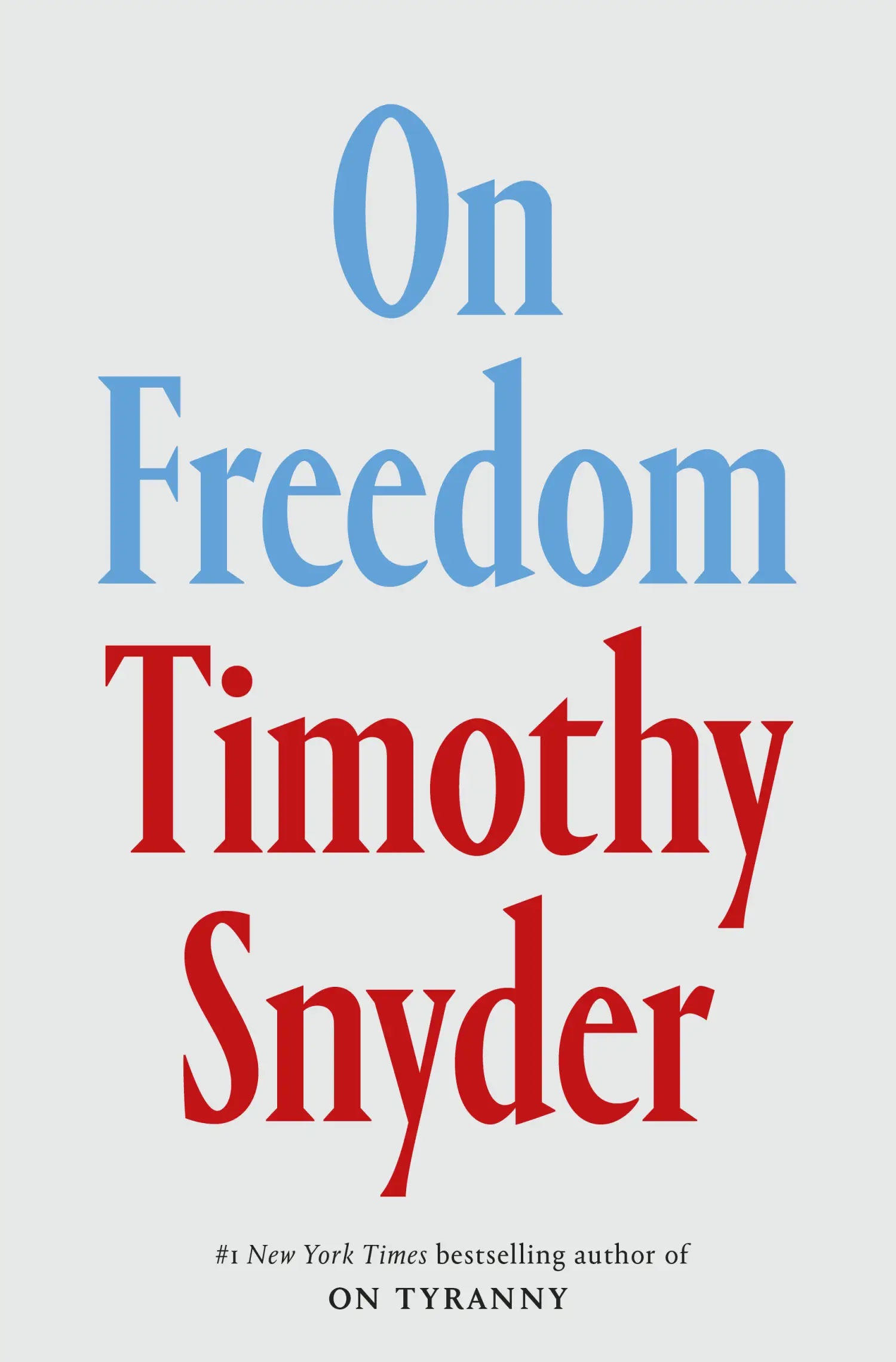
On Freedom
By Timothy Snyder
Crown, New York, 2024
Timothy Snyder is the Levin Professor of History at Yale University. He’s written more than a dozen books, mainly about the history of central and eastern Europe particularly Poland, Ukraine and Russia. I’ve read and reviewed two of his recent books, On Tyranny and The Road to Unfreedom.
Sovereignty
Snyder’s first form of freedom is sovereignty. This term is usually applied to governments. It refers to a government’s ability to act as the sole dominating power within a given territory. But Snyder applies it to individuals.
“A sovereign person knows themselves and the world sufficiently to make judgements about values and to realize those judgements.” [p. 21]
In the Biblical story, the Samaritan was a sovereign person. He defied the conventions of his time, acted on his own values and was able to realize them in the world.
“To be sovereign means to have a sense of what ought to be and how to get there.” [p. 28]
But how do we get the knowledge of ourselves and the world that we need to be sovereign? By understanding others. Snyder gives a simple example. When we see our child getting irritable because they’re tired or hungry, we realize that we too get irritable when we’re tired or hungry. We gain knowledge of ourselves by interacting with others. Even the capacity to think requires this interaction. There’s plenty of evidence showing that a baby’s brain needs deep interaction with other people in order to fully develop. Raising a child, raising a sovereign individual, is therefore a social act, a collective act.
Freedom, in other words, is a social project. And it starts a birth.
Birth, Snyder says, shows the absurdity of negative freedom. A newborn is not going to be free due to the absence of something. It depends on others for warmth, nourishment, shelter, upbringing and love. It needs barriers and boundaries. If we only think about freedom starting as adults, from some point of “magical maturity,” then freedom is about protecting what we already have. But we forget to ask how we got our freedom in the first place. From those who came before us, from those who raised us and created the culture and environment in which we grow up.
Negative freedom is not just a mistake or a misunderstanding, Snyder says, it’s a repressive idea because it separates us. It’s a barrier that blocks us from seeing what we really need to be free. In the extreme case it leads to slavery. The Confederate States justified their rebellion (freedom from the Federal government) on “States rights,” which really meant the right to enslave Blacks. There’s no greater perversion of freedom than using it to justify enslaving others, threating them as property, as objects.
If we see each other as objects, we dehumanize each other. We become more vulnerable to dictators who exploit the barriers between us to expel, imprison, enslave and murder. We must see each other as subjects, not objects, Snyder urges, so that we gain more knowledge about the world and about what we all need to build together to be free.
This is why Snyder vests sovereignty in the individual, starting as infants. Because sovereignty rooted in individuals can help justify legitimate government. Why should newborns be subject to a social contract they never agreed to? How is that freedom? Locating sovereignty in the individual solves this problem. It shows us that together we must create governments that enable freedom, enabling babies to develop and flourish and grow into sovereign people.
Unpredictability
The second form of freedom is unpredictability. Unpredictability, Snyder argues, arises from our values. As sovereign individuals, we make choices based on our beliefs and values. We act within “a realm of good and evil, right and wrong, virtue and vice.” Snyder refers to this realm of values as a “fifth dimension” in addition to the familiar four dimensions of space and time. Values are critical because,
“Without a sense of what should be, we cannot be clear about how what is could ever change.” [p. 65]
Snyder says unpredictability is an inevitable consequence of exercising our sovereignty in the realm of values and realizing those values in the physical world. People working together, making sovereign choices, acting on their values, weighing them against each other, bring unpredictability into the world. When we affirm and balance and compromise among our values, we operate in the “borderland of unpredictability.”
Unpredictability is also how we resist tyranny. Snyder draws on the works of Václav Havel (1936 – 2011), the Czech playwright, dissident and President of the Czech Republic after the fall of the Berlin Wall, and especially his lengthy essay on freedom titled “The Power of the Powerless.” Havel wrote that modern tyranny requires predictability rather than devotion. We are more easily manipulated and dominated when we are predictable.
But life resists. Quoting Havel:
“Life rebels against all uniformity and leveling; its aim is not sameness, but variety, the restlessness of transcendence, the adventure of novelty and rebellion against the status quo.” [p. 68]
Here Snyder delivers an extensive critique of social media, especially the computerized algorithms that drive them.
“Algorithms herd us into categories defined by our least interesting features and distract us from the choices to be made in the physical and social world around us.” [p. 70]
The “dread superpower” of these algorithms is that they predicitify us, they make us “predictable as individuals and classifiable as groups.” They play on our fears and stoke our outrage making us easier to rule.
“When your fears are predictable, then so are you, which means that you (and your digital demographic) are ripe for manipulation. When you are predictable, you predictably bring your country down.” [p. 105]
Mobility
The third form of freedom is mobility which Snyder defines as,
“… capable movement in space and time and among values, an arc of life whose trajectory we choose and alter as we go.” [p. 114]
In other words, mobility in all five dimensions is critical for freedom. This form of freedom also depends on those who came before us, those who built the roads and laid the tracks on which we move, and those who created the institutions and structures that enable mobility.
In the post-war period, Snyder describes how western societies invented a new form of mobility: social mobility. In the US, this became the American Dream, made possible by the GI Bill which paid for college education for returning servicemen, the interstate highway system and the growth of suburbia, and supportive welfare programs. People in a multi-generational project improving their lives, moving from lower to middle and upper classes, building generational wealth. Of course, it was never fully realized: Blacks were excluded.
This period came to a crashing halt with the election of Ronald Reagan. Reagan’s rallying cry, “the government is the problem,” ushered in a pivot to negative freedom, freedom from government. But that meant a reduction in mobility, a reduction in freedom. When your health care is provided by your employer, it’s harder to move jobs. Poverty immobilizes us and makes us more predictable. Snyder points out that one of the most devastating effects of racism is the way it restricts mobility. Before the Civil Rights Act, racism prevented Blacks from riding busses and staying at most hotels, among many other forms of discrimination. Reagan’s war on drugs led to the mass incarceration of Blacks, the ultimate loss of mobility.
Freedom requires mobility in all five dimensions. That’s why dictators always strive to reduce mobility, Snyder explains. They close off the future, the fourth dimension, and replace it with either a single future like the Marxist worker’s paradise, or with no future at all like Putin’s nostalgia for 1945. And they replace all our personal values, the fifth dimension, with just a single value, the purity of the race, for example, or with a denial of values altogether. Snyder sees similar trends in the US. After the collapse of the Soviet Union, we fell prey to the idea that a single future, the worldwide triumph of capitalism, was inevitable. When that failed in the financial crisis of 2008, many abandoned any aspiration for a better future and instead yearned to make America great again. And after the 2024 election, it’s clear that values, especially truth, don’t matter to a majority of the electorate.
Dictators try to trap us in three dimensions and push back the borders of unpredictability to make us less free.
Factuality
When we act in the world, guided by our values, to bring about what ought to be, we must first see clearly what is. To do that, we need the fourth form of freedom, factuality. Truth, Snyder says, isn’t some anachronistic virtue or eccentric habit, it’s a necessity and a source of freedom.
“When we are open to facts, they help us to be unpredictable and therefore free. Facts are not what we expect or want. They do not fit our prejudices but knock holes in them. They challenge what people around us think. Facts temper our minds to resist the power of the machine to predictify us.” [p. 175]
Factuality starts with recognizing that the universe has constraints that we cannot escape, cannot sweep away. Negative freedom won’t save us from climate change.
“We will not be free, nor will we survive, if we ignore the limits of our Earth or deny the rules of our universe. Freedom and survival depend on recognizing constraints and turning them to our favor.” [p. 166]
We need factuality to build a shared sense of reality. Values vary from one person to another, as they should, but to build the structures and institutions we all need in order to flourish, we need the common ground of factuality.
“If we have different values, we will nevertheless sometimes have a shared interest in action. But if we have different facts, concord is impossible. We can disagree about how best to get clean water. But if we disagree as to whether lead is poisonous, we won’t get far.” [p. 175]
For this reason, Snyder laments the decline of local news reporting. He says that when local factuality disappears it makes us more susceptible to tyrants and the big lies they tell. And we can’t rely on the internet for news either. “The internet cannot report, it can only repeat.” Eventually it doesn’t even repeat, it just (algorithmically) tells us what we want to hear.
But reporting the truth is risky. It invites criticism and hatred. In many places it can get you killed. That’s why it’s so important to protect journalists.
“Freedom of speech requires free human speakers, as free as possible and as many as possible. Such people are sovereign, capable of judgement on their own; they are mobile, able to see and take risks; they are unpredictable, and so they can accept that facts beliefs. They are facing danger for the rest of us and helping us to see the state of the world.” [pp. 189-90]
Snyder cautions against putting too much emphasis on “free speech” because free speech requires people to speak freely. Speech cannot be oppressed or liberated, only people can be. Free speech requires real human people to take the risks of speaking freely.
Solidarity
Snyder’s last form of freedom is solidarity. It’s the understanding that our freedom depends on others and that as a result we must work to ensure others’ freedom.
“Solidarity closes a circle. None of the things that we need to become free, including knowledge, can we produce by ourselves. The most fundamental truths, the ones about ourselves that allow us to see the world, we must owe to others … If freedom is the value of life, one of its forms is the self-conscious labor of making freedom possible for others.” [p. 195-6]
Snyder calls freedom the “value of values.” Without it, no other values are possible. It takes effort so see the world as it is and to work with others to realize our values in the world.
“The space between what is and what ought to be is where we roam as free people, extending the borderland of the unpredictable. We decide what values to affirm, in what combination, for what reasons, and at what time. Then we try again. With practice, we attain our own human form of grace.” [p. 231]
Unsolicited Feedback
You can read Timothy Snyder’s previous two books, On Tyranny and The Road to Unfreedom, in one sitting. It took me a while to get through On Freedom. It’s not because it drags or is badly written. On the contrary. But this book is densely packed with ideas from history, politics, philosophy and Snyder’s autobiography that challenge conventional thinking. I’ve just scratched the surface in this review.
On Freedom is also a timely warning. Snyder explains patterns of behavior we’ve seen from dictators is other countries and are now starting to see here in the US. We’ve just elected a lying, autocrat-loving, convicted criminal as President. We’ve placed our own freedom, in all its forms, at terrible risk.
On Freedom isn’t a playbook for defending freedom or fighting tyranny. But it will help you understand better what freedom is for.
It’s an important book, well worth the effort.
This has been a long review. Thanks for reading.
Discover more from Unsolicited Feedback
Subscribe to get the latest posts sent to your email.


 Unsolicited Feedback
Very important ideas, indeed. And we have realized with the latest elections how factuality is so important. One of the reasons a would-be dictator was elected is all the lies he spread and keeps spreading: people are not free to choose a leader who defends the values in which they believe if they keep being lied to about the world in which they live.
Thank you so much for this review!!
LikeLiked by 2 people
Pingback: 2024 Reading Wrap-Up | Unsolicited Feedback
Pingback: An Evening with Timothy Snyder | Unsolicited Feedback