
I just got back to the US after several weeks holiday overseas. When I left home in June, the United States was a country where no person was above the law, at least in theory. When I returned, that was no longer true thanks to the United States Supreme Court’s opinion in Trump v. United States, the Trump immunity case.
The opinion, released on Monday, July 1, 2024, is a disgusting betrayal of bedrock principles on which this country was founded. It gives Donald Trump everything he asked for and more. It’s a massive power grab by the Court at the expense of the American people and their elected representatives in Congress. It’s also a nasty piece of gaslighting by John Roberts, the Chief Justice and author of the conservative majority’s 6-3 opinion. It has terrifying implications for the future of American democracy.
Trump’s Immunity Claim
As a quick refresher, this case arose from a federal indictment of Donald Trump on August 1, 2023 on four counts related to his attempts to overturn the 2020 presidential election which he lost. The indictment charged Trump with knowingly spreading false claims of election fraud to get state officials to change electoral votes in his favor, organizing fraudulent slates of electors in seven states, attempting to get the US Department of Justice to conduct sham investigations into election fraud, and attempting to persuade Vice President Pence to use his ceremonial role in certifying the election on January 6, 2021 to fraudulently alter the results.
Trump moved to have these charges dismissed claiming he had absolute immunity from criminal prosecution for any action taken as part of his official duties as President. The case went through several rounds of appeals before ending up at the Supreme Court which took the case in order to determine:
“Whether and if so to what extent does a former President enjoy presidential immunity from criminal prosecution for conduct alleged to involve official acts during his tenure in office.” [Trump v. United States, Opinion of the Court, p. 5]
Layers of Immunity
In its opinion, the Court majority creates a brand new three-tiered hierarchy of Presidential immunity from criminal prosecution.
- Presidents have absolute immunity from criminal prosecution for any exercise of their “core powers.” These are the powers granted exclusively to the President by the Constitution such as command of the US armed forces, the power to grant pardons and the power to appoint and fire government officials. Since the Constitution grants these powers exclusively to the President, the Court says that Congress cannot regulate, and the Courts cannot review, how the President uses them.
- Presidents have presumptive immunity from criminal prosecution for any of their official acts involving the use of non-core powers which are either granted by or shared with Congress. “Presumptive” immunity means there is a burden of proof on the prosecution to show that no immunity exists in a specific case.
- There is no immunity for unofficial acts.
The Court provides no clear guidelines for distinguishing official acts from unofficial acts. Indeed, the Court says that presumptive immunity extends to the “outer perimeter” of the President’s official responsibilities, without defining clearly what that is.
I’ve tried to illustrate all this in the diagram below.
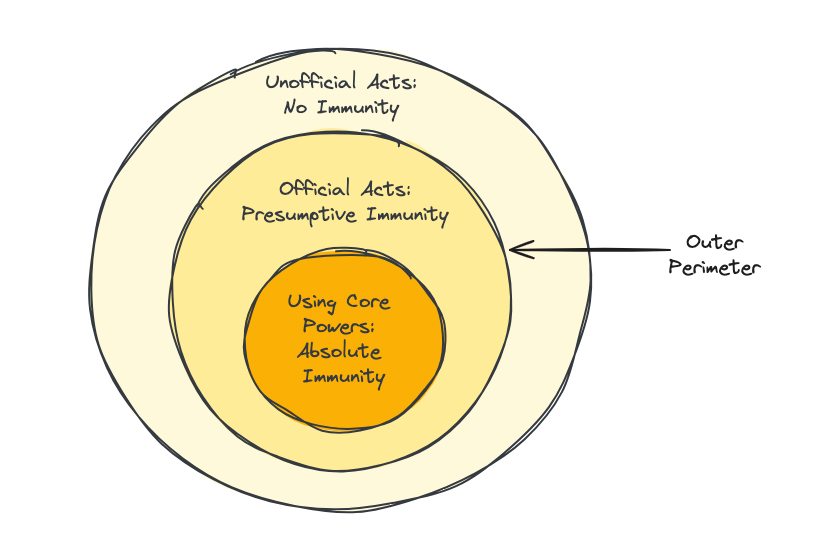
In short, the Supreme Court has carved out huge swathes of presidential action that are either absolutely or presumptively immune from criminal prosecution.
Even in areas where the President has no immunity or where presumptive immunity might be challenged, the Court has made criminal prosecution of the President incredibly difficult. That’s because of three additional directives in the Court’s opinion.
First, there is a high burden of proof on the prosecution for demonstrating that presumptive immunity does not exist for a President’s official actions in a specific case. The prosecution must show that lack of immunity “would pose no dangers of intrusion on the authority and functions of the Executive Branch.” In other words, the prosecution must prove a negative.
Second, Courts may not consider the President’s motives when attempting to determine whether an action was official or unofficial, no matter how blatantly unethical or criminal those motives may be.
Finally, when hearing a case about a President’s unofficial actions, courts may not consider evidence about any official actions that may be related to the case. This was too much for Justice Amy Coney Barrett who joined with the dissenting liberal justices on this one point.
Why?
Why, nearly 250 years after the Nation’s founding, does the Court now think the President needs such broad immunity from criminal prosecution?
The majority has only one explanation, if you can call it that: the country needs a “vigorous” and “energetic” Executive who is not distracted by proceedings (or the threat of them) that might make him “unduly cautious in the discharge of his official duties.”
Apparently, the mere threat of criminal prosecution after they leave office is so unnerving that Presidents might become “enfeebled.”
This is, of course, absurd. For nearly 250 years, Presidents have taken all kinds of dramatic, far-reaching and controversial actions, like dropping nuclear bombs, or firing every air traffic controller in the country, apparently without any undue caution.
More importantly, the real problem, as this case clearly shows, is not that Presidents are too cautious, it’s that they’re too powerful. In fact, for all its recent fixation on “history and tradition,” the Supreme Court ignores a lesson that even the most cursory reading of history reveals: ordinary people have far more to fear from their own governments than from any external power or threat. Constraining the power of government is one of democracy’s most enduring benefits. The Supreme Court has dangerously weakened those constraints in its decision here.
Implications
For the first time in nearly 250 years, the Supreme Court has granted the President broad immunity from criminal prosecution. It’s a betrayal of one of the fundamental founding principles of the country, a principle that goes all the way back to the Magna Carta.
The President is now above the law.
As Justice Sonia Sotomayor says in her fiery dissent:
“The President of the United States is the most powerful person in the country, and possibly the world. When he uses his official powers in any way, under the majority’s reasoning, he now will be insulated from criminal prosecution. Orders the Navy’s Seal Team 6 to assassinate a political rival? Immune. Organizes a military coup to hold onto power? Immune. Takes a bribe in exchange for a pardon? Immune. Immune, immune, immune.
Let the President violate the law, let him exploit the trappings of his office for personal gain, let him use his official power for evil ends. Because if he knew that he may one day face liability for breaking the law, he might not be as bold and fearless as we would like him to be. That is the majority’s message today.
Even if these nightmare scenarios never play out, and I pray they never do, the damage has been done. The relationship between the President and the people he serves has shifted irrevocably. In every use of official power, the President is now a king above the law.” [Sotomayor dissent, pp. 29-30]
Justice Ketanji Brown Jackson wrote a separate dissent which I found very informative even though it has received less attention in the media.
Justice Jackson points out that immunity from a law is different than a defense under a law. There are plenty of situations where a person charged with a crime can produce a defense that might excuse them from punishment. (I was speeding because I had to take my kid to Emergency.) A President can do this too, of course. But immunity means that a President does not even have to produce a defense because they cannot be prosecuted for a crime: the law simply does not apply to them.
Justice Jackson challenges the entire premise of the 3-tiered immunity approach adopted by the majority. She argues that assigning immunity based on the nature of the President’s responsibilities leads to “odd” outcomes. For example, in a footnote she says:
“While the President may have the authority to decide to remove the Attorney General, for example, the question here is whether the President has the option to remove the Attorney General by, say, poisoning him to death. Put another way, the issue here is not whether the President has exclusive removal power, but whether a generally applicable criminal law prohibiting murder can restrict how the President exercises that authority.” [Jackson dissent, footnote p. 10]
This decision is also a massive power grab by the Supreme Court. As Justice Jackson points out, from now on, the Courts will have first say in any attempt to criminally prosecute a former president. The Court has imposed its own “preclearance” requirement: it will first have to rule whether the alleged criminal action was within the President’s core powers, and if not whether the action was official or unofficial.
“Effectively, the Court elbows out of the way both Congress and prosecutorial authorities within the Executive Branch, making itself the indispensable player in all future attempts to hold former Presidents accountable to generally applicable criminal laws.” [Jackson dissent, p. 15]
If you’re frustrated by how long it has taken for this case to get to trial, prepare yourself for even more delays as these preclearance procedures work their way through the Courts before an actual prosecution can get started.
The decision is a huge win for Donald Trump. The case has been sent back to the lower courts to determine whether Trump’s actions were official or unofficial. This will certainly delay prosecution of the case until after the 2024 election. The decision makes it harder to convict Trump, and should he win the 2024 election, it gives him all the latitude he needs to order the Justice Department to drop the case. He won’t even have to pardon himself. He’ll just be immune.
Gaslighting Galore
The American Psychological Association defines “gaslighting” as “manipulat[ing] another person into doubting their perceptions, experiences, or understanding of events.” It’s a form of psychological abuse.
Chief Justice John Roberts’s majority opinion is riddled with gaslighting. He’s gaslighting all of us. It’s infuriating. Here are just two examples. He says:
“This case poses a question of lasting significance: When may a former President be prosecuted for official acts taken during his Presidency? Our Nation has never before needed an answer. But in addressing that question today, unlike the political branches and the public at large, we cannot afford to fixate exclusively, or even primarily, on present exigencies. In a case like this one, focusing on ‘transient results’ may have profound consequences for the separation of powers and for the future of our Republic” [Opinion of the Court, pp. 41-42]
Pure gaslighting. Roberts makes it sound like the circumstance leading up to this case, namely Trump’s attempts to overturn the 2020 election, are not important, and that the public has become too “fixated” on these events. Patting us on our collective heads, he says the Court must focus on longer term issues. But of course, Trump’s threat to our democracy is a long-term issue and granting him and all future presidents immunity from criminal prosecution will have profound consequences for the future of our Republic.
More insulting yet, Roberts concludes his opinion by proclaiming, apparently with a straight face, that “The President is not above the law” while elevating the President to a position that is clearly above the law.
Unsolicited Feedback
If your chain of reasoning leads you to conclude that the President of the United States could order the assassination of a political rival and still have even the slightest chance of immunity from criminal prosecution, then you’ve fucked up.
The United States Supreme Court has fucked up.
Asked what to do about a President who abuses their power, the Supreme Court’s answer is to give the President even more power. Virtually unlimited power.
This decision vastly expands the power of the President and the power of the Courts at the expense of Congress and the American people. It virtually guarantees future Presidents will abuse their power to the detriment of us all.
These idiots haven’t thought it through. Suppose a President became frustrated with a Supreme Court whose rulings thwarted the President’s policy objectives. By the Court’s own logic, the President would be immune from criminal prosecution if they ordered the assassination of a Supreme Court justice to create a vacancy they could fill with an appointee more to their liking. I sincerely hope this never happens.
The Supreme Court is off the rails and in urgent need of dramatic reform. The details deserve careful thought and debate. But there’s an election coming up and I’d like to raise two related points.
- We the people should be demanding a commitment to Supreme Court reform from any candidate for the House or Senate in this election.
- The next President may have the opportunity to appoint three new Supreme Court justices because Clarence Thomas, Samuel Alito and Sonia Sotomayor are all over 70. Do you want Donald Trump making those appointments?
I hope you and your family have a good 4th of July weekend. Unfortunately I’m not sure we can really celebrate our independence from kings this year.
Related Links
United States Supreme Court. Trump v. United States. 1 July 2024, https://www.supremecourt.gov/opinions/23pdf/23-939_e2pg.pdf.
Lithwick, Dahlia and Mark Joseph Stern. “We Have a Theory About Why John Roberts Went Full MAGA This Term.” Slate, 8 July 2024, https://slate.com/news-and-politics/2024/07/supreme-court-term-end-john-roberts-maga.html.
Millhiser, Ian. “The Supreme Court’s disastrous Trump immunity decision, explained.” Vox, 1 July 2024, https://www.vox.com/scotus/358292/supreme-court-trump-immunity-dictatorship.
Shaw, Kate. “The Supreme Court Creates a Lawless Presidency.” The New York Times, 2 July 2024, https://www.nytimes.com/2024/07/02/opinion/supreme-court-immunity-trump.html.
Totenberg, Nina. “Supreme Court granted Trump immunity on election subversion charges.” All Things Considered, NPR, 1 July 2024, https://www.npr.org/2024/07/01/nx-s1-5025238/supreme-court-granted-trump-immunity-on-election-subversion-charges.
Waldman, Michael. “The Supreme Court Gives the President the Power of a King.” Brennan Center for Justice, 1 July 2024, https://www.brennancenter.org/our-work/analysis-opinion/supreme-court-gives-president-power-king
Discover more from Unsolicited Feedback
Subscribe to get the latest posts sent to your email.


 Unsolicited Feedback
Well said! In many ways this is worse than the January 6th attack on our democracy. SCOTUS succeeded.
LikeLiked by 1 person
Yes. They’re helping him get away with it.
LikeLike