
In November 2024, voters in Washington State will cast their ballots on Initiative 2117 which calls for repealing the state’s Climate Commitment Act (CCA). The CCA is one of seven major laws and programs Washington has enacted to fight climate change. To get better informed, I did some research into the CCA – it’s a little complicated – and wrote this explainer to describe it as clearly and factually as I can. I hope you find it helpful especially if you live in Washington like I do. I plan to write a separate article on Initiative 2117 before the election.
A Quick Overview
In 2008, the State of Washington set an ambitious goal to fight climate change by reducing its human-caused greenhouse gas (GHG) emissions to 95% below 1990 levels by 2050. [1] In 1990 the state’s annual GHG emissions stood at 93.5 million metric tons of carbon dioxide equivalent (Mt CO2e).[2] The goal is to bring them down to 5 Mt CO2e by 2050. Statewide emissions peaked at 111.5 Mt CO2e in 1999 and declined slightly to 102.1 Mt CO2e in 2019. Clearly, Washington still has a lot of work to do. (For an explanation of how GHG emissions are measured, see the infographic Measuring Greenhouse Gas Emissions.)
The CCA went into effect on January 1, 2023. It is designed to force the state’s largest producers of GHGs to reduce their emissions, ideally to zero, by making those emissions increasingly expensive. It also provides protection and support for Washington communities most impacted by air pollution and climate change.
To achieve these goals, the CCA does three things:
- It places an upper limit or cap on the total amount of GHG emissions originating in Washington State. The cap will be steadily reduced over time until it reaches 5 Mt CO2e in 2050.
- It requires Washington’s largest GHG emitters, like refineries and utilities, to obtain permits or allowances for the GHGs they emit. Some of these allowances are granted for free, but the majority must be purchased at state-run auctions held every three months. This follows the “polluter pays” principle where those responsible for pollution pay for the harm done to human health and the natural environment. In 2023, the state collected about $1.8-billion in proceeds from allowance auctions.[3]
- The CCA requires the state to spend this money on specific climate mitigation and adaptation efforts. Mitigation means reducing the severity or impact of climate change by, for example, investing in clean transportation and clean heating of public buildings. Adaptation means responding to actual or expected harm by ensuring cleaner air for communities that are disproportionately affected by climate change and air pollution, and by increasing climate resilience in ecosystems and communities.
The overall approach is called a cap-and-invest program.
Here’s a diagram showing how the elements of the CCA fit together.

Over time, as the emissions cap comes down, emitters should adopt new methods and technologies to emit less GHGs. They will then need to purchase fewer emission allowances so revenues to the state from allowance auctions should decline too.
The Details
Coverage
The Climate Commitment Act is focused on Washington’s largest GHG emitters.[4] So who’s covered and who’s not?
Covered:
- Any business or entity that emits more than 25,000 tons of GHGs per year, including fuel suppliers and electricity and natural gas utilities. Railroads will also be covered starting in 2031.
Exempt:
- Anyone emitting less than 25,000 tons of GHGs per year.
- There are special exemptions for emissions from:
- Fuels used in agriculture,
- Aviation fuels,
- Marine fuels burned outside of Washington,
- Fuels exported out of Washington and burned elsewhere.
- Methane emissions from landfills which are covered under a separate program.
In total, the CCA covers about 75% of Washington’s GHG emissions.
Allowances
Any business covered by the CCA must obtain allowances for their GHG emissions. Allowances can be obtained in three ways:
- Purchased at quarterly auctions or via trading with other allowance holders.
- Up to 5% of an entity’s GHG emissions can be covered by offsets earned from approved projects in Washington that reduce GHG emissions.[5]
- Granted by the State at no-cost until 2034 to ease the costs of lowering GHG emissions. No-cost allowances are allocated to:
- Natural gas utilities,[6]
- Electrical utilities,[7]
- About 40 so-called emission-intensive trade-exposed (EITE) entities, basically heavy industries in Washington State.[8], [9]
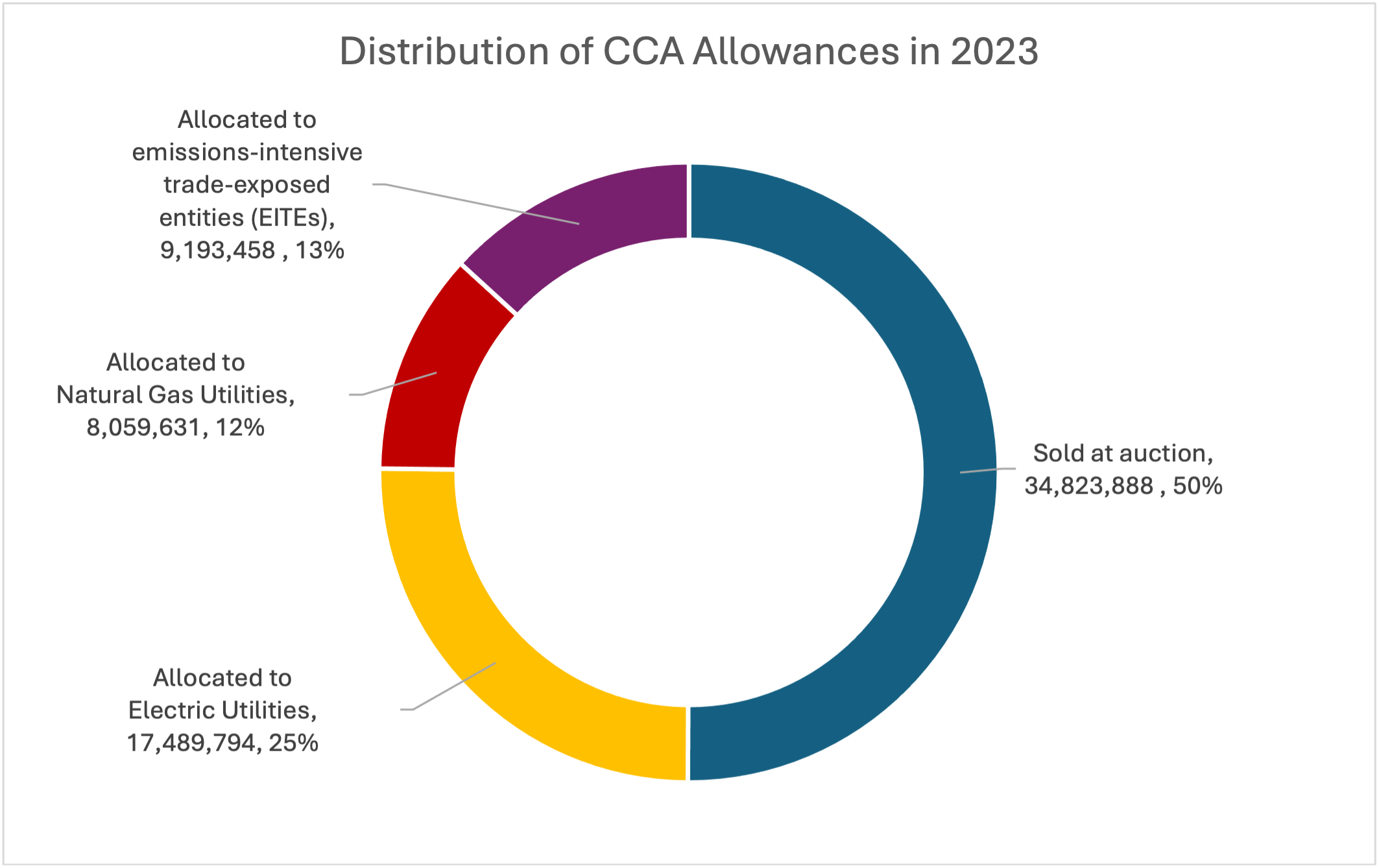
This chart shows how emission allowances were distributed in 2023. This picture will change from year to year because the number of no-cost allowances declines over time. Note that 1 allowance covers 1 metric ton of GHG emissions.
Investing Auction Proceeds
The CCA lays out rules for how auction proceeds get invested. It places special emphasis on promoting climate justice and equity by requiring that at least 35% of CCA investments go to helping Native American tribes and communities identified by the Department of Health as most harmed by the impacts of climate change and air pollution. CCA investments are divided into three main categories:
- Reducing emissions from the transportation industry and increasing access to public transportation.
- Supporting the clean energy transition, ecosystem resilience and carbon sequestration.
- Reducing pollution and health disparities in overburdened communities highly impacted by air pollution.
Here are just a few examples of projects that have been allocated CCA funds in the state’s 2023-2025 budget: [10]
- $403-million – the largest single allocation – for public transit projects including free transit passes for kids under 18.[11]
- $120-million to help support transitioning to zero-emission commercial vehicles including school buses.
- $115 million to reduce energy bills for low-income households and small businesses and to help them with heat pump installations and replacing gas furnaces with electric alternatives.
- $85-million to add nearly 5,000 electric vehicle charging stations across the state.[12]
- $50 million for Tribal climate adaptation grants.
- $17.6 million to reduce flooding and improve salmon habitat.
Is it working?
It’s a little too early to tell. The CCA only went into effect on January 1, 2023. That means 2023 was also the first year of allowance auctions so businesses haven’t yet made major process or technological changes to reduce their emissions. Similarly, many of the investments and programs funded by the CCA are just getting under way.
We need to watch for two things: First, are Washington’s GHG emissions declining? Second, are the programs funded by the CCA having their intended effects? A new emissions inventory report from the Department of Ecology is due this year. In addition, the department must produce a full report on the impacts of the CCA every four years starting in December 2027. [13]
Of course, all this depends on whether Washington voters decide to keep or repeal the CCA in November.
Washington’s Climate Commitment Act Explained © 2024 by Harry Katz is licensed under CC BY-NC 4.0


You can download a PDF version of this explainer here:
Click here for more posts on climate change.
If you enjoyed this explainer, please subscribe to Unsolicited Feedback.
References
[1] Washington State Legislature. RCW 70A.45.020 § 1(c). https://apps.leg.wa.gov/rcw/default.aspx?cite=70A.45.020
[2] “Washington State Greenhouse Gas Emissions Inventory: 1990–2019.” State of Washington Department of Ecology, Publication No. 22-02-054, Dec. 2022, https://apps.ecology.wa.gov/publications/documents/2202054.pdf
[3] “Washington Cap-and-Invest Program Annual Proceeds Report.” State of Washington Department of Ecology, 12 Jan. 2024, https://apps.ecology.wa.gov/publications/documents/2414011.pdf.
[4] “Washington’s Cap-and-Invest Program.” State of Washington Department of Ecology, https://ecology.wa.gov/air-climate/climate-commitment-act/cap-and-invest. Accessed 25 Feb. 2024.
[5] Washington State Legislature. RCW 70A.65.170 § 3(a). https://app.leg.wa.gov/RCW/default.aspx?cite=70A.65.170
[6] “Allowance Allocation to Natural Gas Utilities for the First Compliance Period.” State of Washington Department of Ecology, Publication No. 23-02-074, Jun. 2023, https://apps.ecology.wa.gov/publications/documents/2302074.pdf.
[7] “Allowance Allocation to Electric Utilities for the First Compliance Period (Updated).” State of Washington Department of Ecology, Publication No. 23-02-031, Sep. 2023, https://apps.ecology.wa.gov/publications/documents/2302031.pdf.
[8] “Emissions Intensive Trade Exposed industries (EITEs).” State of Washington Department of Ecology, https://ecology.wa.gov/air-climate/climate-commitment-act/cap-and-invest/emissions-intensive-trade-exposed-industries. Accessed 25 Feb. 2024.
[9] “Allowance Allocation to Emissions-Intensive, Trade-Exposed Industries for the First Compliance Period.” State of Washington Department of Ecology, Publication No. 23-02-098, Oct. 2023, https://apps.ecology.wa.gov/publications/documents/2302098.pdf.
[10] “How the Climate Commitment Act invests in a pollution-free Washington.” Office of Governor Jay Inslee, Oct. 2023, Version 2, https://governor.wa.gov/sites/default/files/2023-10/How_CCA_invests_in_WA.pdf.
[11] Lagerberg, Brian. “Youth can ride transit for free in most of Washington.” Washington State Department of Transportation, 3 Nov. 2023, https://wsdot.wa.gov/about/news/2022/youth-can-ride-transit-free-most-washington.
[12] “Commerce awards over $85 million to expand electric vehicle charging across Washington state.” Washington State Department of Commerce, 1 Feb. 2024, https://www.commerce.wa.gov/news/commerce-awards-over-85-million-to-expand-electric-vehicle-charging-across-washington-state/.
[13] Washington State Legislature. RCW 70A.65.070 § 5. https://app.leg.wa.gov/RCW/default.aspx?cite=70A.65.070
Discover more from Unsolicited Feedback
Subscribe to get the latest posts sent to your email.


 Unsolicited Feedback
Pingback: Vote No on Washington’s Initiative 2117 | Unsolicited Feedback