We’re not on track to meet the Paris Agreement goal of limiting global warming to 1.5°C above pre-industrial levels by 2050.
While there has been some progress, it hasn’t been nearly fast enough. In the last two decades, the amount of greenhouse gas emissions for each dollar of gross domestic product – known as the carbon intensity of the economy – has declined by only 1.5% per year. To meet the 1.5°C target, we need to reduce carbon intensity by 8% per year over the course of this decade.
“In other words, we need to rip fossil-burning out of the global economy roughly five times faster this decade than we managed over the past two decades.” [1]
How?
That’s the inspiration behind Simon Sharpe’s timely book Five Times Faster: Rethinking the Science, Economics, and Diplomacy of Climate Change, published in April 2023.
Simon Sharpe is Director of Economics for the UNFCCC Climate Champions and a Senior Fellow at the World Resources Institute. He was also Deputy Director of the UK government’s COP26 Unit helping prepare for the COP26 conference hosted by the UK in Glasgow in 2021.
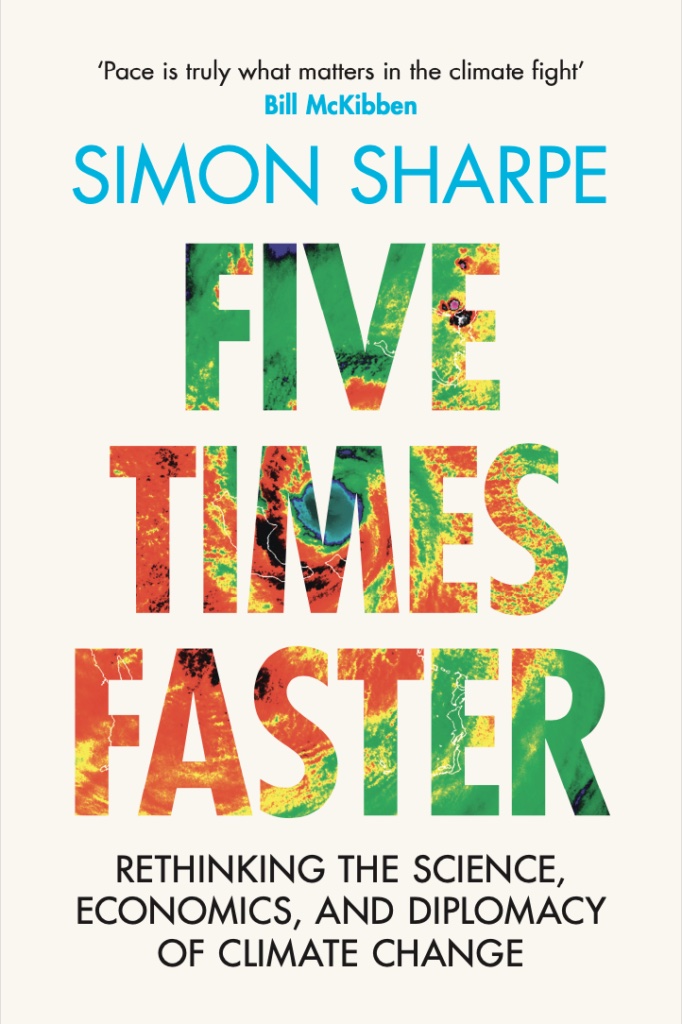
Five Times Faster:
Rethinking the Science, Economics, and Diplomacy of Climate Change
By Simon Sharpe
Cambridge University Press, Cambridge, 2023
As the subtitle suggests, Five Times Faster is organized into three sections that look at the science, economics and diplomacy of climate change. In each area, Sharpe proposes significant changes to accelerate the transition away from fossil fuels.
Science
We’ve known for well over a century that releasing carbon dioxide into the atmosphere warms the planet. In recent years, scientists have developed sophisticated climate models to predict how hot it will get, how much sea levels will rise, how much polar ice will melt, and more.
Sharpe argues this predictive approach doesn’t provide clear enough guidance for policy makers. He says that in addition to predicting the most likely outcomes of climate change, we also need to assess the risks of specific, dangerous outcomes we want to avoid.
It’s a subtle distinction that’s worth understanding.
Predictive models like the ones used by the Intergovernmental Panel on Climate Change (IPCC) look at a limited number of scenarios – they’re known as Representative Concentration Pathways (RCPs) – and try to predict what will happen to the climate in each of them. They tell us something like: if we follow path X then the most likely outcome will be Y.
If we release X amount of greenhouse gasses into the atmosphere then the most likely outcome will be a global temperature rise of Y degrees.
In contrast, a risk assessment model lets us ask: what is the likelihood of outcome Y and how does that likelihood change over time?
Then we can ask: what path X should we follow to minimize the likelihood of outcome Y?
It’s important to know that melting ice sheets in Greenland and the Antarctic will likely lead to sea levels rising 65 meters. But for leaders and policy makers, it’s even more important to know if and when New York, Mumbai, or London will be completely flooded.
Sharpe says that making policy decisions about climate change without a risk assessment approach is like living below a river dam without ever asking how likely it is to burst.
He stresses that it’s especially critical to assess the risk of major tipping points in Earth’s climate system. At a tipping point, a small input can trigger a disproportionately large response, often abrupt and irreversible, that puts a system into a qualitatively different state. Melting of the Greenland or Antarctic ice sheets are climate tipping points that would trigger disastrous increases in sea level. Thawing of the Arctic permafrost is a tipping point that would release huge quantities of methane – an even more powerful greenhouse gas than carbon dioxide — into the atmosphere.
Sharpe suggests that scientists have done little risk assessment so far because they prefer novel findings with high certainty. They are trained and incentivized to be “conservative” by avoiding false positives — saying something is true when it’s not. They are more interested in correctness and less interested in policy guidance.
People who specialize in risk assessment are “conservative” in a different way. They seek to understand and minimize risk even if the likelihood is small. They’re biased against false negatives – asserting some outcome won’t happen when it really could. They’re more interested in policy guidance than absolute correctness.
Sharpe argues convincingly that we need to place more emphasis on risk assessment in order to provide policy makers with more specific information and motivation to act decisively. How likely is it that New York, London, Mumbai or any other coastal city will be completely flooded? How likely is it that the wheat crop will fail in Australia or the United States? How about the Amazon tipping over from a carbon sink into a carbon source? How do those probabilities change over time as the planet heats up?
We know far too little about these risks.
Economics
In Part 2 of Five Times Faster, Sharpe delivers a stinging critique of standard neoclassical economics exemplified by Nobel laureate William Nordhaus. (I reviewed Nordhaus’s recent book The Spirit of Green here. I’d probably have been more critical of that book if I had read Five Times Faster first.)
In mainstream economic theories, the economy is viewed as a machine. Policy makers, advised by economists, are like mechanics who make small tweaks to the machine attempting to keep it balanced in a state of equilibrium.
When it comes to climate, mainstream economics is mostly concerned with finding the “optimal” balance between the costs of climate change and the benefits of mitigation. Its main policy prescription is to put a price on carbon emissions and then let free markets do the rest.
Sharpe calls this approach “worse than useless” and says it leads to the trivialization of risk, arbitrary policy guidance and undermining of public trust.
Instead, Sharpe argues we should view the economy as a complex dynamic system that is constantly changing and never in equilibrium. In other words, the economy is an ecosystem not a machine, and we should act like gardeners rather than mechanics.
Sharpe calls for governments to take a mission-oriented approach aimed at solving problems that matter to many people across society, across national boundaries, and across long periods of time. In Sharpe’s view, the purpose of government policy is not to keep the economy in a mythical state of equilibrium, but instead to shape the evolution of the economy toward desired outcomes, or to avoid undesirable ones.
We want to transition away from fossil fuels to avoid the worst effects of climate change. In that case, governments should employ a robust set of policy measures including funding research and development of new technologies like solar panels, subsidizing the production of new products based on these technologies, using its procurement power and tax credits to stimulate demand for new products, investing in infrastructure like EV charging networks to smooth broad public adoption, and finally regulating and taxing incumbents to make them less competitive.
Sharpe argues against carbon pricing. He says carbon pricing is a blunt instrument that mainly puts pressure on incumbents but does little to stimulate investment in new industries or support them early in their lifecycles. He presents some evidence that carbon pricing actually costs society more than targeted policy interventions.
Diplomacy
If you paid any attention at all to COP28 earlier this year in Dubai, then you’re probably aware that nearly 200 countries agreed to “transitioning away from fossil fuels” for the first time in thirty years of United Nations climate conferences.
This was a welcome development for sure, but it shouldn’t have taken thirty years.
It doesn’t help that COP documents require unanimous agreement of the Parties on every word and every comma.
Sharpe argues we could make quicker progress by breaking down climate diplomacy into smaller chunks and attacking them individually, sector by sector.
This final part of Five Times Faster is deeply informed by Sharpe’s own research and his experience working on the UK government’s preparations for COP26 in Glasgow. He presents detailed case studies on power generation, zero emission vehicles and deforestation.
Take cars for example. Sharpe points out that the average lifespan of an automobile is 15 years. So to hit the Paris Agreement target of net zero emissions by 2050, all new cars sold after 2035 must be zero emission vehicles. This is why many national and state governments have already enacted regulations to this effect even without any international coordination.
Yet there’s a huge opportunity here for targeted diplomacy. Sharpe notes that the rules for over half the world’s car sales are written by just three regulators: Brussels, Beijing, and California. If these three governments were to collaborate on rules and standards for zero emission vehicles, the world could make much faster progress. For example, global standards on car charging could help speed the development of charging networks and lower their costs by creating a more unified global market for this important infrastructure.
Lots of people, including me, have been critical of the current COP process because it provides little accountability. Sharpe’s perspective is different. He says holding countries accountable is less important than finding ways to help them. Many countries, especially in the developing world, face immense challenges in transitioning to clean energy while simultaneously developing their economies and dealing with a mountain of foreign debt.
On deforestation, for example, Sharpe says it’s a myth that international diplomatic efforts to reduce deforestation have been hampered by each country worrying that other countries won’t do their fair share. He says foot-dragging is more likely the result of internal domestic politics.
Rather than fretting about accountability, Sharpe advises that it’s more productive for international diplomacy to strengthen the hands of those domestic interests in favor of climate action.
Brazil is a good case in point: the recent election of President Luiz Inácio Lula da Silva has led to a 34% drop in deforestation in the Amazon.
This section of the book really opened my eyes to the challenges of reaching diplomatic agreements where there is no ultimate decision-making authority. Even on something as seemingly obvious as getting off coal for power generation, many countries face enormous challenges, including:
- Financing to help less developed countries make the transition.
- Renegotiation of foreign debt to reduce interest payment which could then free up funds for other transition investments.
- Grid interconnections across national boundaries and the energy security implications of those connections.
- Figuring out a future for workers in coal mining, power plant construction and operations, and retraining them. China employs between 1.5 and 2.6 million workers in coal mining alone, for example.
The good news from Five Times Faster is that Sharpe believes there could be positive tipping points, even tipping cascades, in the transition away from fossil fuels. We could see faster-than-expected progress with the right combination of technology, economic policy and international diplomacy.
Unsolicited Feedback
If we want to have any chance of limiting global warming to 2°C, let alone 1.5°C, by 2050, we must move faster. That means we must do things differently.
I really like how Simon Sharpe proposes some refreshing, even controversial ways of doing just that:
- Taking a risk assessment approach to identify the most dangerous climate threats,
- Using robust economic and industrial policies to guide the development and adoption of clean technologies, and
- Adopting a more targeted sectoral approach to international diplomacy.
Even though Five Times Faster doesn’t provide anything like a precise mathematical formula for accelerating the transition away from fossil fuels, these ideas are sensible and promising.
Our efforts would be more focused. We would learn more and progress faster.
Sharpe was directly involved in many of the events and initiatives he describes in the book. This on-the-ground perspective helped me better understand both the challenges and the opportunities we face. It makes his writing livelier too.
In a few places the book got a little bogged down in the narrative details of which officials from which countries attended which meetings. And although the book is just 300 pages, it’s set in slightly smaller type and closer line spacing than most books I’ve read. It would probably be 350 pages or so with more conventional formatting. But these are minor quibbles.
We can’t transition away from fossil fuels without widely available, low-cost alternatives. Sharpe clearly understands this. I like his approach of focusing climate science, national economic policy, and international diplomacy on creating new technologies, new products, and new opportunities to help us transition faster.
Thanks for reading.
Click here for more posts on climate change.
If you enjoyed this review, please subscribe to Unsolicited Feedback.
References
[1] Sharpe, S. (2023). Five Times Faster: Rethinking the Science, Economics, and Diplomacy of Climate Change. Cambridge: Cambridge University Press. doi:10.1017/9781009326506. p. 1.
Related Links
COP28: signal, noise, and structure
Simon Sharpe blog post. December 13, 2023.
We need a new kind of climate diplomacy
Simon Sharpe. Prospect. November. 1, 2023.
Accelerating the Low Carbon Transition: The Case for Stronger, More Targeted and Coordinated International Action
Victor, D.G., Geels, F.W. and Sharpe, S. Brookings Institution. December 9, 2019
The Global Tipping Points Report
T. M. Lenton, D.I. Armstrong McKay, S. Loriani, J.F. Abrams, S.J. Lade, J.F. Donges, M. Milkoreit, T. Powell, S.R. Smith, C. Zimm, J.E. Buxton, E. Bailey, L. Laybourn, A. Ghadiali, J.G. Dyke (eds), 2023, The Global Tipping Points Report 2023. University of Exeter, Exeter, UK.
How Close Are the Planet’s Climate Tipping Points?
Raymond Zhong and Mira Rojanasakul, The New York Times, August 11, 2024
Carbon pricing alone is not enough — other measures are needed to meet Paris Agreement targets
Sean Cleary and Neal Willcott. The Conversation. December 19, 2023.
Why the World Must Set a Price on Carbon
Lynn Forrester de Rothschild. Time. December 20, 2023.
Discover more from Unsolicited Feedback
Subscribe to get the latest posts sent to your email.


 Unsolicited Feedback
This looks like another important book worthy of conversations and policy decisions. I’m currently reading an easier book on climate, Not the End of the World, by Hannah Ritchie. I don’t feel fully-versed on the subject enough to know what to agree with and what not to agree with, or to form my own independent opinions yet, but I am hopefully gaining more information along the way. I’d like to have more conversations about these topics in my in-person life, but other than with my climate group, those conversations haven’t happened.
LikeLiked by 1 person
Not the End of the World is near the top of my TBR too. I’m interested in your thoughts on it once you finish. The web site HannaH Ritchie helps run — Our World in Data — is a fantastic resource!
LikeLiked by 1 person
I’ll have to look up the website! Thanks.
LikeLike