In The Spirit of Green: The Economics of Collisions and Contagions in a Crowded World, Yale economics professor William D. Nordhaus examines a wide range of economic, social and political issues from a Green perspective.
Nordhaus won the 2018 Nobel Prize in Economics “for integrating climate change into long-run macroeconomic analysis.” He was the first person to create something called an integrated assessment model which brings climate and economic modeling together. Nordhaus’s Dynamic Integrated Climate-Economy (DICE) model attempts to predict how the climate and the economy co-evolve over the long term based on different sets of assumptions. Its main purpose is to help guide policy-making.
In The Spirit of Green, Nordhaus uses and explains many of the ideas that he and other environmental economists have developed over the last several decades.
He uses the terms environmental movement, Green movement, the Spirit of Green, or just plain Green interchangeably. It’s a bit confusing, but they all refer to a broad social movement that advocates for new approaches to individual action, companies, politics and laws in order to address the harmful side effects of our modern industrial world.
The Spirit of Green, Nordhaus says, is a useful framework not only for thinking about new ways to construct buildings or manufacture physical goods, but also for how we design institutions, laws and ethics. That’s why the book includes obvious topics like sustainability and fairness, and less obvious ones like taxation, corporate social responsibility and many others.
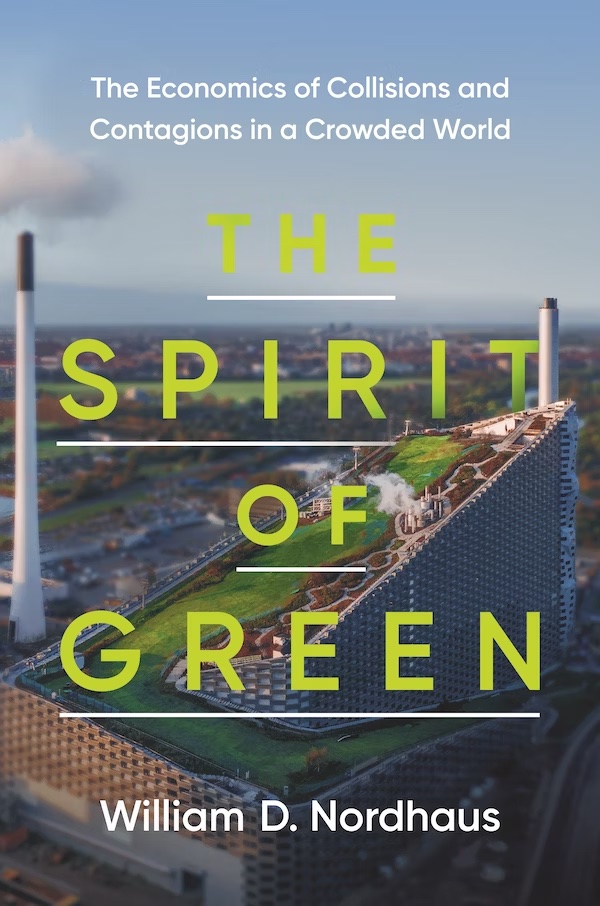
The Spirit of Green:
The Economics of Collisions and Contagions in a Crowded World
By William D. Nordhaus
Princeton University Press, Princeton, 2021
A mainstream approach to Green
Nordhaus might have been the first to integrate climate change into economic modeling, but he’s no radical. He incorporates Green approaches in ways that fit comfortably into mainstream (i.e. neoclassical) economic thinking.
That means, among other things, he takes a cost/benefit approach to addressing problems like pollution. For example, he’ll say that we should invest in pollution abatement up until the point where the marginal cost equals the marginal benefit. (Here’s an article explaining marginal analysis in economics in case you’re not familiar with the concept – it can seem a little weird at first.)
This leads to the rather uncomfortable idea of “optimal pollution.” The cost of eliminating every last speck of some pollutant, say sulphur dioxide, from the atmosphere would be enormous and would far exceed any benefits such as public health improvements. So there’s some point where we might say, “OK we’ve done enough to remove most of the SO2. It’s not worth the cost to remove any more so let’s stop here.” That’s the idea of optimal pollution.
This approach got Nordhaus into hot water a few years ago when he said that 3°C of global warning would reduce global GDP by only 2.1% – implying that 3°C of warming wasn’t really all that serious.
Still, Nordhaus is no free-market ideologue either. He’s quite clear that we need markets, laws and government action in order to live in a “well-managed society.”
“Private markets are necessary to provide ample supplies of goods such as food and shelter, while only governments can provide collective goods such as pollution control, public health, and personal safety. Operating the well-managed society without both private markets and collective actions is like trying to clap with one hand.” [p. 2]
Carbon pricing
The main thrust of The Spirit of Green is an argument for carbon pricing – putting a price on carbon emissions. Nordhaus suggests this could be done through taxes on carbon emissions or some kind of cap and trade system such as the one used to reduce sulphur dioxide emissions in the US.
He says, correctly, that the world is not on track to meet UN targets for carbon reduction. A key reason for this, he argues, is that carbon emissions are an externality that is not reflected in market prices for the goods we produce and consume.
OK, so what’s an externality? It’s a key concept in economics. Simply put, an externality occurs:
“… when the costs of an activity spills over to other people, without those other people being compensated for the damages.” [p. 245]
Carbon dioxide emissions are a perfect example of an externality because “those who generate emissions do not pay and those who are harmed are not compensated.” (This article gives a more extensive definition of externality with some examples.)
Externalities are an example of market failure because they result in market prices that do not reflect the true cost of a good or service. And this puts low-emission products at a serious competitive disadvantage.
Bill Gates touches on this in his 2021 book How to Avoid a Climate Disaster. He introduces the idea of a “green premium.” That’s the additional amount you must pay if you switch from conventional carbon-emitting products to zero-carbon alternatives. For example, today’s electric vehicles (EVs) still cost several thousand dollars more than comparable internal combustion engine (ICE) cars. Nordhaus would argue that if ICE cars or the gasoline they burn included the price of carbon emissions, then the green premium would be much lower, possibly negative, meaning EV’s would be cheaper than ICE vehicles.
Nordhaus writes that by putting a price on carbon, markets could then send the proper price and profit signals to encourage consumers to buy lower emission products like electric vehicles and heat pump furnaces, and incentivize producers to invest in innovative technologies that reduce or eliminate carbon emissions.
“The point of correcting the prices and profit calculation is not primarily to penalize the companies. Rather, it is to give the proper signals so that firms will change their behavior.” [p. 187]
In other words, carbon pricing “internalizes the externalities” and thereby levels the competitive playing field for new, zero-emission products. Without a price on carbon, we are, in effect, subsidizing high-emission products.
Trouble is, carbon pricing is a political non-starter for the US federal government, although some state governments have implemented limited carbon pricing policies. If you look at the Biden Administration’s signature climate policy, the Inflation Reduction Act, it’s all about incentives and stimulus for technology innovation. Nordhaus appears to support these policies but I think he would say they’re unlikely to succeed without carbon pricing.
“Developing radically new and economical low-carbon technologies requires substantial public support for science and technology along with the incentive of a high carbon price.” [p. 293]
Climate compacts
He’s also pessimistic about the current state of international climate efforts like the Paris Agreement, primarily because they’re voluntary.
“Countries have strong incentives to proclaim lofty and ambitious goals …. and then to ignore these goals and go about their business as usual. When national economic interests collide with international agreements, there is a temptation to shirk, dissemble, and withdraw.” [p. 289]
Sadly, he’s spot on.
To remedy this, Nordhaus proposes the idea of climate clubs or compacts. These would be international agreements, somewhat like the World Trade Organization, that commit member states to binding targets like a harmonized carbon price and would penalize members that fail to meet them.
It’s an interesting idea. Unfortunately, he doesn’t go into details about how these compacts would work, or what the penalties would be. This might be a scenario where border carbon adjustments are used, but that’s just me speculating. Nordhaus doesn’t mention them.
Can humanity overcome its tendencies to quarrel and pollute in order to realize the dream of a Green Earth? Nordhaus says the jury is still out.
Unsolicited Feedback
You might think a book about economics would be dull and plodding, but The Spirit of Green is neither. There are many useful and important ideas here and Nordhaus explains them well. You’ll definitely get a good sense of how economists think about the world from reading this book.
However, while it’s great to see economists finally taking the environment and climate change seriously, the perspective in this book is solidly mainstream. Nordhaus, and I guess most economists, have basically just bolted environmental factors onto standard neoclassical models. He says as much here:
“The mainstream view, largely adopted here, is that environmental goods and services are like normal ones except that they suffer from market failures. The remedy, in the mainstream view, is to correct the market failures and then proceed with business as usual.” [p. 74]
I think we need something more than business as usual.
Elsewhere, he says,
“We cannot neatly separate Green issues from other issues in economic, social, and political life. The Green society is nested inside the broader society.,” [p. 68]
Many environmentalists would argue that Nordhaus has it backwards, that in fact the broader society is nested inside the Green. As Kate Raworth says in Doughnut Economics, we need to move beyond the traditional view of the economy as a stand-alone system and instead understand it as being embedded within society as a whole which in turn is embedded within the environment. We need to think about the environment as both enabling economic activity and putting boundaries on it too.
There’s nothing in this book about more radical approaches like the circular economy or re-thinking the quest for endless economic growth into something more sustainable.
On the other hand, there is a chapter about the feasibility of exo-civilizations – human civilizations on other planets. I have no idea what it’s doing in this book. Nordhaus wrote The Spirit of Green in 2021 during the COVID-19 pandemic so there’s also a chapter on pandemics and other catastrophes. But this too seems only tenuously related to Green approaches to the economy or politics.
Despite all this, I do agree with much of what he says in The Spirit of Green, including the need for carbon pricing. Nordhaus deserves acclaim as a pioneer in economics. We just need to move farther.
Thanks for reading.
If you enjoyed this review, please subscribe to Unsolicited Feedback.
Discover more from Unsolicited Feedback
Subscribe to get the latest posts sent to your email.


 Unsolicited Feedback
I’m still relatively new to these deeper looks at actual solutions to our climate crisis, so I appreciate you explaining things as you go. I’m learning from you and the books you read. 🙂 This economics approach is an important one as money talks.
My local climate group is gearing up to speak with our congressional representatives in a few days (I’m opting out; I’d be more of a hindrance at this point), but our politicians thus far have proven unresponsive to even acknowledging there is a crisis. Sigh.
LikeLiked by 1 person
Thanks Lisa! Glad to know these reviews are helpful.
I doubt you’d be a hindrance. The more people who show up to a meeting, the more pressure on your representative to take the problem seriously.
I’m curious to know what climate group you’re involved with?
LikeLike
Citizens Climate Lobby. An acquaintance of mine highly recommended it, so I joined a couple months ago.
LikeLiked by 1 person
Pingback: Five Times Faster | Unsolicited Feedback