On a recent holiday in Ireland, we encountered several species of birds from the crow family that are quite different from the American Crow we see almost every day at home. The Hooded Crow has a black head but a grey back and body. The Eurasian Jackdaw is a small crow with a silvery sheen rather than the blue/violet sheen of the American Crow. Finally, the Rook has a distinctive light grayish patch at the base of its beak.
They’re all part of the Corvidae family that also includes magpies and jays.
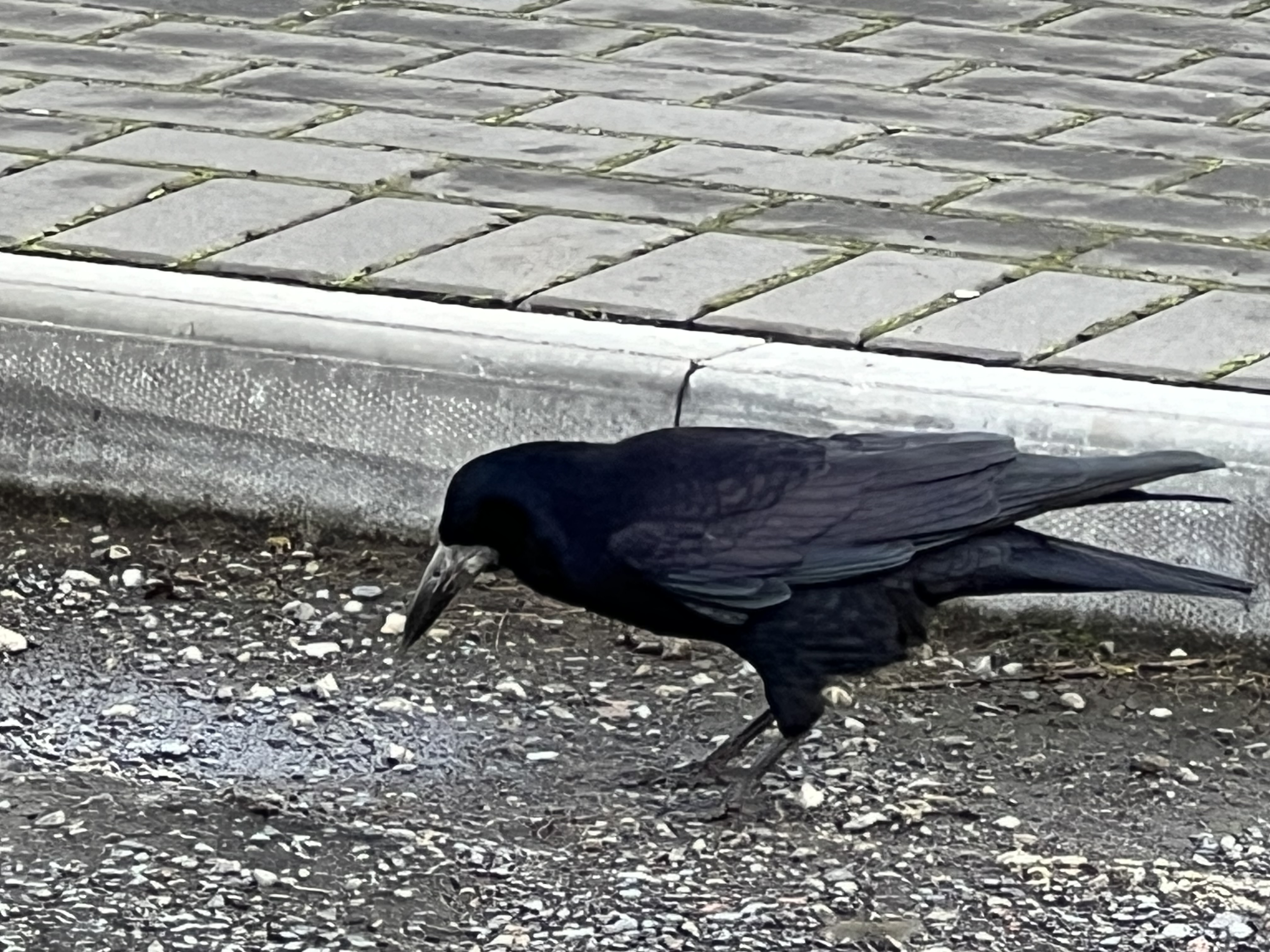
Anyway, these crow encounters motivated me to read Crow Planet: Essential Wisdom from the Urban Wilderness by Seattle author and naturalist Lyanda Lynn Haupt.
I read Haupt’s book Mozart’s Starling earlier this year and really enjoyed it. Crow Planet is similar to Mozart’s Starling in that it explores a wide range of topics related (sometimes loosely) to the main subject of the book. Crow Planet is an earlier work and I think doesn’t fit together quite as well as Mozart’s Starling, but Haupt has written both with the same deep humility and love of nature.
And both books carry the same essential message about the importance of connecting with the natural world.
To begin with, Crow Planet is about crows as animals: about their intelligence, their sociability and their raucous cawing. It’s about how they feed, build nests, reproduce, and even walk. Yes, crows walk a lot, Haupt informs us.
The book is also about how humans relate to crows. We have strong opinions about them. We fear them or admire them. We’ve created myths about them. Many people have “crow stories” about incidents with crows they’ve witnessed or been involved in. Lots of people even have crow tattoos.
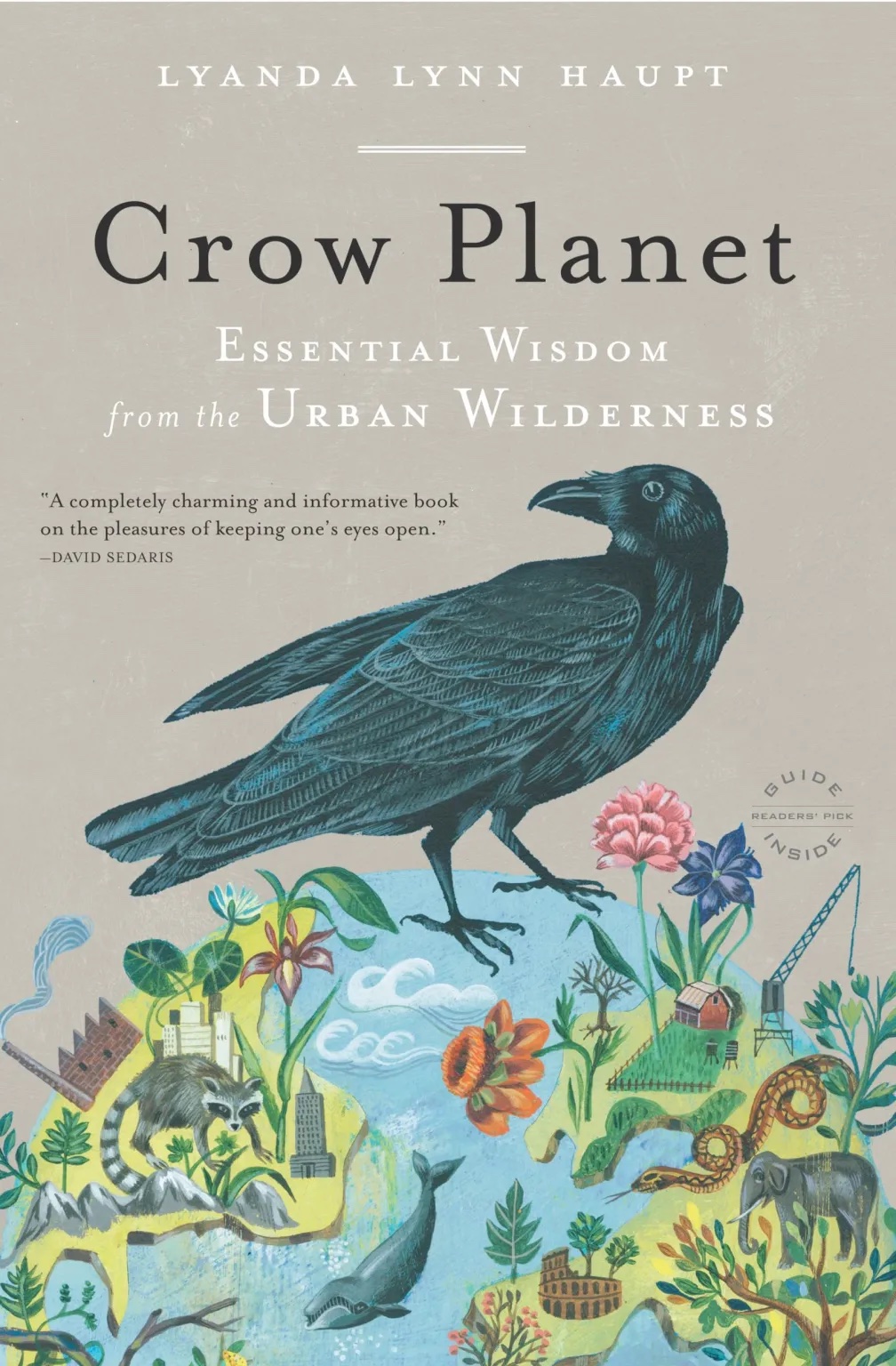
Crow Planet: Essential Wisdom from the Urban Wilderness
By Lyanda Lynn Haupt
Little, Brown Spark, New York, 2009
But Crow Planet is also about crows as a proxy for “wild” nature. That’s because,
“For the majority of people on the face of the earth, the crow will be the single most oft-encountered native wild animal in their lives.” [Kindle loc. 290]
Haupt admits there’s no statistical evidence to support this claim but given the ubiquity of various crow species around the world and how well they’ve adapted to human-built environments, it sounds reasonable to me.
As a result, Haupt suggests, crows are the de facto representatives of wild nature to us humans. Crows remind us of and draw our attention to the parts of nature that we don’t see.
“Crows bring the wild earth to our doorstep and with their presence invite us beyond the parameters of our everyday human lives and into communion with that wildness.” [Kindle loc. 55]
“In their bold, boisterous, watchable presence, they remind us of the myriad organisms – the creatures, trees, fungi, and soils that are hidden, silent, undersea and atop mountains – that we will never see yet connect with deeply in the pattern of our lives. Crows call us to pause, sometimes, to remember that we live on a damaged earth, yes, but one that remains full of grace and beauty and more-than-human intelligence – one on which we watch, watch over and are watched in return.” [Kindle loc. 62]
I think this connection to nature, this shared existence on a damaged earth, is the deepest theme of Crow Planet.
Haupt has a refreshing, expansive view of nature. It’s not just “out there” in the forest or on the trail. It’s everywhere and we are part of it. Most of us don’t live in log cabins in the woods next to babbling brooks. In fact, most of us live in a zoöpolis, “where the polis meets the zoo.”
So Haupt urges us to seek our connections to wild nature wherever we live, especially in cities and suburbs. That means recognizing wild life wherever we are but also preserving spaces for creatures who don’t adapt to humans as well as crows and who need contiguous, undisturbed habitats to survive and flourish.
We need to find better, healthier, more sustainable ways to coexist with wild life, Haupt urges.
Coexistence means we don’t get to choose, let alone dictate, which wild creatures share our space or how they behave. We can’t just have “nice” birds nesting in the neighborhood trees. We must accept that others, like starlings and crows, may choose to live there too, and that these and many other animals, seen and unseen, live among us.
More importantly we can’t hope to repair the world without this broader sensibility and perspective about nature and our relationship with it.
“We live on a changing earth where ecological degradation and global climate change threaten the most foundational biological processes. If the evolution of wild life is to continue in a meaningful way, humans must attain a changed habit of being, one that allows us to recognize and act upon a sense of ourselves as integral to the wider earth.” [Kindle loc. 118]
In that sense, Crow Planet and crows themselves offer both a warning and a hope. The warning is that if we continue on our current path, humanity will so devastate the environment that only crows and other adaptable species like them will survive. The hope is that if we awaken our deep connection to nature and act accordingly, we give ourselves the chance to create a more sustainable, livable future for humans and nonhumans alike.
Thanks for reading.
If you enjoyed this review, please subscribe to Unsolicited Feedback.
Discover more from Unsolicited Feedback
Subscribe to get the latest posts sent to your email.


 Unsolicited Feedback
What a great review! This is on my wish list and this makes it definitely stay there. I do love a crow, and we’re fortunate to have crows and jackdaws as well as magpies around here. The crows on the university campus where we use to both work were amazing and we both miss them!
LikeLiked by 1 person
Thanks, Liz! I like them too. We have just the American crow here along with jays. They’re both fascinating to watch.
LikeLiked by 1 person
Pingback: What an Owl Knows | Unsolicited Feedback
Pingback: A Sand County Almanac | Unsolicited Feedback