Whether you believe that God gave man dominion “over all the earth, and over every creeping thing that creepeth upon the earth” or that humans have spent the last two hundred thousand years or so winning the Darwinian race, there’s no doubt that today we dominate the earth.
In fact, scientists say we’re now living in a new geologic epoch called the Anthropocene in which human activity has significantly altered Earth’s systems, climate and even its geology.
So how are we doing at this business of world domination?
Under a White Sky: The Nature of the Future by Elizabeth Kolbert is a report card from some of the hot spots of the Anthropocene.
It’s part science journalism and part travelogue. Kolbert visits Chicago, New Orleans, the Greenland ice sheet, Australia’s Great Barrier Reef and other locations to investigate how we’ve transformed our world and how we’re now struggling to deal with the consequences we’ve set in motion.
Elizabeth Kolbert is a staff writer at The New Yorker magazine. She won a Pulitzer Prize in 2015 for her book The Sixth Extinction, which I have not yet read.
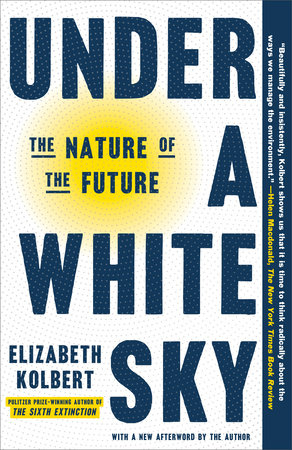
Under a White Sky: The Nature of the Future
By Elizabeth Kolbert
Crown, New York, 2022
Controlling our controls
You can look at much of human history as a long struggle to get control over our environment. That’s what agriculture is all about. And air conditioning.
In the Anthropocene we’ve succeeded. Sort of.
The main idea in Under a White Sky is that our control of the environment frequently has unintended consequences. Our challenge now is to get control of our controls. As Kolbert puts it:
“If control is the problem, then by the logic of the Anthropocene, still more control must be the solution.” [p. 32]
Take the Chicago River. In the opening chapter, Kolbert embarks on a cruise, if you can call it that, of the Chicago Ship and Sanitary Canal.
Back in the late 1800’s, the city of Chicago, in an effort to prevent the city’s sewage from polluting its main source of drinking water, dug the canal as part of a mind-boggling engineering project to reverse the flow of the Chicago River so that it no longer drained into Lake Michigan, but into the Mississippi River.
Chicago successfully cleaned up its drinking water, but in so doing, it created a connection between the Great Lakes watershed and the Mississippi watershed where none had existed before, thereby “upending the hydrology of roughly two thirds of the United States.”
This wasn’t a huge problem until invasive Asian carp showed up in the Mississippi, decimating the populations of just about every native species they encountered. To prevent Asian carp from getting into the Great Lakes, Chicago now runs high a voltage electric current across one section of the canal. This electrocutes the carp, which are then turned into fertilizer.
“First you reverse a river, then you electrify it.” [p. 8]
“No longer fully natural”
The second message of Under a White Sky is that there’s no such thing as the “natural world” or even “nature” itself anymore. Yes, there are still remote wilderness areas with no obvious signs of direct human intervention – roads, buildings, fences, etc. – but human activity has impacted the whole world, especially the climate. And there’s no going back. All the conservation, decarbonization, and climate mitigation efforts now underway will not turn back the clock. We are building a new future, hopefully a more sustainable future, but one where “nature is no longer fully natural.”
That’s why I like the double entendre of the book’s subtitle, The Nature of the Future: what the future will be like and what nature will be like in the future.
In Australia, Kolbert interviews scientists who are working to preserve the Great Barrier Reef. Her findings echo what Juli Berwald wrote about in her book Life on the Rocks: Building a Future for Coral Reefs. Scientists are attempting to breed more resilient coral that can survive rising marine temperatures. This “assisted evolution” is a way to extend the life of the reef, to buy time until we slow down and hopefully reverse climate change. But as Kolbert says:
“Everyone I spoke to in Australia understood that preserving the Great Barrier Reef in all its greatness was beyond what could realistically – or unrealistically – be hoped for. Even settling for a tenth of it would mean shading and robotically seeding an area the size of Switzerland. What was at issue was, at best, a diminished thing – a kind of Okay Barrier Reef.” [p. 110]
Towards the end of the book, Kolbert talks to scientists researching geoengineering, specifically, solar radiation management. The idea is to dump aerosol particles high up in the atmosphere to reflect more sunlight back into space. It could rapidly cool the earth. It would also have many side-effects, including whitening the sky – hence the title of this book.
But despite the scientific and ethical concerns, geoengineering may become necessary if we don’t meet our emissions targets. Kolbert quotes one official who compared geoengineering to chemotherapy:
“No one in his right mind would undergo chemotherapy were better options available. ‘We live in a world,’ he has said, ‘where deliberately dimming the fucking sun might be less risky than not doing it.’” [p. 200]
Unsolicited Feedback
Under a White Sky is an unflinching look at some of the critical problems humans have caused and how difficult they will be to solve. It’s neither optimistic nor pessimistic. In this way, it’s similar to Vaclav Smil’s book How the World Really Works, but while Smil takes a system-wide, macroeconomic look at solving the climate problem, Kolbert provides detailed reports from the field.
Kolbert is also a far better writer than Smil, in fact, they’re not even in the same league. She’s incisive and evocative, laced at times with dark irony.
Here’s her description of how the Mississippi River used to replenish the sinking Louisiana lowlands:
“Whenever the river overtopped its banks – something it used to do virtually every spring – it cast its sediment across the plain. Season after season, layer after layer, clay and sand and silt built up. In this way, the ‘strong brown god’ assembled the Louisiana coast out of bits and pieces of Illinois and Iowa and Minnesota and Missouri and Arkansas and Kentucky.” [p. 33]
And when her tour boat on the Chicago Ship and Sanitary Canal nearly gets squished between two barges,
“The deckhands yell down instructions that are initially incomprehensible, then become unprintable.” [p. 6]
Under a White Sky is a short, fabulously written book that examines head on some of the thorniest problems we’ve created in the Anthropocene. It looks at some potential solutions too.
Some of them might even work.
Update (Oct. 7, 2024): In an article titled When the Arctic Melts, published in The New Yorker on Oct. 7, 2024, Elizabeth Kolbert writes about the state of the Greenland ice sheet and how meltwater flowing into the Atlantic ocean could lead to the collapse of the Atlantic Meridional Overturning Circulation, a dangerous climate tipping point.
Thanks for reading.
Click here for more posts on climate change.
If you enjoyed this review, please subscribe to Unsolicited Feedback.
Related Links
Climate Change Is a Waste Management Problem
Article by Klaus S. Lachner and Christopher Jospe in Issues in Science and Technology 33, no. 3 (Spring 2017) suggesting a reframing of carbon dioxide emissions as a waste management problem to “help clear the path for practical approaches to reducing carbon in the atmosphere.”
Plows, Plagues and Petroleum: How Humans Took Control of Climate
Book by William Ruddiman suggesting that the Anthropocene actually began about 8,000 years ago. Published in 2016.
Discover more from Unsolicited Feedback
Subscribe to get the latest posts sent to your email.


 Unsolicited Feedback
Thanks for addressing the writing style, which people don’t always comment on in nonfic books, but matters to me! I liked both quotes.
LikeLiked by 2 people
Thanks Laura, I agree. This stuff can be dry, not to mention depressing. Good writing helps keep it interesting and Kolbert’s writing is among the best I’ve read recently.
LikeLike
We absolutely agree. For us the style is what interests us most in book.
All the best
The Fab Four of Cley
🙂 🙂 🙂 🙂
LikeLiked by 1 person
This sounds like another good book about climate change. I’m finally getting around to reading The Ministry for the Future. I’m not sure I like it because it’s so depressing. ha. But it feels important to read (even though it’s fiction) so I’m pushing forward. The worst thing we can do is look away from the problems we continue to create.
LikeLiked by 1 person
I agree – looking away doesn’t solve anything. Glad you’re reading The Ministry for the Future! I hugely enjoyed the book despite its depressing start. It gave me a great introduction into many approaches to dealing with climate change all wrapped up in a good story.
LikeLike
Thanks for your review of this book we otherwise would never notice.
All the best
The Fab Four of Cley
🙂 🙂 🙂 🙂
LikeLiked by 1 person
👍👍
LikeLike
Pingback: Nonfiction November 2023 Week 1: Your Year in Nonfiction | Unsolicited Feedback
Pingback: 2023 Reading Wrap-Up | Unsolicited Feedback