Climate change is happening now. Record-setting heatwaves, devastating forest fires, intense tropical storms and extreme flooding are no longer distant predictions, they’re daily events.
In The Climate Book, Swedish environmental activist Geta Thunberg has gathered the expertise of over 100 climate scientists, oceanographers, engineers, economists, philosophers and Indigenous leaders. Each has written a short chapter, most less than four pages. Thunberg herself has contributed 18 entries.
The book is richly illustrated with dozens of greyscale diagrams, graphs, charts and photos.
The result is a 436-page volume that lays out in stark detail our current understanding of the climate problem and our recklessly inadequate response so far.
The overall message in not without hope, but it is forceful and urgent: we’re almost out of time to prevent the worst effects of climate change.
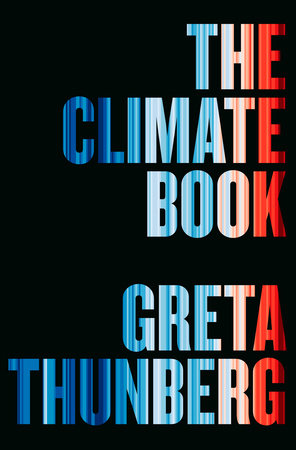
The Climate Book
Created by Greta Thunberg
Penguin Press, New York, 2023
Right from the flyleaf of the book, even before the title page, The Climate Book presents hard facts:
- The atmospheric concentration of carbon dioxide is now about 420 parts per million (ppm). It might not sound like much, but CO2 levels haven’t been this high in about 4 million years.
- Human activities, mainly burning fossil fuels, have already increased average global temperatures by about 1.2°C since the Industrial Revolution
- Despite increasingly dire warnings, we have emitted more C02 since 1991 than in all the rest of human history.
- Some countries and regions, especially the US, EU and China, have much greater responsibility than others for cumulative historical carbon emissions.
Highlights
The book covers how climate works, how the Earth is changing, the impacts of climate change on us, what we’ve done so far, and what we must do now.
Here are a few points I found especially striking.
In the opening chapter, science journalist Peter Brannen writes about the carbon cycle – a set of natural processes that move carbon through the atmosphere, oceans, plants, soil and solid rock. Earth’s geologic record tells the story of how imbalances in the carbon cycle have repeatedly destroyed life on our planet.
“But if the rocks tell us anything, it is that we are pulling the most powerful levers of the Earth system. And we pull them at our peril.” [p. 8]
You might have seen recent news reports like this one about the possible collapse of the Gulf Stream ocean current: Gulf Stream could collapse as early as 2025, study suggests.
That’s an example of a climate tipping point, a sudden and irreversible change that could throw Earth’s climate into an unstable and possibly uninhabitable state. Other climate tipping points include thawing of Arctic permafrost, or a dieback of the Amazon rainforest.
Johan Rockström, Director of the Potsdam Institute for Climate Impact Research and co-author of the book Big World Small Planet, says in his Climate Book entry:
“We all depend on the tipping elements remaining stable and resilient. They are global commons, which we now need to manage and govern due to the risks we are now taking in the Anthropocene.” [p. 37]
One important concept that appears throughout the book is the carbon budget. The Intergovernmental Panel on Climate Change (IPCC) defines carbon budget as:
“… the total net amount of CO2 that human activities can still release into the atmosphere while keeping global warming to a specified level, like 1.5°C or 2°C relative to pre-industrial temperatures.” 1
Writing about carbon budgets his chapter of The Climate Book, Kevin Anderson, Professor of Energy and Climate Change at the Universities of Manchester, Uppsala and Bergen, says:
“Our remaining carbon budget range is small and rapidly shrinking. For a ‘likely’ chance of not exceeding 1.5°C we have under eight years at the current rate of emissions. Weakening the commitment to ‘well below 2°C’ (and thereby accepting more devastating impacts) slows the ticking clock, but still fewer than twenty years’ worth of current emissions remain.” [p. 206]
David Wallace-Wells, author and opinion writer for The New York Times, writes about lessons learned from the COVID-19 pandemic and how they could be applied to the climate crisis. While there were both success and failures in our global pandemic response, Wallace-Wells celebrates how quickly governments acted.
“… when it came to public spending, every nation in the world was suddenly operating in an entirely new reality, without any of the political and social constraints which had previously set the speed limit on climate action. In the years to come, one lesson drawn from the pandemic response will inevitably be: there is no speed limit but the one we set ourselves.” [p. 381]
Thunberg’s Message
Over and above the contributions of all these eminent scholars and writers, Thunberg herself is a constant presence throughout the book. Her voice is crystal clear; angry, scolding, at times sarcastic, but above all, urgent. It’s a tone that’s consistent with her famous September 23, 2019 speech at the UN Climate Action Summit in New York, where she blasted the assembled world leaders for their inaction on climate change.
“You have stolen my dreams and my childhood with your empty words. And yet I’m one of the lucky ones. People are suffering. People are dying. Entire ecosystems are collapsing. We are in the beginning of a mass extinction, and all you can talk about is money and fairy tales of eternal economic growth. How dare you!” 2
Thunberg celebrates technological advances in renewable energy, especially wind and solar, but she warns that technology alone cannot solve the climate crisis. Instead, we need a combination of technology, individual behavior and government policy.
This is partly because some of the technology being touted simply doesn’t yet exist at the scale we need, particularly carbon capture and storage (CCS) and carbon dioxide removal (CDR). These are two sets of related technologies, still in early development, that remove carbon from the atmosphere after it has been emitted.
Thunberg is scathing in her criticism of CCS and CDR for another reason: they are being used by the fossil fuel industry as an excuse to continue burning fossil fuels.
But the main problem with technological approaches is they can’t address the problem of climate justice.
Thunberg calls for justice in solving the climate crisis. Rich countries in the Global North are vastly more responsible for cumulative greenhouse gas emissions than poorer countries in the Global South. Rich countries must therefore pay the lion’s share of the costs of adapting to and mitigating climate change.
They must also pay climate reparations to compensate poorer countries for loss and damage from a problem they did not cause.
And within countries, wealthy individuals emit far more carbon than poorer individuals, sometimes many times more. This is where behavior changes are most urgently needed.
Thunberg calls for broad systemic changes too. She says repeatedly that “the climate crisis cannot be solved within today’s systems.” She’s referring here to global capitalism which drives wasteful consumerism as well as resource extraction and exploitation of poorer nations. She and other contributors urge that we move to a more just and sustainable way of living.
Unsolicited Feedback
The Climate Book is an anthology. Even though it’s well-organized, the flow from one chapter to the next, from one voice to the next, is sometimes a little choppy. But that’s a quibble.
It’s an encyclopedia. Its brief chapters present a comprehensive picture of the causes, impacts and approaches to the climate crisis.
Finally, The Climate Book is an urgent, sometimes angry call to action. Climate change is no longer something that will happen in the future. It’s happening now. We’re witnessing its devastating impact already. And it will get much worse if we don’t act immediately.
Thunberg’s words often made me uncomfortable, but they are correct, necessary and justified.
After all, her generation will inherit the Earth. And the crisis that previous generations, including mine, have created.
We’ve done too little and delayed too long.
Our chances of limiting warming to 1.5°C are slipping away.
Thunberg quotes UN Secretary General Antonio Guterres:
“Now is the time to turn rage into action. Every fraction of a degree matters. Every voice can make a difference. And every second counts.” [p. 428]
Thanks for reading.
Click here for more posts on climate change.
If you liked this post, please subscribe to Unsolicited Feedback.
References
1 Canadell, J.G., P.M.S. Monteiro, M.H. Costa, L. Cotrim da Cunha, P.M. Cox, A.V. Eliseev, S. Henson, M. Ishii, S. Jaccard, C. Koven, A. Lohila, P.K. Patra, S. Piao, J. Rogelj, S. Syampungani, S. Zaehle, and K. Zickfeld, 2021: Global Carbon and other Biogeochemical Cycles and Feedbacks. In Climate Change 2021: The Physical Science Basis. Contribution of Working Group I to the Sixth Assessment Report of the Intergovernmental Panel on Climate Change [Masson-Delmotte, V., P. Zhai, A. Pirani, S.L. Connors, C. Péan, S. Berger, N. Caud, Y. Chen, L. Goldfarb, M.I. Gomis, M. Huang, K. Leitzell, E. Lonnoy, J.B.R. Matthews, T.K. Maycock, T. Waterfield, O. Yelekçi, R. Yu, and B. Zhou (eds.)]. Cambridge University Press, Cambridge, United Kingdom and New York, NY, USA, pp. 673–816, doi:10.1017/9781009157896.007. FAQ 5.4, p. 777.
2 Thunberg, Greta. Transcript: Greta Thunberg’s Speech At The U.N. Climate Action Summit. NPR. September 19, 2019.
Related Links
The Climate Book website
Author biographies and endnotes for the book.
The triple inequality of the “global” climate problem,
Post by historian Adam Tooze in Chartbook highlighting recent research showing that climate change will most heavily impact those who have contributed least to the problem and are least able to pay for solutions. June 10, 2023.
We need biosphere stewardship that protects carbon sinks and builds resilience.
Article by Johan Rockström et al in the Proceedings of the National Academy of Sciences suggesting that critical biomes which provide a “vast subsidy” to the world economy be recognized as global commons and calling for international biosphere stewardship. September 15, 2021.
Discover more from Unsolicited Feedback
Subscribe to get the latest posts sent to your email.


 Unsolicited Feedback
Thanks for sharing these thoughts because I don’t know if I’m courageous enough to read the entire book. 😦 It’s quite depressing to see us headed toward disaster yet watch the major players refuse to take the desperate actions that are so needed.
LikeLiked by 1 person
It’s not an easy book, for sure.
I still believe we can avoid the worst possible outcomes, and we all have a part to play.
LikeLike
Pingback: The Ends of the World | Unsolicited Feedback
Pingback: Nonfiction November 2023 Week 1: Your Year in Nonfiction | Unsolicited Feedback
Pingback: Non-Fiction November 2023 – Week Five – This Reading Life
Pingback: January 2024 | The Books – This Reading Life
Pingback: What If We Get It Right? | Unsolicited Feedback