Do you have trouble focusing these days? Are you getting interrupted by so many notifications, beeps and pings that you can’t concentrate on anything? Are you reaching for your phone every two minutes to check for the latest updates, likes or comments, or to just mindlessly scroll away the hours?
Yeah, me too.
Stolen Focus: Why You Can’t Pay Attention — and How to Think Deeply Again looks at the causes of our increasing inability to focus, and at some potential solutions.
It’s written by Johann Hari, a British writer who lives in London. Hari studied Social and Political Science at Cambridge University. He’s published articles in The New York Times, Los Angeles Times and the Guardian. Stolen Focus is his third book.
Overall, I think Stolen Focus correctly shows how the way we live and work today harms our ability to concentrate. I’m less certain about the solutions the book proposes.
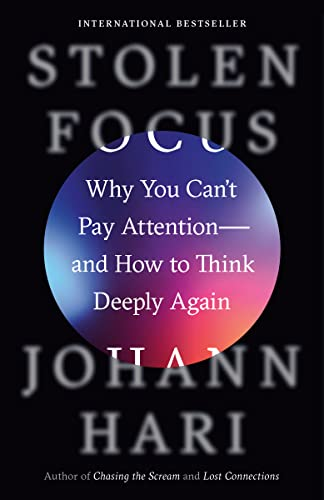
Stolen Focus:
Why You Can’t Pay Attention — and How to Think Deeply Again
By Johann Hari
Crown, New York, 2023
Why can’t we focus?
Hari identifies three main causes of our distractedness. The first culprit, no surprise, is technology. So much information is coming at us so quickly that we’re perpetually drinking from the firehose. It’s overwhelmed our brain’s natural ability to filter out irrelevant distractions and focus on important details.
According to research Hari cites, “the average American worker is distracted roughly once every three minutes.” Even Fortune 500 CEOs get less than half an hour of uninterrupted time each day.
Worse yet, some of our latest technologies, particularly social media, are specifically engineered to keep us “engaged and enraged.” They call it the attention economy for good reason. (Note: I used to work at Meta, the parent company of Facebook and Instagram.)
The second major cause of our loss of focus is the environment we’re living and working in. Working from home using always-on technology, or working at gig economy jobs, means the boundary between work hours and personal hours has become blurred or even disappeared altogether. One result: most of use aren’t getting enough sleep.
Pollution and highly processed foods add to the problem by introducing chemicals into our bloodstream and brains that we aren’t evolved to handle and that impair our ability to focus.
Lastly, the way our kids are growing up today puts them on a path where they don’t develop the ability to focus. Childhood trauma, for example, described in The Deepest Well by Dr. Nadine Burke Harris, whom Hari interviewed for Stolen Focus, causes increased anxiety and decreased ability to pay attention. Kids can’t focus when they don’t feel safe and have cortisol surging through their bodies.
Hari also points to over-protective parenting and standards-based education as two other factors which deprive children of opportunities for self-directed unsupervised play and intrinsically motivated learning, both of which can contribute to children learning to focus and solve problems.
When you add it all up, it’s a depressing litany: everything, everywhere, all at once.
How to regain focus
Hari suggests two main ways we can regain our focus. First there are actions we can take as individuals. I’ve heard many of these before, and you probably have too, like not looking at glowing screens for the last two hours before you go to bed so you get a better night’s sleep.
You can also change your phone’s settings to turn off notifications from social media apps. Here, for example, are instructions for turning off mobile push notifications from Facebook. It won’t stop you looking at these apps, but at least they won’t be nagging you all the time.
But Hari warns that individual action can only go so far and what’s really needed are systemic changes. He advocates banning surveillance capitalism — the systems by which our online activities are tracked, packaged and sold in order to predict and influence our behavior, especially our spending and voting.
He also wants a four-day work week, stronger unions to protect workers rights, and a reformed education system.
Again: everything, everywhere, all at once.
Hari concludes Stolen Focus by warning that our inability to focus is preventing us from making progress on our most pressing problems, particularly climate change.
Unsolicited Feedback
There’s no disputing that we’re living at a faster pace than ever before, or that we’re inundated with information overload, or that we’re distracted by constant interruptions. I think Hari has made a solid case here, backed by extensive research. He interviewed scientists and experts all over the world for the book. His travel expenses must have been astronomical.
He also raises important concerns about the impact of trauma, pollution, poor nutrition and lack of sleep on our ability to pay attention, especially for kids.
Hari has some good suggestions for things we can do as individuals to help reduce distractions and interruptions. I’ve actually turned off notifications for most of the apps on my phone. We’ll see how long this lasts. 🙂
On the other hand, most of his proposals for systemic change strike me as little more than wishful thinking. For example, banning surveillance capitalism? I can see more regulation of social media companies. It’s already happening in Europe and there are calls for it in the US. But an outright ban? Highly unlikely.
I think Stolen Focus over-promises in its subtitle, “How to Think Deeply Again.” That seems to refer to the individual and systemic remedies Hari recommends. There’s nothing in the book about specific techniques for critical thinking or analyzing information or even focusing your mind.
What bothers me most about Stolen Focus is Hari’s nostalgia for the past. This comes through in multiple places in the book, such as the chapter about modern parenting.
He looks back fondly at his own childhood when kids roamed the streets or the nearby woods until they got hungry or it got dark. I did that too. But is that really something we want to return to? Kids did get up to mischief, fought with and bullied each other, and sometimes got seriously injured. Hari notes that fears of child abductions — every parent’s worst nightmare — are overblown and statistics actually show a dramatic decline in violence since the end of the Second World War. Yet maybe the reason for that decline is more protective parenting. In any case, the connection to our ability to focus seems tenuous at best.
Hari laments the decline in reading, especially novels. Gallup confirms this trend in a 2022 survey. Well you don’t have to convince a book blogger like me about the importance of reading. But is the decline in reading a cause of our loss of focus, as Hari suggests, or a result?
In fact, it’s not clear to me that reading is declining at all. I read news and magazines and technical material all day on my computer and my phone. We read lots of text on social media, albeit very short snippets. It might be true there’s been a decline in the kind of sustained book reading that many people used to do, but I wouldn’t be surprised if the total volume of material we read has actually increased. Here too, I’m not convinced there’s been a long-term impact on our ability to concentrate.
And why is sustained reading the benchmark? Again, I love reading but we have more options today. I also listen to podcasts. Audio books are incredibly popular.
In the US, about 20% of people have dyslexia which makes reading a constant struggle. But with text-to-speech technology people with dyslexia can listen instead of read. So can all of us.
Hari worries that mobile phones and social media will hurt our kids’ ability to think deeply. When I was growing up, our parents used to fret that television would destroy our minds. Yet somehow most of us survived. And have you ever watched a teenager playing video games? Now that’s intense focus! Maybe this isn’t the kind of thing we want them to focus on, but I don’t think you can deny kids’ ability to concentrate when they’re motivated by something they like doing.
Finally, it’s a huge leap to suggest that improving our ability to focus would necessarily lead to more progress on major issues like climate change. I’d love it if this were true, but previous generations, who presumably were more focused than we are today, knew that burning fossil fuels would cause climate change and did nothing to stop it.
As you can probably tell, I found Stolen Focus a little exasperating; yet another book detailing how we’ve totally screwed up our world and suggesting that we need to change everything to address the problem.
Sigh.
Thanks for reading and focusing.
Click here for more posts about thinking.
If you liked this post, please follow Unsolicited Feedback.
Discover more from Unsolicited Feedback
Subscribe to get the latest posts sent to your email.


 Unsolicited Feedback
I find this approach frustrating too. No one’s going to turn back the clock, and every generation has something that’s ruining young minds.
I’ve had notifications off for years, but I really struggle with the no screens before bed thing!
LikeLiked by 1 person
So do I! 🙂
LikeLike
I recalled reading this and not thinking much of it: then this is what I found on my blog: “I did skim Johann Hari’s “Stolen Focus” but it wasn’t much new, he seemed to state things as new that weren’t and he’s the guy there was a huge plagiarism scandal over, so I decided not to review the book here”.
I gave it three stars on NetGalley and said this there: “This book covers a lot of the usual suspects that have helped us lose our concentration and ability to pay attention – sleep and the lack of it, social media inventors making sure we get addicted to constant small rewards, etc. – and works them into a whole, he then offers both individual and societal cures for this, most usefully linking to organisations working against various factors. I’d forgotten the plagiarism issues this author had got into a few years ago and there has been some criticism of this book (see references on his Wikipedia entry) so I can’t recommend this book wholeheartedly but it certainly pulls together some useful information, if seen in conjunction with those sources.”
So there we go!
LikeLiked by 1 person
It looks like we cane to similar conclusions, and you got there with admirable brevity. 🙂
I had no idea about Hari’s plagiarism and other scandals. Serves me right for not reading his Wikipedia page! Had I known about them, I might not have read the book at all. Thanks for making me aware.
LikeLike
Ugh, I’m reading this right now within 30 minutes of bedtime. ha. Yeah, I agree with you that the genie is out of the bottle; there’s no going back. We just somehow have to learn how to manage our technology uses in a more fitting way. I do a few of the little things too (like keeping most notifications off) but I’m not sure it’s all adding up.
I do feel that my attention span has shrunk (even though I do still read long books!). And I also agree with you that our total reading time may actually be up because some people who would never read a book are now reading articles and things online.
LikeLiked by 1 person
I’m guilty of the same thing!
I’m not sure if my attention span has got shorter, but my patience sure has. 🙂
LikeLike