India today has the largest population of any country in the world, and the 4th or 5th largest economy by GDP. Not only that, but Indian women and men, a few of whom I’m lucky to count as friends, have established themselves in successful and influential communities all over the globe. It’s an amazing change from 50 years ago when, recently independent after centuries of invasion, occupation and colonization by the British, the Mughals and the Mongols, India was one of the world’s poorest countries.
What I didn’t know, and what apparently isn’t taught much even in Indian schools, is that India once held sway over a vast sphere of influence extending from Egypt to China and throughout Southeast Asia. William Dalrymple calls this the “Indosphere.” He reveals its fascinating history in his 2024 book The Golden Road: How Ancient India Transformed the World.
William Dalrymple is an award-winning British historian and broadcaster. His is the author of nine previous books and has written for The Guardian, The New Yorker, The New York Review of Books, Time and others. He lives on a goat farm outside Delhi.
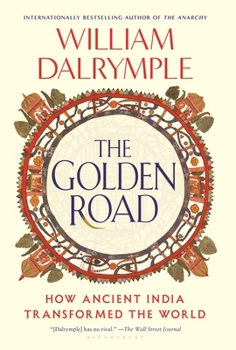
The Golden Road:
How Ancient India Transformed the World
By William Dalrymple
Bloomsbury, New York, 2024
The Golden Road covers the period from 250 BCE to about 1200 CE when:
“… India was a confident exporter of its own civilization, creating around it an empire of ideas which developed into a tangible ‘Indosphere’ where its cultural influence was predominant. During this period, the rest of Asia was the willing and even eager recipient of a startlingly comprehensive mass transfer of Indian soft power, in religion, art, music, dance, textiles, technology, astronomy, mathematics, medicine, mythology, language and literature.” [p. 3]
The Indosphere, Dalrymple emphasizes, was created not by military conquest but through trade in goods and ideas. The annual Asian monsoon cycle gave Indian merchants predictable trade winds that provided easy access to the Red Sea and to the west coast of the Bay of Bengal and points beyond. Dalrymple calls these sea routes the “Golden Road.” He shows that Europeans have vastly overestimated the importance of overland trade routes like the Silk Road – a term that wasn’t even coined until the late 1800s.
Travel by sea was faster, more secure and more reliable.
The Golden Road begins with an account of the origins and spread of Buddhism from northeastern India throughout the subcontinent and into Southeast Asia starting around 500 BCE. Monks and missionaries traveled with the merchants bringing Buddhist teachings with them. Hinduism later spread in a similar way. There seems to have been none of the Christian squeamishness about merchants and commerce in Buddhism. Monasteries accumulated wealth through donations from merchants. Merchants in turn were hailed as heroes in early tales. Both prospered.
Dalrymple describes how trade between India and Rome increased dramatically after the Battle of Actium in 31 BCE, when Augustus defeated Antony and Cleopatra and brought Egypt under Roman control. Huge quantities of Roman gold and silver flooded into the port cities of western India, so much so that the Roman author and scientist Pliny the Elder described India as “the sink hole for the world’s precious metals.” [p. 66] You can still see evidence of this today. Some enterprising folks at Oxford University have been mapping the locations of hordes of Roman coins discovered all over the world. I was surprised by how many have been found in India.
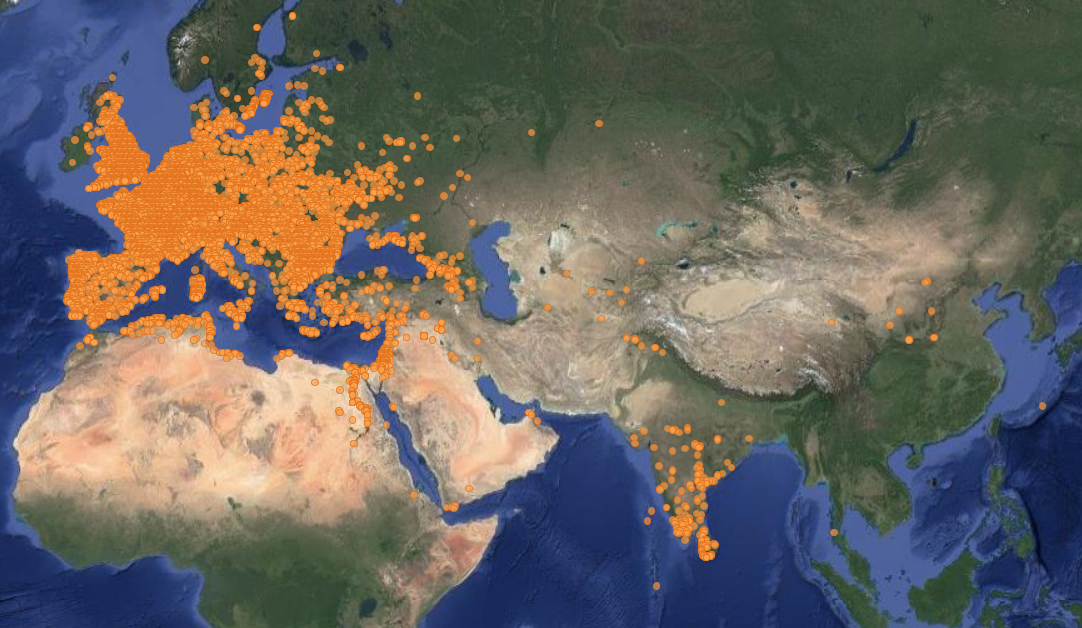
After the fall of the Roman Empire, demand for Indian goods fell dramatically, and the majority of Indian trade shifted to Southeast Asia and China. Dalrymple documents the spread and influence of Buddhism, particularly in China, Indonesia and Cambodia.
It was the rise of Islam, and especially the founding of Baghdad in 762 CE, that led to the decline of India’s direct influence over its Indosphere. However, its indirect influence continued long after. Indian works of science, mathematics and philosophy were translated into Arabic and spread across the Islamic world. And when Christians reconquered Spain, around the turn of the millennium, many of these works were translated into Latin. It was, Dalrymple says:
“… a sometimes forgotten but crucial moment in the development of western civilization: the revival of medieval European learning by a wholesale translation of scholarship from the Indo-Islamic world in a combined operation by Muslim, Jewish and Christian scholars. The importance of this moment, which revolutionized medieval Europe and helped give rise to a renewed culture of science in the west, cannot be exaggerated.” [p. 275]
I was really interested in the chapter that dealt with the spread of Indian numbers and mathematics into Europe. The numerals we use today, which we often call Arabic numerals, actually originated in India. The Indian number system contains two critical innovations that we take for granted but which were revolutionary when first developed. The first is the idea of place value, which you might know better as the ones column, the tens column, the hundreds column, etc. It’s the idea that a digit’s place in a number conveys its scale. The second innovation was the number zero, which was used to signify “nothing” when there were no ones, tens, hundreds, etc. in a particular number. Roman numerals have neither place value nor zero. As a result, they’re basically useless for any kind of calculation.
Indian numerals made their way to Europe via Arabic and gained popularity with the publication in 1202 of Liber Abaci by Leonardo of Pisa, better known as Fibonacci. There was occasional resistance to the adoption in Europe of these new numbers,
“But the progress of Indo-Arabic numerals was ultimately unstoppable: these are the numerals that we now almost all use, around the world, every day. They are arguably the nearest thing the human race has to a universal language.” [p. 268]
Unsolicited Feedback
The Golden Road is similar to a couple of other history books I’ve read in recent years, like Josephine Quinn’s How the World Made the West and Richard Fidler’s The Book of Roads and Kingdoms. These books cover overlapping time periods and even some of the same events. The central point all three make is that history advances through contact and trade across geographies and across civilizations. They also remind us that important history happened all over the world, not just in Europe.
This book is a history of the Indosphere rather than an internal history of India itself. So it does not delve deeply into internal competition or conflict between, say, rival groups or regions within India, or the relationship between Hinduism and Buddhism, or the development of the caste system. All subjects for further reading, I guess.
I’ll freely admit that The Golden Road contained too many unfamiliar names and places for me to remember. I skimmed over some of the details. But Dalrymple’s own enthusiasm for the story of the Indosphere permeates the whole book and brings it to life.
The book is well produced too. There are maps at the beginning of each chapter which I found helpful because ancient place names are mostly not the same as modern ones. There are also three sets of color photographs of art, architecture and historical sites.
I like how Dalrymple concludes the book:
“For a thousand years, India’s ideas spread with its traders along the Golden Road and transformed the world, creating around itself an Indosphere, a cultural zone that spread over political borders – comparable to the Hellenised world fashioned by Alexander the Great, except that India’s was spread not by the sword but by the sheer power of its ideas. Within this area Indian culture and civilization transformed everything they touched.” [p. 298]
As India rises once more, Dalrymple asks, could they do it again?
Thanks for reading.
Discover more from Unsolicited Feedback
Subscribe to get the latest posts sent to your email.


 Unsolicited Feedback