Hannah Ritchie’s new book, Clearing the Air: A Hopeful Guide to Solving Climate Change – in 50 Questions and Answers, was published last year in the UK and will be released in the US on February 17, 2026. I got my copy on a recent trip to Sydney.
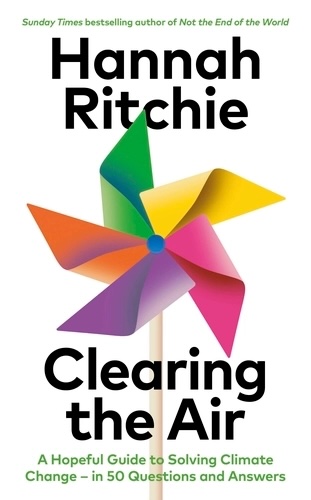
Clearing the Air:
A Hopeful Guide to Solving Climate Change –
in 50 Questions and Answers
By Hannah Ritchie
Chatto & Windus, London, 2025
Hannah Ritchie is Deputy Editor and Lead Researcher at Our World in Data, a fantastic online resource for research and information about the world’s biggest problems. She is also a senior researcher at the Programme on Global Development at the University of Oxford.
I highly recommend Ritchie’s first book, Not the End of the World. It’s a refreshingly optimistic look at eight of our most pressing environmental problems including sustainability, climate change, biodiversity loss and deforestation.
In Clearing the Air, Ritchie answers 50 common questions exclusively focused on climate change. These questions often arise from contradictory claims and outright misinformation that roil public debate and sow doubt and confusion about what we should do.
For example, the fifth question in the book asks, “Aren’t our efforts pointless if China’s emissions keep growing?” Ritchie’s answer is, yes China is the world’s largest emitter of CO2 but it’s rolling out renewables and electric vehicles at “breakneck speed.” She provides detailed information to back this up. In fact, late last year, after the book was published, Carbon Brief, a climate news website, reported that China’s carbon emissions have been flat or declining for the last 18 months. And just last week the same site reported that coal-fired power generation dropped in both China and India in 2025, for the first time in 52 years.
Ritchie arranges these 50 questions into topic areas like fossil fuels, renewable energy, electric vehicles (EVs), nuclear power and minerals. You can read them in any order because they’re mostly independent of each other. For each question, Ritchie provides a headline answer, a detailed answer supported with useful data and charts, a set of “things we need to do” – actions that individuals and governments should take – and some things to keep in mind for a deeper understanding of the issue.
A couple of important themes emerged from the book for me.
First, when you see criticism of climate change solutions, remember to keep the right comparisons in mind. For example, some people claim that wind turbine blades are filling up our landfills, or that we need to mine huge quantities of lithium for batteries, with devastating ecological consequences. It’s certainly true that transitioning to clean energy requires more minerals, and that there will be some waste as a result. However, when compared to the fossil fuel industry, renewables need far less material and generate far less waste and pollution. The point is to compare renewables to our current fossil-based energy system, not to some imaginary zero-impact system that has never existed and never will.
In fact, Ritchie points out that clean-energy alternatives often perform better than fossil incumbents even in areas where clean-energy comes under fire. For example, EVs are often criticized for car fires and poor mileage in cold weather, yet Ritchie shows that gasoline-powered cars have worse performance than EVs on both.
The second theme is that even if clean-energy solutions are imperfect or expensive today, they can be improved and made cheaper and more efficient. The cost of solar panels and batteries has plummeted in recent years due to improvements in technology and manufacturing, for example. And materials used in batteries, solar panels and wind turbines can be recycled. The same cannot be said for fossil fuels: in the end, we’re just burning stuff, and as Ritchie shows, burning stuff is horribly inefficient.
Clearing the Air was published in September 2025, so it must have been written in 2024 and early 2025 – in other words before Donald Trump had done much damage to environmental policy and renewable energy in the US. And it’s true that, globally, the political winds on climate change have shifted dramatically in the last year, as David Wallace-Wells reports in this New York Times article.
Ritchie doesn’t deal much with politics in the book. That’s probably a good thing because her strength is data analysis. But the changing political landscape does give the book a certain shouting-into-the-void quality.
Nonetheless, Clearing the Air provides well-researched, easy-to-understand information to dispel doubts, myths and misinformation about solving climate change.
Thanks for reading.
Related Links
By the Numbers, https://hannahritchie.substack.com/
Hannah Ritchie’s Substack.
David Gelles, “How Wall Street Turned Its Back on Climate Change,” The New York Times, Jan. 17, 2026, https://www.nytimes.com/2026/01/17/climate/how-wall-street-turned-its-back-on-climate-change.html.
David Wallace-Wells, “It Isn’t Just the U.S. The Whole World Has Soured on Climate Politics.” The New York Times, Sept. 16, 2025, https://www.nytimes.com/2025/09/16/magazine/climate-politics-us-world-paris-agreement.html.
Lauri Myllyvirta, “Analysis: China’s CO2 emissions have now been flat or falling for 18 months,” Carbon Brief, Nov. 11, 2025, https://www.carbonbrief.org/analysis-chinas-co2-emissions-have-now-been-flat-or-falling-for-18-months/.
Lauri Myllyvirta, “Analysis: Coal power drops in China and India for first time in 52 years after clean-energy records,” Carbon Brief, Jan. 13, 2026, https://www.carbonbrief.org/analysis-coal-power-drops-in-china-and-india-for-first-time-in-52-years-after-clean-energy-records/.
Discover more from Unsolicited Feedback
Subscribe to get the latest posts sent to your email.


 Unsolicited Feedback
Hi Harry-The link to “read more” could be broken unless it’s a problem on my end. Gwen Hanson, MD 425-830-9402Citizens Climate LobbyYouth Mentor, Co-State Coordinator, and Co-Group Leader Washington State.
LikeLike
I’ve been wanting to know your thoughts on this book. I knew it was about to come out here. I have slacked off participating in my local climate group. It’s hard to remain hopeful with this current administration. But seeing your review reminds me that I need to continue having climate discussions and learning more and contacting legislators. Doing something is better than doing nothing. Thanks, Harry.
LikeLiked by 1 person
I 100% agree with you, Lisa. We still have agency here.
LikeLike
This is really valuable and uplifting information. Thank you.
LikeLiked by 1 person