In the last couple of years, while reading about the environment and climate change, I’ve started to learn about Indigenous ways of knowing and living. This wasn’t at all planned, more a happy accident. Despite having lived my entire life in North America, my knowledge about Indigenous people is rudimentary, cartoonish even. Yet it seems clear that for thousands of years Indigenous people have had a more sustainable and a more respectful relationship with Nature. Earlier this year I read Medicine Wheel for the Planet, a book about Indigenous ways of knowing. But I have much more to learn.
In the Spirit of Right and Respectful Relations is another step along that path.
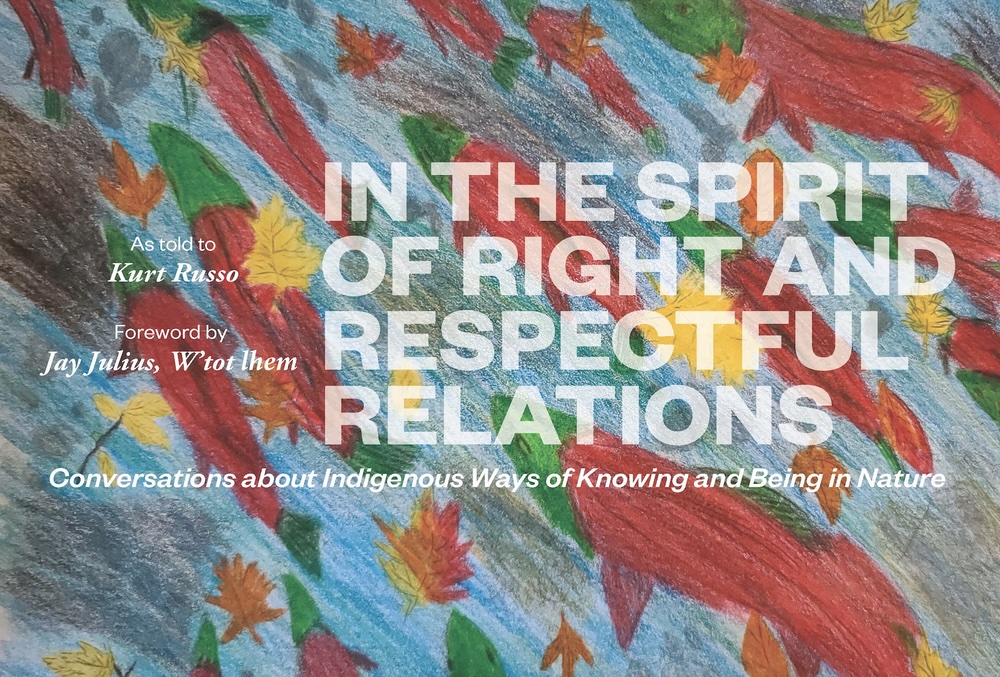
In the Spirit of Right and Respectful Relations:
Conversations about Indigenous Ways of Knowing and Being in Nature
As told to Kurt Russo
Braided River, Seattle, 2025
This slim book – it’s just over 100 pages and beautifully illustrated – is intended as a bridge between settler people like me and the Original Peoples of the Salish Sea, an area along the Pacific coast of southern British Columbia and northern Washington State.
The book was inspired by conversations at a 2023 gathering of respected Pacific Northwest tribal leaders on Orcas Island off the coast of Washington. The gathering was organized by Se’Si’Le, an Indigenous-led organization whose name means “our grandmother” in the language of the Lummi people. The group’s mission is “to utilize Indigenous ancestral knowledge for the benefit of our Mother Earth, Indigenous lifeways, and for future generations.” Kurt Russo, the Co-Executive Director of Se’Si’Le, prepared the book based on those discussions. It’s an attempt to,
“Find a reference point where we are not crossing each other and where, through an exercise of identity and truth-telling, we can find the expression of the spirit of right and respectful relations.” [p. 49]
If I understood correctly, the Indigenous leaders who met on Orcas Island are asking us, the descendants of European settlers, to consider something fundamental: what does it mean to be human? Their answer seems to be that being human means living in the spirit of right and respectful relations.
The book explores what it means to live in the spirit of right and respectful relations with creation, with history and the law, with nature, honor, identity, and even technology.
There cannot be right and respectful relations without truth-telling. So let’s start there.
On May 15, 1792, a merchant named Robert Gray became the first American to sail into the mouth of the Columbia River. He and his crew traded with the local Indians, apparently peacefully. At some point during his nine-day stay on the Columbia, Gray came ashore and claimed all the lands drained by the river and its tributaries – an area about the size of France – for the United States, while the Indians watched from their canoes.
That encounter marked the beginning of “a catastrophic disruption that has brought us in the span of just ten generations to an age of ecological collapse and mass extinction.” [p.39]
The legal justification for Gray’s claim comes from something called the Doctrine of Discovery. Have you ever heard of this? I learned in school about intrepid European explorers claiming land for their countries, but I only recently learned about the so-called legal basis for these claims. The chapter on right and respectful relations with history and the law goes into this in detail.
The Doctrine of Discovery dates back to the 15th Century. It granted Christian European nations the “right” to claim ownership of non-Christian lands outside Europe and to enslave their non-Christian or “pagan” inhabitants. The Doctrine of Discovery is rooted in Papal Bulls (decrees) issued by Pope Nicolas V and his successors starting in 1452 declaring that Indigenous lands were terra nullius or “nobody’s land” and therefore could be claimed by European colonizers who “discovered” them.
In short, the history of colonialism and the displacement, dispossession and dehumanization of Indigenous peoples in the US and many other parts of the world is based on “a false religious pretense” originated nearly 600 years ago by the Roman Catholic Church. (The Vatican did finally repudiate the doctrine. In 2023.)
The Doctrine of Discovery was incorporated into US law through a series of three Supreme Court decisions from the early 1800s known as the Marshall Trilogy. These rulings gave “plenary” or full power over Indigenous people to the US Congress, essentially stripping Tribal Nations of their sovereignty and reducing them to “domestic dependencies.”
In the Spirit of Right and Respectful Relations recounts this horrific history, but participants in the Orcas Island gathering still tried to find common ground. They noted that,
“Everyone alive today comes from an Indigenous heritage somewhere back in their history.” [p. 23]
All of our ancestors sat around a fire telling stories.
So when and why did settler’s European ancestors come to see themselves as masters of nature rather than one with it?
“Seeing nature as a resource is a very different kind of relationship. A relative is not a resource; a resource is a commodity. To value a river, and ocean, a stream, an orca, a salmon, or a human being as a resource is to ‘see through the eye of a colonialized imagination’ … There is no deep relationality or empathy, only an objectified, self-regarding transaction.” [p. 61]
The Lummi people, in contrast, consider salmon and orcas to be their relatives. But dams – there are over 60 of them in the Columbia River basin – over-fishing and climate change have reduced the salmon population by 90% since pre-settlement times. And the orcas, which feed on salmon, are critically endangered in the Salish Sea. The Indigenous people and their way of life are also under threat.
“I am not a radical. What is radical is to believe it is right and respectful to murder Mother Nature.” [p. 59]
In the Spirit of Right and Respectful Relations could have been filled with anger over betrayals and broken promises and been completely justified. And there is some of that in the book. But I was also struck by a spirit of openness and generosity towards the possibility of dialog, understanding and better relations between Indigenous and settler peoples.
Yet there’s a clear message too: unless we settler people adopt right and respectful relationships with Nature, and with all of Creation including other peoples, the result will be “ecocide leading to extinction and, with it, genocide.”
The tipping point is not in some distant future. It’s already here.
Thanks for reading.
Discover more from Unsolicited Feedback
Subscribe to get the latest posts sent to your email.


 Unsolicited Feedback
A good piece about an important book, thank you for sharing.
LikeLiked by 1 person
This sounds like a valuable book. The older I get, the more I realize I wasn’t taught much of history after all; instead, I just got a very small, carefully curated slice of a very one-sided story.
LikeLiked by 1 person
Yes, exactly!
LikeLike