Over the years, I’ve read a few books about investing, personal finance and retirement planning. I got fascinated by the stock market in my early twenties while I was still at university. Fortunately, I didn’t have enough money back then to lose anything significant. Eventually I realized that although the market as a whole generally performs well, consistently making money picking individual stocks is a crap shoot. Since then, most of my investing has been about saving for retirement through 401K plans at work.
For younger people the job market has become extremely volatile. Companies discard employees through endless rounds of layoffs, seemingly just to please Wall Street. You need to regularly update your skills and even change careers to stay relevant and competitive. And then there’s the ominous threat of AI displacing even more workers.
So, while saving for retirement is still very important, I think everyone needs a financial cushion to help them through tough times. Equally important, a financial cushion gives you the flexibility to live your life the way you want to, to take time off for study or travel, or to pursue other life goals.
This is where the financial independence movement comes in. Financial independence means accumulating enough wealth so that you can live off the income generated by your investments and you no longer need work. Does this sound like a pipe dream?
JL Collins, author of The Simple Path to Wealth: Your Road Map to Financial Independence and a Rich, Free Life has been called the “godfather of financial independence.” He got started by writing a series of letters to his then-teenage daughter Jessica about investment and financial freedom. Those letters formed the basis for a blog which he then turned into this book, first published in 2016. I read the revised 2025 edition. Collins has a degree in English Literature from the University of Illinois at Champaign-Urbana.
“For me, the pursuit of financial independence has never been about retirement. I like working and I’ve enjoyed my career. It’s been about having options. It’s been about being able to say no. It’s been about having “F-You Money” and the freedom it provides.” [p. 5]
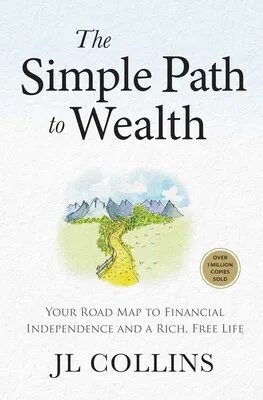
The Simple Path to Wealth:
Your Road Map to Financial Independence and a Rich, Free Life
By JL Collins
Authors Equity, New York, 2025
The Simple Path
In The Simple Path to Wealth, Collins prescribes three basic principles for achieving financial independence.
- Spend less than you earn.
- Invest the surplus.
- Avoid debt.
I’ll summarize each one briefly. Oh, and I hope I’m not disappointing anyone: this is a book review only. I’m not offering any investment advice here.
Collins advises living on just 50% of the income you earn and saving the rest. This instills the discipline of living below your means which gives you greater financial freedom. He also says to avoid fiscally irresponsible people. Never marry one or give them access to your money.
Next, invest what you’ve saved. Collins suggests putting 75% of your savings in low-cost stock market index funds. The other 25% should be invested in bonds, specifically broad-based bond funds. The caveat here is that you’ll need to learn to tolerate the ups and downs of the stock market in order to build wealth. Once you can live on 4% of your investments, or your investments total 25 times your annual expenses, you are financially independent.
Finally, Collins urges everyone to avoid the ball and chain of debt. Debt is the exact opposite of financial freedom. It makes you a slave to your job. If you already have debts, and most of us do, Collins advises ranking them in order by interest rate, paying off the highest interest debt first while making the minimum required payments on everything else. Then work your way down the list.
But, what about …?
You probably have questions.
So did I.
Can you actually live on just 50% of your income? I think this is extremely hard, and for people in low-wage jobs or with young children to support or elders to care for or other demanding circumstances it’s probably impossible. Collins certainly doesn’t claim it’s easy. His point is that if you want to achieve financial independence you must accumulate wealth and that means saving as much of your income as possible. His other point is that you can live on much less than you think. A lot of our spending is about wants rather than needs.
OK, but can you actually live on 50% of your income. Or do you have to subsist on ramen noodles and live in a tar-paper shack? I don’t think Collins is suggesting we should all live like monks, but if you spend money to achieve a particular lifestyle, that money is no longer available to invest. This trade-off is what economists call opportunity cost.
Does this mean you have to be obsessed with money or spend huge amounts of time tracking it and managing it? Collins says no. His program is designed to be very simple and doesn’t require constant monitoring or tinkering. Nevertheless,
“Life choices are not always about money, but you should always be clear about the financial impact of the choices you make.” [p. 267]
Avoiding debt sounds great in theory, but how can you buy a car or a house or get a college education without it? Contrary to popular opinion, Collins isn’t a fan of home ownership as an investment. He says houses are an expensive “indulgence” though he still owns one. What he suggests is to buy the minimum house you need rather than the maximum house you can afford. I think his point here is that even though your home will usually appreciate in value, the stock market performs better than real estate over the long term. The data seems to confirm this. The same advice would apply to cars – buy the minimum car you need.
On college education, Collins doesn’t really have an answer. He rails against the current student loan system in the US, and says it has driven up tuition fees and saddles young people with enormous debt burdens. But he doesn’t suggest any alternative. I don’t think there is an alternative without major new legislation. And did you know that, unlike other kinds of debt, you can’t get rid of student loans by declaring bankruptcy?
Unsolicited Feedback
Collins writes in an informal, chatty style but there’s no mistaking his passion for the subject. Some of the material is a bit repetitive, but it’s all presented in a very understandable way.
Most of the book is devoted to the second of Collins’ three principles – investing your savings. The book doesn’t tell you how to set up and manage a budget, for example. You’ll need to find other sources if that’s a topic you’re interested in.
Collins is a strong advocate for investing with Vanguard. It’s an investor-owned financial management company founded 50 years ago by John Bogle that pioneered in offering low-cost mutual funds. I have no objections to Vanguard, but Collins’ repeated touting of them put me off. It made him sound like a sales rep for the company. That said, I do agree that you should look carefully at the costs (expense ratios) of any investment funds you buy.
I read the revised 2025 edition, but it seemed to me that some of the content was still a little dated. For example, in my opinion there should have been more emphasis on Exchange Traded Funds (ETFs) over mutual funds. Fortunately there’s a handy Tool Kit chapter at the end of the book that both summarizes the key points and provides an FAQ that gives some good updates.
Despite these minor complaints, I think Collins’ three principles are fundamentally sound even if they seem a little extreme. The overall point is to be intentional about how you use your money over the course of your life.
Whether you aspire to financial independence and early retirement or just want to build up some F-You Money, knowing how to save and invest are important life skills. You’re never too young to start or too old to brush up. The Simple Path to Wealth is one of many books that can help you.
Thanks for reading.
If you enjoyed this review, please subscribe to Unsolicited Feedback.
Discover more from Unsolicited Feedback
Subscribe to get the latest posts sent to your email.


 Unsolicited Feedback
I’m currently reading “Die with Zero” that a friend recommended. The author’s financial advice is to spend your money when you can most enjoy it, which basically is when you’re younger vs when you’re older. The concept makes sense, but not sure it can work that way for everyone. 😉 I do like his premise though that making money isn’t the goal itself, but just a conduit for the real goal of enjoying life.
In the book you mention, I like the freedom concept of having “F-You Money.”
LikeLiked by 1 person
Yes, I liked that idea a lot too!
LikeLike