
On August 1, 2025, the US Environmental Protection Agency (EPA) announced it was proposing to reconsider its 2009 endangerment finding about greenhouse gas emissions. “Reconsidering” here means rescind, revoke, roll back.

In describing this action, Trump’s EPA Administrator, Lee Zeldin, crowed:
“We are driving a dagger straight into the heart of the climate change religion …”

Of course, climate change isn’t religion, it’s science. However, there’s no point expecting anyone in the Trump Administration to acknowledge that. Still, Zeldin is right about one thing: rescinding the endangerment finding is a dagger to the heart of climate regulation in the US. In this post, I’m going to explain why.
What is the endangerment finding?
It’s an official statement from the EPA in 2009 that:
“… greenhouse gases in the atmosphere may reasonably be anticipated both to endanger public health and to endanger public welfare.”
It further lists these six greenhouse gasses as air pollutants:
- Carbon dioxide (CO2)
- Methane (CH4)
- Nitrous oxide (N2O)
- Hydrofluorocarbons (HFCs)
- Perfluorocarbons (PFCs)
- Sulfur hexafluoride (SF6)
Why is the endangerment finding so important?
To understand the importance of the endangerment finding, we need to look at the Clean Air Act (CAA), the 1970 law that gives the EPA the authority to regulate air pollution.
Section 202(a) of the CAA says:
“The Administrator shall by regulation prescribe (and from time to time revise) in accordance with the provisions of this section, standards applicable to the emission of any air pollutant from any class or classes of new motor vehicles or new motor vehicle engines, which in his judgment cause, or contribute to, air pollution which may reasonably be anticipated to endanger public health or welfare. …”
The writing style they use in legislation can be a little hard to parse if you’re not used to it. Essentially what section 202(a) does is give the Administrator of the EPA broad authority to regulate air pollutants coming from new motor vehicles or motor vehicle engines. I want to highlight two words from this section.
First, the word “shall” in this context really means “must.” It’s a command, a direct order from Congress to the EPA to regulate motor vehicle air pollution. It’s not optional, not something the EPA should do if they have time, or might do when they get around to it. It’s mandatory.
But the EPA can only regulate an air pollutant if they determine that it “endangers” public health or welfare.
For a long time, the EPA resisted regulating greenhouse gasses. Under the Bush Administration, the EPA claimed it lacked authority from Congress to regulate GHGs. But in a 2007 case called Massachusetts v. EPA, the US Supreme Court said that GHGs are pollutants under the CAA and that the EPA has the authority to regulate them.
Now, SCOTUS did not say the EPA had to regulate GHGs, only that it had the authority to do so. That’s why the endangerment finding is so critical: once the EPA concluded GHGs endanger public health and welfare – which they finally did in 2009 during the Obama Administration – they were obligated under the CAA to regulate them.
So as of 2009, we had support for regulating GHGs from all three branches of government: from Congress in the Clean Air Act, later reenforced by the Inflation Reduction Act, from the courts in Massachusetts v. EPA, and from the executive branch with the endangerment finding.
Think of it as a three-legged stool on which all subsequent greenhouse gas regulations sit. This includes regulation of GHGs in tailpipe emissions from cars and trucks, GHG emissions from power plants, and even regulating methane leaks from oil and gas operations.
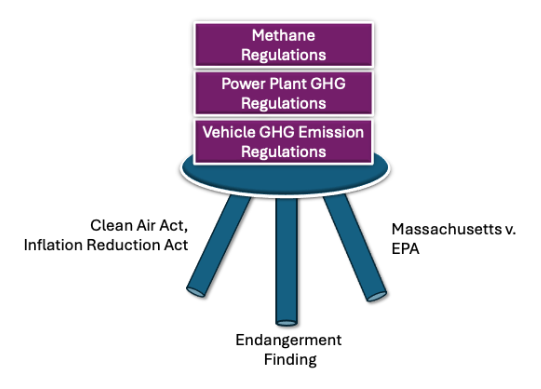
By rescinding the endangerment finding, the Trump Administration is trying to knock out one leg of the stool, and I think they hope the Supreme Court will knock out another one – by overturning Massachusetts v. EPA – when it rules on the inevitable lawsuits.
If the endangerment finding falls, all the regulations that depend on it fall too.
How can they justify this?
Back in 2009, the scientific evidence that anthropogenic GHG emissions cause climate change was pretty solid. Sixteen years later, that evidence is now overwhelming. And our own experience confirms it: we’ve seen and lived through increasingly frequent and dangerous forest fires, storms, floods, heatwaves, etc. So how can the Trump Administration possibly justify rolling back the endangerment finding?
Without getting into too much detail, they’re basically saying three things:
They’re attacking the EPA’s authority to regulate GHGs. They claim the EPA can only regulate local or regional pollutants, not global pollutants like GHGs.
They’re attacking the science. The EPA relies heavily on a report called A Critical Review of Impacts of Greenhouse Gas Emissions on the U.S. Climate from the Department of Energy’s Climate Working Group – a handpicked crew of five well-known climate skeptics.
Finally they’re claiming that even if the government did regulate GHGs from motor vehicles, it would have no significant impact since US vehicles account for only a small portion of global GHG emissions.
You could say these justifications are far-fetched, politically motivated or just plain bogus, and I’d agree. But, as always, follow the money. Depending on how you count, the oil and gas industry spent between $219-million and $450-million supporting Trump and Republican candidates during the 2024 election cycle. They’re certainly getting their money’s worth.
What happens now?
A public comment period runs until September 15. Anyone can submit a comment by going to https://www.regulations.gov/commenton/EPA-HQ-OAR-2025-0194-0093. I plan to. If you’d like to submit a comment – please do! – you might want to check out a little guide called “What Makes an Effective Public Comment” from Protect Democracy.
The EPA will also be holding virtual public hearings on August 19 and 20, possibly spilling into August 21 if needed. You can register to participate by sending an email to EPA-MobileSource-Hearings@epa.gov. Register by August 12 if you want to testify.
Next the EPA will respond to the comments and post a revised final rule. My guess is that this will happen early in 2026.
Then come the lawsuits. I’ve no doubt that environmental groups and others will sue the EPA over this rollback. These cases will work their way through the lower courts and end up at the Supreme Court, probably in 2027 or 2028.
What happens at the Supreme Court is anyone’s guess. Massachusetts v. EPA was decided by a slim 5-4 majority. All five of the majority justices have either retired or died. Three of the four dissenters remain on the Court – Roberts, Alito and Thomas – and the overall composition of the Court has shifted sharply to the right since 2007.
In recent years, the Supreme Court has been notably hostile to the EPA. It debuted its “major questions doctrine” in West Virginia v. EPA back in 2022, a case about regulating GHG emissions from power plants.
If the Supreme Court rules in favor of the EPA, it will permanently block any future Administration from regulating GHGs. We would need new legislation from Congress.
In a sane world, you’d expect the EPA’s rollback of the endangerment finding to get laughed out of court. But that’s not the world we live in. Frankly even if the Supreme Court eventually rules against the EPA, the Trump Administration still wins by tying up any regulation of GHGs for the next few years. Clearly, that’s what they want: to not regulate GHG emissions at all.
And that’s the best case scenario.
A couple of weeks ago I posted a rare bit of good news on climate change from the International Court of Justice. Well, this is anything but good news. I wish I could say there’s a silver lining lurking somewhere in this mess. But there isn’t.
Thanks for reading.
Related Links
“The E.P.A.’s Disastrous Plan to End the Regulation of Greenhouse Gases” Article by Elizabeth Kolbert in The New Yorker, August 4, 2025, https://www.newyorker.com/news/the-lede/the-epas-disastrous-plan-to-end-the-regulation-of-greenhouse-gases.
“Trump’s EPA proposes to end the U.S. fight against climate change” Article by Harvard Law Professor Jody Freeman in the Los Angeles Times, August 5, 2025, https://www.latimes.com/opinion/story/2025-08-05/climate-change-epa-greenhouse-gas-emissions-endangerment-finding.
“The Republican campaign to stop the U.S. EPA from protecting the climate” Article by Dana Nuccitelli article in Yale Climate Connections, August 1, 2025, https://yaleclimateconnections.org/2025/08/the-republican-campaign-to-stop-the-u-s-epa-from-protecting-the-climate/.
“Trump’s Move to Kill the Clean Air Act’s Climate Authority, Forever” Episode of the ShiftKey podcast hosted by Robinson Meyer and Jesse Jenkins, August 6 2025. Available on Apple Podcasts at https://podcasts.apple.com/us/podcast/trumps-move-to-kill-the-clean-air-acts-climate/id1728932037?i=1000720867702 and on Spotify at https://open.spotify.com/episode/0Y0BDxrRrunoybJZ09mmze.
“Trump Is Destroying the Future of America to Own the Libs.” Article by Robinson Meyer in The New York Times, August 11, 2025, https://www.nytimes.com/2025/08/10/opinion/electric-vehicles-china-clean-energy.html. While not directly related to the endangerment finding, this article shows how Trump’s war on our electricity industries, including clean technologies like wind and solar, are destroying our long term economic future.
Discover more from Unsolicited Feedback
Subscribe to get the latest posts sent to your email.


 Unsolicited Feedback
Pingback: My Testimony at the EPA | Unsolicited Feedback
Thanks for explaining this in an understandable way. Truly heartbreaking.
LikeLiked by 1 person
Pingback: Endangerment Finding Revoked | Unsolicited Feedback