Ever since the November 2024 election, Democrats, liberals, progressives – whatever you want to call them – have been doing some deep soul searching (maybe even soul spelunking), asking themselves, “How on Earth could we have lost to Donald Effing Trump, again?” And, “Where do we go from here?”
Abundance, a new book by Ezra Klein and Derek Thompson, offers an inspiring framework for finding the answers. Ezra Klein is a New York Times columnist and author of Why We’re Polarized, and Derek Thompson is a staff writer at The Atlantic. The thesis of their book is simple: “to have the future we want, we need to build and invent more of what we need.” [p. 4]
Sounds sensible, right? Maybe even obvious.
The problem, as Klein and Thompson argue, is that liberalism has made it damn near impossible to build and invent here in the US. As evidence they walk us through the nationwide housing crisis, California’s absurd decades-long failure to build high-speed rail and the increasingly risk-averse way that research grants are awarded by the National Institutes of Health. It’s not entirely the fault of the left of course.
“Over the course of the twentieth century, America developed a right that fought the government and a left that hobbled it.” [p. 5]
Still, Abundance is primarily a critique of liberalism, by liberals, for liberals.
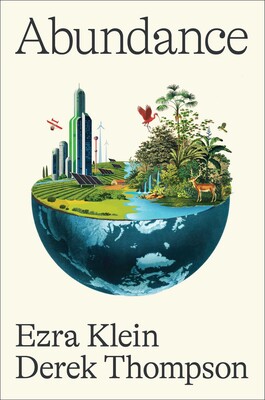
Abundance
By Ezra Klein and Derek Thompson
Avid Reader Books, New York, 2025
How did we get here?
Klein and Thompson trace the origins of the problem back to the successful reforms of the 1970s. At that time, progressives were alarmed by the excesses of New Deal and post-war growth, like air and water pollution and freeways getting rammed through Black and low-income neighborhoods.
Congress, with bipartisan support, enacted the Clean Air Act, the Clean Water Act and other legislation to slow down government, to make government think about what it was doing. But regulations, initially well-intentioned, have become so complex and burdensome that they’re now dysfunctional. They have weakened the capacity of government to deliver for the people. Yesterday’s solutions have become today’s problems.
The housing crisis is perhaps the most visible example of this. Building codes and zoning regulations are designed to protect the value of existing homes, making it difficult to build new ones or to increase housing density. To make matters worse, cities like San Francisco can’t build affordable housing because their own procurement rules get in the way. They’ve layered on so many requirements, like employing unionized labor, contracting with minority-owned businesses, and environmental impact studies, that costs balloon and construction gets delayed. Any one of these rules and requirements may be laudable by themselves but their combined effect is that not enough housing gets built.
The key point Klein and Thompson make here is that we have a housing shortage because of our choices.
We have chosen scarcity.
The problem is especially acute in blue states which have come to value process over results. “We prefer that projects go badly by the book,” said one government official. Klein and Thompson note the inability of governments to prioritize, to say “no” to interest groups, or to even recognize that trade-offs exist. They call this “everything-bagel liberalism.”
People have noticed. And they’re responding — by moving to red states like Texas and Florida. This has dire political consequences for Democrats because the 2030 census could shift Congressional seats to red states making it even harder for Democrats to win national elections.
And it’s not just housing. To fight climate change, we need to build huge amounts of clean energy generation and transmission capacity.
“Either we build faster or we accept catastrophe. There is no third option.” [p. 97]
It’s ironic, but today red states are better at building out renewable energy — solar and wind — than blue states.
What’s happened is that liberals have become schizophrenic, seeing government as a problem solver and then as a problem source. To be fair, conservatives are schizo too.
“Liberals speak as if they believe in government and then pass policy after policy hamstringing what it can actually do. Conservatives talk as if they want a small state but support a national security and surveillance apparatus of terrifying scope and power.” [p. 105]
How do we get out of here?
Abundance is not a prescription or a policy blueprint. It’s not trying to be a liberal Project 2025 — thank goodness! As Klein and Thompson say, they’re offering a lens not a list.
That lens in abundance.
They explicitly reject a scarcity mindset and the idea of degrowth.
“We do not subscribe to the seductive ideologies of scarcity. We will not get more or better jobs by closing our gates to immigrants. We will not turn back climate change by persuading the world to starve itself of growth. It is not merely that these visions are unrealistic. It is that they are counterproductive. They will not achieve the futures they seek.” [p. 19]
Instead, they advocate a vision of abundance, a vision of the future that escapes the trap of chosen scarcity. Abundance, they say, is “a state in which there is enough of what we need to create lives better than what we have had.” [p. 20]
The way to achieve abundance is through new science and technology and “a liberalism that builds.”
Science and technology are essential because that’s how we increase productivity and with it our living standards. That’s how we address climate change too.
“Politics should take technology more seriously. Innovation can make impossible problems possible to solve, and policy can make impossible technologies possible to create. The fundamental link between the two is not at the core of the Democratic or the Republican agenda. Instead, we are stuck between a progressive movement that is too afraid of growth and a conservative movement that is allergic to government intervention.” [p. 173]
But invention isn’t enough. Governments also need to enable implementation, deployment, and building.
“Whether government is bigger or smaller is the wrong question. What it needs to be is better. It needs to justify itself not through the rules it follows but through the outcomes it delivers.” [p. 128]
And it is possible. The authors celebrate the development of COVID-19 mRNA vaccines in less than a year under Operation Warp Speed, and the June 2023 reconstruction of the collapsed I-95 bridge in Philadelphia, Pennsylvania that took just twelve days. Now, both were emergency situations where the standard rules and procedures were, with good reason, set aside. But they illustrate what governments are capable of.
They point out that external pressures and internal crises converged in the 1930s and in the 1970s to open new possibilities and create new kinds of politics. That could be happening again with China as the external pressure and our internal divisions and sclerosis as the internal crisis. It’s an opportunity to escape the noxious politics of scarcity that’s focused on endless arguments about fairness and redistribution, and instead choose an abundance mindset open to new inventions, new solutions and new possibilities.
Unsolicited Feedback
I’m not familiar with Derek Thompson’s work, but Ezra Klein has previewed many of the ideas in Abundance in his New York Times articles and in episodes of his podcast, The Ezra Klein Show. The book weaves them together into an organized, well-articulated whole. It’s passionately argued, but never crossed the line into a polemic.
Abundance reflects what seems to be a broad consensus on both the right and the left that all levels of government in the US need serious reform. Governments are too bloated, too slow and too unresponsive to our needs. We can all see how Donald Trump and Elon Musk are tackling the problem at the federal level – with a chainsaw. And with cruel contempt for the people they’re affecting – be they government employees or US citizens.
So are Klein and Thompson calling for a liberal version of DOGE, Trump’s so-called Department of Government Efficiency? Or maybe a “kinder, gentler” DOGE? Well, no. Abundance doesn’t get much into specific policies. The book is more a framework – a lens – for thinking about how to move forward. Nonetheless, reform will require hard choices. Democrats will have to prioritize some things and let go of others. They’ll need to streamline some processes and roll back some regulations. They will disappoint, even piss off some people, probably some of their own supporters. While the authors don’t get into the details of what those reforms should be, they clearly think reform must be in service of achieving some vision for the future. Their vision centers on abundance. It’s not clear to me that conservatives, at least the ones currently in office, have any vision at all beyond nihilism, or if they do have one, it’s based on a return to some imagined glorious past of the 1950s or maybe the 1850s.
I hope we change course and choose abundance.
Thanks for reading.
If you enjoyed this review, please subscribe to Unsolicited Feedback.
Related Links
Thompson, Derek (host). “Derek Thompson and Ezra Klein on the Essay That Inspired Their New Book, ‘Abundance’.” Plain English with Derek Thompson, Mar. 17, 2025, https://www.theringer.com/podcasts/plain-english-with-derek-thompson/2025/03/17/abundance-with-ezra-klein
Thompson, Derek. “The Political Fight of the Century.” The Atlantic, 18 Mar 2025, https://www.theatlantic.com/ideas/archive/2025/03/abundance-americas-next-political-order/682069/.
A summary of some of the key points of Abundance by one of its co-authors.
Dunkelman, Marc J. “The Question Progressives Refuse to Answer.” The Atlantic, 2 Apr. 2025, https://www.theatlantic.com/ideas/archive/2025/04/democrats-need-to-want-to-build/682264/
A more academic review of the history of progressivism in the US highlighting the central problem of deciding which institution should exercise power in order to make government work better.
Discover more from Unsolicited Feedback
Subscribe to get the latest posts sent to your email.


 Unsolicited Feedback
Fascinating. This sounds like it could be a good complement to the books I’ve read lately about why folks support Trump. While there are some differences with the housing situation here in Canada (incl houses being even more expensive than in the States), one commonality is that we need better alternatives to what we’ve done in the past and to what the right offers.
LikeLiked by 1 person
I agree. People expect their governments to deliver. If they don’t it leaves an opening for radical/destructive actors like we’re seeing in the US.
LikeLiked by 1 person
Such an interesting perspective! I just got the sample sent to my Kindle so I can check it out. I’m up for ideas on how we can self-critique to find better ways of moving forward to get out of this message we’re currently in.
LikeLiked by 1 person