What If We Get It Right? Visions of Climate Futures is a different kind of climate book. It’s not about how badly we’ve messed up the planet, or about technical solutions to decarbonizing particular industries. Instead, the book asks us to imagine what the world might look like if we implement the solutions we already have.
Author Ayana Elizabeth Johnson interviewed twenty people – scientists, activists, journalists, policy experts, entrepreneurs, and artists – for their visions of the future. I was familiar with only a few of them, like environmental activist Bill McKibben, who founded 350.org and Third Act, Jigar Shah, who headed up the Loan Programs Office at the US Department of Energy in the Biden Administration, and climate scientist Kate Marvel. The interviews are mingled with poetry and photography, and Johnson herself wrote the opening and closing essays. All in all, What If We Get It Right? delivers a broad range of perspectives.
Ayana Elizabeth Johnson is a marine biologist, writer and policy expert. She holds a BA in Environmental Science from Harvard University and a PhD in Marine Biology from Scripps Institute of Oceanography. I first encountered her writing in The Climate Book, created by Greta Thunberg, which included Johnson’s essay Remembering the Ocean.
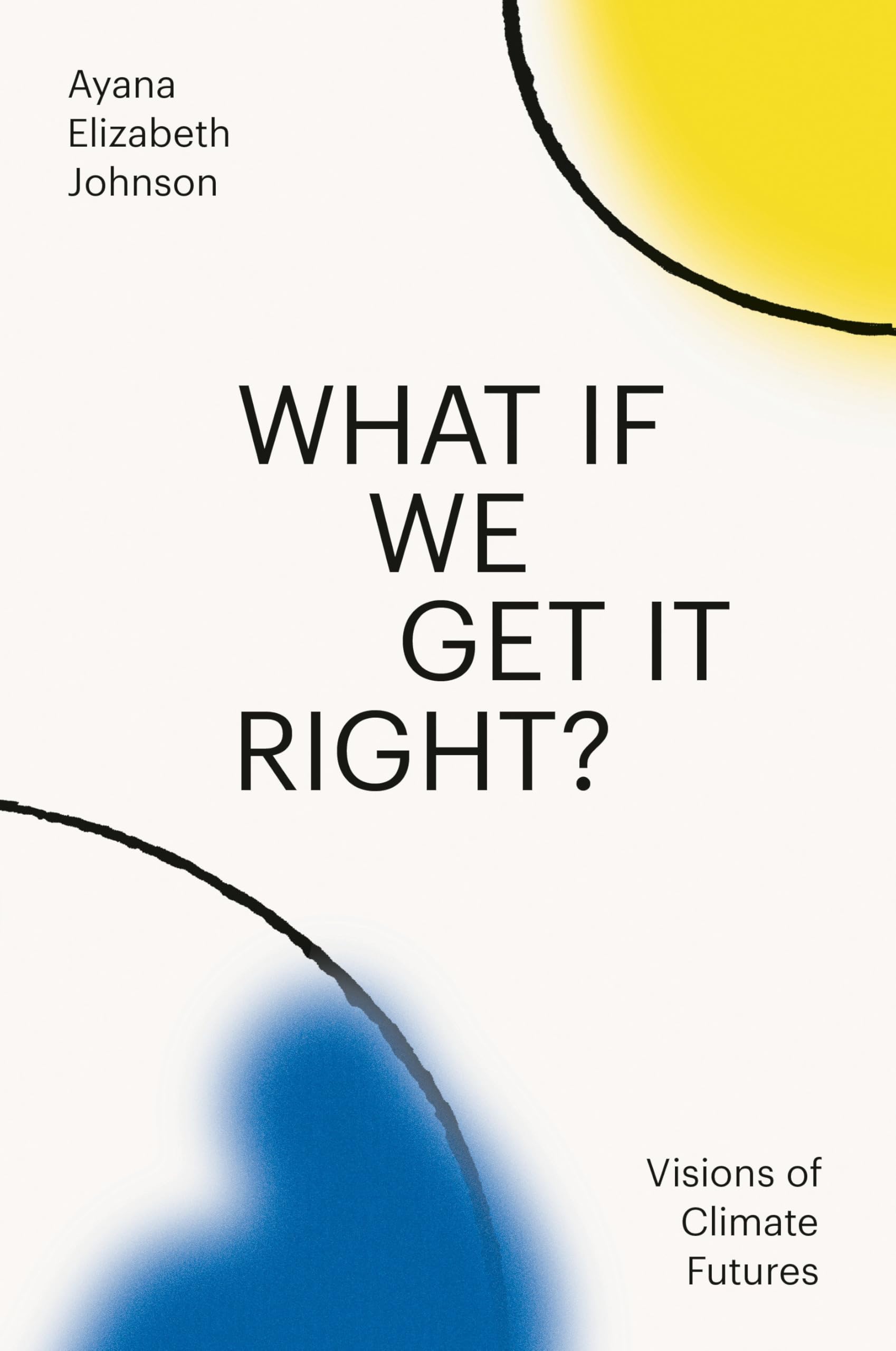
What If We Get It Right? Visions of Climate Futures
By Ayana Elizabeth Johnson
One World, New York, 2024
The interviews, which make up the bulk of the book, are loosely structured and sometimes meander as conversations naturally do. Johnson gets each person to talk about their background and their work, and she asks them some variant of these three questions:
- What does the future look like when we get it right?
- What are three things you wish everyone knew about climate change?
- What is the nerdiest, least sexy, most esoteric thing we need to do?
With twenty different people from a such wide range of disciplines and backgrounds, What If We Get It Right? doesn’t present a single unified view of the future, and that’s a good thing, but there are some recurring themes:
- A closer connection to the land: more people growing more of our food locally on smaller farms and being less dependent on massive agricultural conglomerates in centralized places like California’s Central Valley. This sentiment was especially strong with interviewees from Indigenous communities.
- A greater connection to each other: many interviewees called for a shift away from an isolating individualism towards building and living within communities, including walkable “15-minute cities” with efficient public transit and fewer cars. A more localized economy where we produce more of our energy locally, put our money in local credit unions, and buy goods from local businesses.
- A shift away from an economy built on extraction to one built around regeneration. Echoing Kate Raworth’s ideas from Doughnut Economics, some interviewees showed a clear desire to reshape our economy into something different as we transition away from fossil fuels. Let’s not just insert clean energy into the existing system built around dominant multinational corporations.
- A focus on climate justice: ensuring that the most vulnerable among us are not left behind, again, in the transition to clean energy. This includes making sure the materials and resources used to build the wind turbines and solar panels and all the rest are justly sourced.
Here are some highlights from the interviews.
Bill McKibben says, “Capitalism is straight up behaving like a suicide machine.” The world’s 60 biggest banks have loaned fossil fuel companies over $4-trillion since the Paris Agreement was signed in 2015. The top four US banks alone loaned more than $1-trillion. This means the money in your bank accounts and your retirement accounts is being turned over to Big Oil to produce more fossil fuels. For some Americans, the carbon footprint of their bank accounts might be greater than all the driving, flying, cooking, heating and cooling they do in a year.
Jigar Shah reminds us that we can’t solve all climate problems at the federal level. In fact, most problems are local, he says. For example, only 4% of US homes have installed rooftop solar. In Australia it’s 30%. Shah says that’s because municipal governments place restrictions on installing rooftop solar – something we can change through activism in our own communities.
Johnson spoke with landscape architect Kate Orff about restoring natural shorelines, also known as green infrastructure. Orff, a New Yorker, tells how after hurricane Sandy, she realized that “infrastructure is other people” and “our social lives and our connectedness to each other are going to do as much to protect us from whatever risks we face as any physical project.” [p. 96]
Collette Pichon Battle is an attorney and climate justice organizer at Taproot Earth working to build resilient communities along Louisiana’s Gulf Coast. She highlights the traditional ecological knowledge held by Black and Indigenous elders and how that knowledge can help meet the challenges of climate change and climate disasters.
Bren Smith, co-founder of Greenwave, provides a toolkit for people who want to set up regenerative ocean farms growing kelp and shellfish. He speaks to Johnson about “working-class environmentalism” and worries about how to empower small farmers so that ocean farming doesn’t become yet another industry dominated by huge multinational corporations.
A lot of this, most of it really, makes sense. Let’s use the climate crisis as an opportunity to change how we relate to each other and to the Earth. However, I have to say that some aspects of these visions didn’t appeal to me. I have no interest in farming, for example. I worry that an over-emphasis on place and locality can lead to parochialism and narrow-mindedness, and we have way too much of that already. I got an overall sense of a future characterized by contraction, even hunkering down. No one seemed to be envisioning a world of cheap, clean energy and what that could do for increasing abundance and prosperity. After all, as Hannah Ritchie points out in her book Not the End of the World, we’ve never had a sustainable society because we’ve never met the needs of everyone in the present generation, let alone future ones. We actually need an expansive vision that ensures everyone is thriving and free from hunger and preventable disease. That seems to me like a vision worth aiming for too.
The most poignant thing about What If We Get It Right? is that it was published just a few months before Donald Trump won the 2024 US election. In his first week in office, Trump signed a bunch of executive orders on climate change that are a huge reversal for the US and the world. We don’t have time for this stupidity. The Earth can’t wait another four years. As Johnson says,
“… it’s too late to ‘solve’ or ‘stop’ climate change. We have already changed the climate. We have already frayed the web of life. The greenhouse gasses are out of the bag, and we don’t have a time machine. We are at the stage of figuring out how to minimize the damage, mitigate the impacts, and adapt to this unknown new world – while ensuring that those who are already marginalized and struggling aren’t placed in yet more danger.” [p. 13-14]
We can’t just throw up our hands. We have to find ways to act, perhaps like Jigar Shah suggests, at state and local levels. Because this fight isn’t over.
While climate models have improved dramatically over the last decade, they still contain uncertainties, especially around tipping points like the Amazon turning from a rain forest into a savannah. Climate scientist Kate Marvel says,
“… the best response to the uncertainty is to say: Let’s not do this experiment on our planet. Let’s not go there. What we know for sure is that the more we limit warming, the better. But we can’t ever say, oh, we’re doomed if we exceed this value and we’re saved if we don’t. We just don’t have that level of precision and we never will.” [p. 21]
But she adds,
“The biggest uncertainty in climate projections, the wild card, is what humans will do. So if you don’t like what an article is reporting about a possible future trend, you have the ability to help change that.” [p. 30]
As Ayana Elizabeth Johnson says, “the only way out is through.”
Thanks for reading.
Click here for more posts on climate change.
If you enjoyed this review, please subscribe to Unsolicited Feedback.
Discover more from Unsolicited Feedback
Subscribe to get the latest posts sent to your email.


 Unsolicited Feedback
I had a conversation with my brother-in-law just today about his thoughts on getting solar panels for his house. He’s very interested, which was encouraging to me (even though I haven’t seriously considered it for my own house!). It’s still easy for me to get overwhelmed about the climate, in the midst of all the other craziness going on around us. But you’re right to focus on things we CAN do and not give up the fight. We can’t afford to do nothing.
LikeLiked by 1 person