Getting to net zero isn’t enough.
Average global temperatures have increased by around 1.2ºC above pre-industrial levels. We’re already starting to feel the impacts of climate change. Those impacts are falling hardest on the people, mainly in the global South, who are the least responsible and the least able to adapt. A fair and just response to the climate crisis requires us to first reduce greenhouse gas emissions and then restore our atmosphere, and thus our climate, to pre-industrial conditions. We could do this for methane within our lifetimes.
That’s the central argument of a new book called Into the Clear Blue Sky: The Path to Restoring Our Atmosphere by Rob Jackson. Jackson is a Professor and Senior Fellow at Stanford University’s Woods Institute for the Environment. He’s also the founder and chair of the Global Carbon Project, an international research initiative aimed at improving our knowledge of Earth’s carbon cycle to inform policymaking and guide action to reduce greenhouse gas emissions.
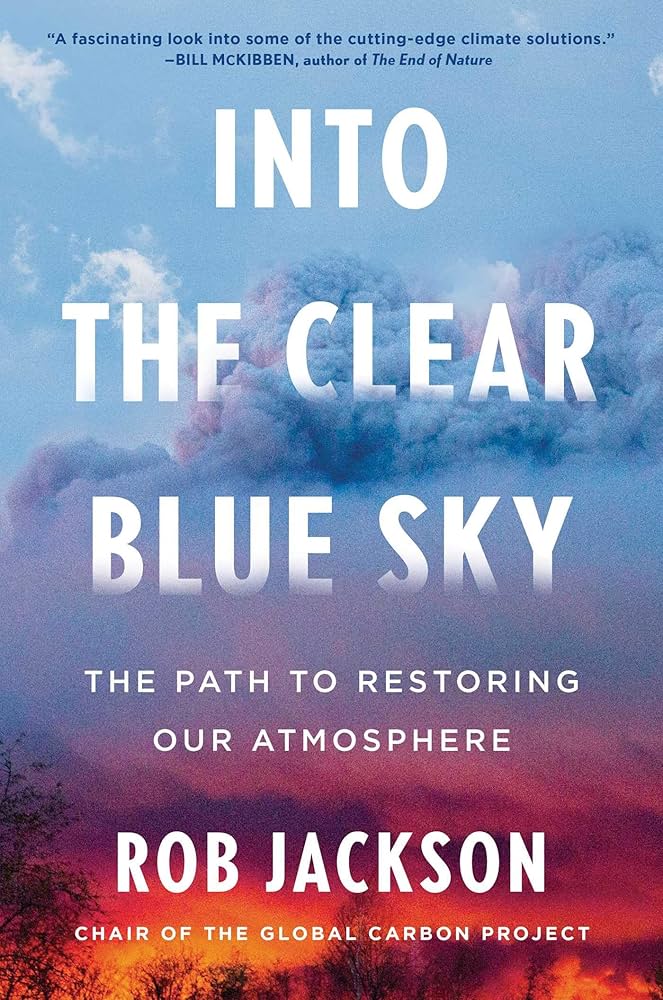
Into the Clear Blue Sky:
The Path to Restoring Our Atmosphere
By Rob Jackson
Scribner, New York, 2024
Into the Clear Blue Sky is a survey of the people, projects and technologies that could help us achieve our climate goals. It’s a non-technical book aimed at a general audience. In the first part of the book, Jackson travels around the world looking at selected ways to reduce greenhouse gas emissions, including plugging methane leaks in natural gas pipes under city streets, developing lab-grown meat to replace beef production, and how a price on carbon emissions is driving Sweden’s steel industry to clean up.
Some of the statistics Jackson cites echo findings from Hannah Ritchie’s terrific book Not the End of the World. For example, he quotes a paper from the journal Nature Sustainability:
“The authors determined that irrigating cattle feed crops was the single largest consumptive water use nationally in the United States and accounted for 55 percent of all water consumption in the Colorado River basin.” [p. 31]
The second part of the book is more speculative, looking at methods and technologies that could help us reduce or draw down carbon dioxide and methane from the atmosphere. These include natural methods like reforestation and rewilding, and nascent technologies like bioenergy with carbon capture and storage (BECCS), enhanced rock weathering, and direct air capture (DAC). Jackson even visits a project in Iceland where they’re capturing carbon dioxide from a nearby power plant, using the CO2 to make fizzy water and then injecting the water back into the earth.
These schemes might seem crazy, unproven and hideously expensive, but as Jackson rightly points out, they’ve become necessary because we’ve dithered and delayed so long on reducing emissions. As a result, we’re likely going to miss the UN’s 1.5ºC target, if we haven’t already, and the 2ºC target is in jeopardy too. In fact, most climate scenarios from the Intergovernmental Panel on Climate Change (IPCC) assume some amount of “overshoot” before temperatures drop back down to target levels late this century. The only way that can happen is through some amount of greenhouse gas removal or drawdown. That’s going to be very, very costly.
This is one reason Jackson, like, many, including me, strongly advocates putting a price on carbon emissions.
“From today onward, every additional ton of carbon dioxide we emit will need to be removed by someone, somewhere, sometime and should come with a price of carbon removal attached to it, far higher than the current price in Europe and elsewhere.” [p. 141]
Throughout the book, Jackson makes the case that we could achieve quick benefits by focusing on methane. As a greenhouse gas, methane is about 80 times more potent than carbon dioxide, but while CO2 remains in the atmosphere for centuries, methane degrades after a couple of decades. Jackson examines ways we could dramatically reduce methane emissions from agriculture (cow burps) and industry (natural gas well and pipeline leaks) and some emerging technologies to draw down methane from the atmosphere. By doing these things, he says we could shave as much as 0.5ºC off peak warming, giving us a bit more time to address CO2 emissions.
Jackson knows that methane removal is even more difficult than carbon removal, but:
“Like carbon removal, methane removal smacks of desperation. We’re examining it only because we’ve put off climate action too long.” [p. 162]
His claim, and his challenge to us, is that we can reduce methane levels to pre-industrial levels within our lifetime.
Unsolicited Feedback
Into the Clear Blue Sky is the first climate book I’ve read that goes into detail about both the necessity of carbon dioxide and methane removal, and the ways it could be done. For that alone, I think the book is a worthwhile contribution to the growing literature on climate change. It’s written in a straightforward conversational style too.
Jackson doesn’t specify precise targets for CO2 or CH4 concentrations other than returning to “pre-industrial levels.” That means getting back to levels from around 1800 to 1850. For CO2, that’s about 280 parts per million (ppm), and for methane it would be about 720 parts per billion (ppb). (For more information on these numbers, please see my infographic on measuring greenhouse gas emissions.)
In this table, I’ve summarized current and pre-industrial levels for both these gasses.
| Greenhouse Gas | Pre-industrial Atmospheric Concentration | Current Atmospheric Concentration |
| Carbon dioxide (CO2) | 280 ppm | 422.99 ppm (Aug. 2024) |
| Methane (CH4) | 720 ppb | 1931.91 ppb (Apr. 2024( |
ppm = parts per million, ppb = parts per billion
As you can see, we have a long way to go, especially since current levels are still going up! The longer we wait to reduce emissions, the more we’ll have to remove later and the more it will cost.
Incidentally, you may have heard of an environmental group called 350.org founded by well-known author and activist Bill McKibben and some others. The name refers to 350 parts per million of atmospheric carbon dioxide, which apparently is considered the “safe amount to avoid the worst impacts of the climate crisis.”
I’m not sure what “safe” really means here or whether 350 ppm is a better or worse target than 280 ppm. Any target is going to be somewhat arbitrary. Still, the key point Jackson makes in Into the Clear Blue Sky is that we must first reduce emissions and then draw down greenhouse gasses to restore the atmosphere for everyone on Earth.
Thanks for reading.
Click here for more posts on climate change.
If you enjoyed this review, please subscribe to Unsolicited Feedback.
Related Links
“Carbon dioxide now more than 50% higher than pre-industrial levels.” NOAA, 3. Jun. 2022, https://www.noaa.gov/news-release/carbon-dioxide-now-more-than-50-higher-than-pre-industrial-levels
“Increase in atmospheric methane set another record during 2021.” NOAA, 7 Apr. 2022, https://www.noaa.gov/news-release/increase-in-atmospheric-methane-set-another-record-during-2021
Richter, B.D., Bartak, D., Caldwell, P. et al. “Water scarcity and fish imperilment driven by beef production.” Nat Sustain 3, 319–328 (2020). https://doi.org/10.1038/s41893-020-0483-z
Discover more from Unsolicited Feedback
Subscribe to get the latest posts sent to your email.


 Unsolicited Feedback