According to the cover blurbs, Hot Mess: What on earth can we do about climate change? is supposed to be a “very funny,” “hilarious,” and “side-splitting” look at the oh-so-serious problem of climate change.
It’s written by a Scotsman named Matt Winning who holds a PhD in climate change policy, although he might be better known as a stand-up comedian. You can watch a YouTube video of one of his performances here.
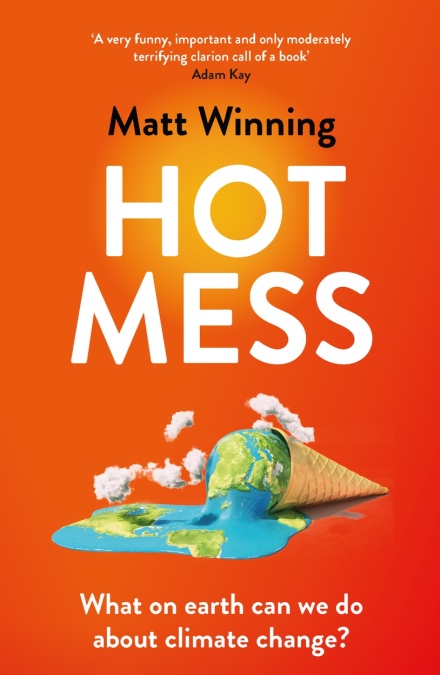
Hot Mess:
What on earth can we do about climate change?
By Matt Winning
Headline Publishing Group, London, 2021
I say “supposed to be” because although I’d love to find some humor among all the depressing books and articles about climate change, Hot Mess mostly didn’t do it for me.
Here’s an example from a section about how melting Arctic ice threatens polar bears and other species:
“Reindeer are also feeling the pinch, their annual herd migration across the land is occurring earlier and becoming more dangerous, and leading to starvation. We should keep an eye on that, because if we end up with fewer than nine reindeer, it’s going to really ruin Christmas.” [p. 61]
Not exactly a knee-slapper for me. Unfortunately, I thought most of the book’s jokes and witty remarks were just as lame. That said, other readers have told me they did find the book quite funny. Each to their own, I guess.
On the other hand, being a comedian gives Winning license to dish out some refreshingly non-academic commentary:
“The number of new homes being built on flood plains in England has doubled in the last few years, and a tenth of new homes in England are being built in high-risk areas. I cannot stress enough how highly this ranks on the list of stupid ideas.” [p. 77]
Now the bulk of the book really is about climate change and here Winning does a much better job. Hot Mess presents a very informative and easy-to-understand introduction to climate change for a general audience. Winning covers:
- Basic climate science including the greenhouse effect,
- The link between burning fossil fuels and global warming,
- The impact of climate change (present and future) on weather patterns, ocean currents and sea level, biodiversity, and humanity,
- A look at some frightening climate tipping points,
- How various types of human activity like electricity generation, transportation, building heating, industry and agriculture contribute to greenhouse gas emissions,
- What we as individuals can do about it,
- The politics of climate change and the pernicious influence of the fossil fuel industry,
- A call for us all to act now.
These are all standard topics you’ll find in most books about climate change. While Hot Mess is not deeply technical, Winning explains concepts like the greenhouse effect, carbon capture and other ideas quite well. He also presents a realistic view of the trade-offs and limitations of some possible climate solutions. And if, unlike me, you enjoy Winning’s sense of humor, you might find Hot Mess entertaining too. (If you do want more technical details, I highly recommend Andrew Dessler’s Introduction to Modern Climate Change.)
One area where I thought the book a little light in content was around public policy. Winning says:
“We need to stop making people feel bad for simply wanting to live in today’s society. The way to solve these problems is for individuals to demand solutions, which must be provided by governments and by new business models.” [p. 262]
Yet he doesn’t go into much detail about what the public should be demanding or what policies governments should be enacting. He barely mentions carbon pricing, for example, and he doesn’t examine whether or how governments should be stimulating research and development into zero-carbon technologies. He tells us that the whole notion of “carbon footprint” was an act of blame-shifting cooked up by British Petroleum’s PR department, yet most of the actions he suggests fall on us as individuals and families. This seems especially odd given his academic background in climate policy.
Hot Mess was written at the height of the COVID-19 pandemic. During that time, Winning and his wife bought their first house just outside London and welcomed their first child. (His suggestion of naming their son “Oscar” – Oscar Winning – was vetoed by his wife. OK, that was pretty funny!) So along with exploring the science of climate change and making jokes about climate change, Winning writes about bringing a child into a climate-changed world. He wrestles with even having a child at all (won’t more people on the planet just contribute to more global warming?), and the choices he should make to reduce the carbon footprint of childrearing (cloth or disposable diapers/nappies?). He worries about the world his child will inherit. I think these are the most heartfelt sections of the book. You can feel how having a child reinforces Winning’s desire to do as much as he can to educate and motivate people, us, to act now.
“Vote like your future and your children’s future depend on it. Because they do.” [p. 268]
I read Hot Mess as a selection of the local climate book club I joined this year. Since I’m pretty well-informed about climate change already (at least I’ve read a lot about it) I’m probably not the target audience for this book. But if you’re looking for an informative, non-technical introduction served up with a spoonful of humor, then Hot Mess might be for you.
Related Links
Winning, Matt. “Climate Strange | Dr Matt Winning | TEDxNewcastleCollege.” YouTube, 30 Oct. 2019, https://www.youtube.com/watch?v=aPCEqPdEY1A.
Discover more from Unsolicited Feedback
Subscribe to get the latest posts sent to your email.


 Unsolicited Feedback
Thanks for the recommendation. I still need easy-to-read books on climate change, so this will fit the bill. And maybe I’ll laugh now and again. I find it hard to see much humor in the subject too, but sometimes we do laugh to keep from crying (cliche, I know). I saved the YouTube video to watch later, maybe before I read the book (I like to have the author’s voice in my head, especially someone with a cool Scottish accent like his, ha). I’m jealous that you have a local climate book club. 🙂
LikeLiked by 1 person