It takes just a couple of minutes to play a hand of poker. During each hand, a player might make around twenty different decisions: whether to play the hand at all, how much to bet, and whether to call, raise, check or fold in each round of betting. In a poker tournament, each player will make thousands of these decisions. Professional players get very good at it.
Annie Duke wasn’t just a pro, she was a champion. Duke won over $4-million as a professional poker player. Today, she’s an author, speaker, and decision strategist. In 2023, she earned a PhD in Cognitive Psychology from the University of Pennsylvania.
In her book, Thinking in Bets: Making Smarter Decisions When You Don’t Have All the Facts, Duke draws on both her professional and academic expertise to teach us how to make better decisions, and more important, how to continuously improve our decision-making skills.
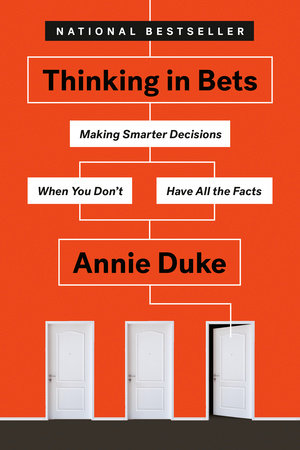
Thinking in Bets: Making Smarter Decisions
When You Don’t Have All the Facts
By Annie Duke
Portfolio/Penguin, New York, 2018
Embrace Uncertainty
The first step to making good decisions, Duke says, it to embrace uncertainty. It’s OK to say, “I don’t know” or “I’m not sure.” In fact, it’s more accurate to say those things than to pretend you are 100% certain about anything. That’s because life is like poker, not chess.
In chess, all the information about the state of the game is right there on the board. There’s nothing hidden. It’s a game of perfect information.
In poker, of course, you can’t see the other players’ cards, and you don’t know what cards are left in the deck. Plus, there’s a huge amount of luck involved in the game.
Every decision we make, in poker and in life, is made under conditions of uncertainty. And a bet, according to Duke, is simply “a decision about an uncertain future.” So, she suggests, let’s think about our decisions as if they were bets.
Decisions vs. Outcomes
Duke emphasizes the importance of separating our decisions from their outcomes. We can make a good decision and still get an undesired outcome.
“Decisions are bets on the future, and they aren’t ‘right’ or ‘wrong’ based on whether they turn out well on any particular iteration. An unwanted result doesn’t make our decision wrong if we thought about the alternatives and probabilities in advance and allocated our resources accordingly …” [p. 33]
We can never completely overcome uncertainty, but by incrementally improving our decision-making skills, we can achieve better results over the long run.
“Improved decision quality is about increasing our chances of good outcomes, not guaranteeing them. Even when that effort makes a small difference—more rational thinking and fewer emotional decisions, translated into an increased probability of better outcomes—it can have a significant impact on how our lives turn out. Good results compound. Good prosses become habits, and make possible future calibration and improvement.” [p. 180]
Better Decisions Through Feedback
Thinking in Bets is about developing the mindset and the habits to make better decisions. Basically, it comes down to building a feedback loop illustrated in this diagram, which I’ve adapted slightly from the one Duke includes in her book.
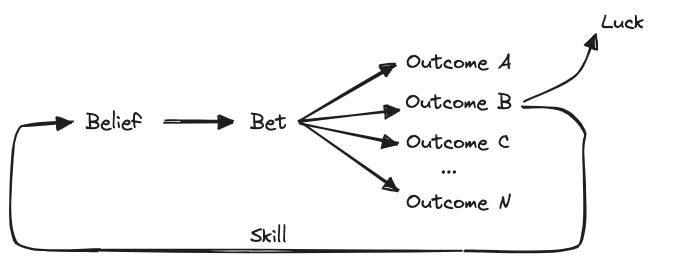
All bets start with our beliefs, Duke says – beliefs about ourselves, the world and the future. For example, I believe I will be better off taking a new job than staying in my current job.
Based on our beliefs, we make a bet or a decision. I quit my current job and take a new one.
Now in every situation there are many possible outcomes. I could keep my current job and still be OK. I could keep my current job and become bored, jaded and unfulfilled. I could take a new job and succeed fabulously, growing my career and making new friends. I could take a new job and get fired. I could take a new job and get laid off because the company fails. You get the idea.
Only one of these outcomes actually happens (at least in this Universe). The actual outcome may be the one we desired – succeeding at a new job – or some other less-desired outcome. The actual outcome could occur due to luck, or our skill or some combination of the two.
Based on the actual outcome we evaluate our decision-making, improve our skills and adjust our beliefs accordingly so that next time we’ll make a better decision.
Duke devotes a couple of chapters of Thinking in Bets to setting up and running this sort of feedback loop.
Wanna Bet?
Whenever we’re faced with a decision, Duke suggests we ask ourselves, “wanna bet?”
Thinking in bets forces us to evaluate our beliefs and to realize that nothing in life is 100% certain. Different outcomes are always possible. Duke says we should try to assign a probability or a confidence level to our beliefs. I believe X and I’m 30% confident on it. This has two immediate benefits. First, it encourages us to seek out new information to update our beliefs and improve our confidence. Second it forces to us account for the other 70%. What other possible outcomes could occur? How confident are we about each of them?
Duke presents many techniques to help improve our decision-making. Some of them involve time traveling. I’ll highlight just a few here.
Ulysses contracts: In Homer’s The Odessey, Ulysses famously has his crew tie him to the mast of his ship and fill their own ears with beeswax so he can hear the Sirens without his crew crashing the ship on the rocks. So, Ulysses contracts are decisions we make that bind our future selves to some course of action. A great example is setting up an automatic payroll deduction into your retirement savings account. This prevents your future self from spending that money on something else.
Backcasting: The opposite of forecasting. Instead of trying to predict how you will achieve your goal, imagine you’ve already achieved it. Now “look back” and identify the steps you would have taken to get there, and the obstacles and challenges you would have overcome. You can build these things into your plan.
Pre-mortem: The opposite of a post-mortem and the compliment to backcasting. This time, imagine you’ve failed to achieve your goal. Now “look back” and try to identify what went wrong. What risks were lurking in your plan? What unforeseen, low probability events might have happened to throw you off track? Now update your plan to avoid those things before they happen.
These techniques, and many others covered in Thinking in Bets, help us take deliberate steps to develop well-informed beliefs that lead over time to better decision-making. As Duke says at the end of the book:
“Life, like poker, is one long game, and there are going to be a lot of losses, even after making the best possible bets. We are going to do better, and be happier, if we start by recognizing that we’ll never be sure of the future. That changes our task from trying to be right every time, an impossible job, to navigating our way through the uncertainty by calibrating our beliefs to move toward, little by little, a more accurate and objective representation of the world. With strategic foresight and perspective, that’s manageable work. If we keep learning and calibrating, we might even get good at it.” [p. 231]
Unsolicited Feedback
Thinking in Bets is full of colorful characters drawn from Duke’s poker playing days, plus she writes in a natural and engaging style. All this makes the book easy and enjoyable to read.
I loved the unexpected themes of humility and compassion running throughout Thinking in Bets. By recognizing that life is uncertain and our understanding of any given situation is imperfect, Duke says that we develop humility about ourselves and our abilities. Instead of getting hung up on taking credit for our skills or laying blame on bad luck, we focus on truthseeking, open-mindedness and learning. We also become more compassionate towards others because we understand that their circumstances might be heavily influenced by factors outside their control even if they tried to make the best decisions they could.
Thinking in Bets echoes ideas and themes from several other books I’ve read in the past few years. 20/20 Foresight by Hugh Courtney goes into depth about different types of uncertainty especially as it relates to business strategy. In Principles, Ray Dalio describes a process of continuous self-evaluation and development similar to the feedback loop in Thinking in Bets. Hans Rosling warns about the dangers of black-and-white thinking in his book Factfulness. He says truth usually lies in the “messy middle.” Finally, in The Optimist’s Telescope, Bina Venkataraman suggests ways we can learn to become good ancestors by making smarter decisions about the long term future.
I do have a couple of nits about the way Annie Duke uses poker as a metaphor for decision-making in real life. Life differs from poker in two key respects that she doesn’t explicitly call out in the book. First, when you make a bet in poker, you get the results in just a minute or two. But in life, the outcome may not be apparent for a long time, decades even. In other words, there’s a lag between when we make a bet and when the outcome happens. That means it can be harder to evaluate the correctness of our decisions because we make fewer of them and the feedback takes so long to come in.
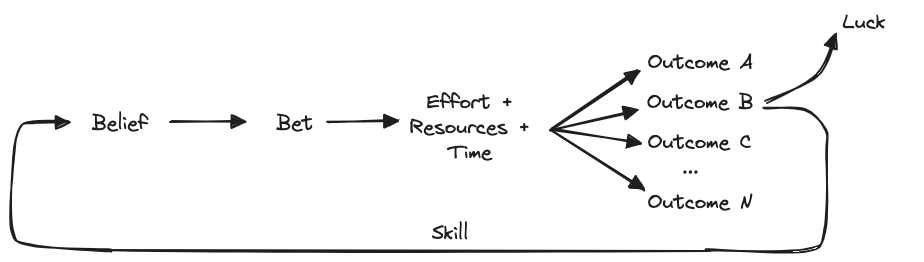
The second difference is that in poker when you make a bet, execution is instantaneous; you thrown in some chips or you throw down your cards. In life, execution can take much longer. For example, you or your team might work on a project for months or years. This is helpful because it means you can do things along the way to make your desired outcome more likely. You can add resources, put in more effort or get more information. In effect, you can adjust your plan. Duke might say that adjusting your plan is like making a new bet, but the point remains that in many situations, execution takes time. So I would modify the original feedback loop diagram to reflect this:
If you’ve spent any time planning projects or forecasting budgets, you might already have developed the habit of imagining different possible outcomes and their probabilities. You might be wondering, “Doesn’t everyone think like this?” I spent most of my career as a project manager, so much of Thinking in Bets feels very natural to me. But, no, not everyone thinks this way, and few of us think this way all the time.
Thinking in Bets will teach you almost nothing about winning at poker, but it will give you a valuable framework and many useful tools to help you become a better decision-maker.
Thanks for reading.
Click here for more posts about thinking.
If you liked this post, please follow Unsolicited Feedback.
Discover more from Unsolicited Feedback
Subscribe to get the latest posts sent to your email.


 Unsolicited Feedback
Pingback: Nonfiction November 2024 Week 4: Mind Openers | Unsolicited Feedback