I’m just old enough to remember the Apollo 11 Moon landing and Neil Armstrong’s first words from the lunar surface. That historic event probably contributed to my lifelong interest in science and science fiction. Of course, I’m not the only one who’s been inspired by the Apollo missions or the Moon.
As Rebecca Boyle tells us in Our Moon: How Earth’s Celestial Companion Transformed the Planet, Guided Evolution, and Made Us Who We Are, the Moon has inspired culture, religion and science for thousands of years. Arguably, our fascination with the Moon helped kickstart the emergence of civilization. But the Moon’s influence goes even farther. In this wide-ranging book, Boyle shows how the Moon also affected the formation of the Earth, and guided the evolution of life itself.
Rebecca Boyle is a science journalist and contributing editor at Scientific American. Her work has appeared in The Atlantic, Nature, The New York Times, Popular Science, WIRED and many other publications. Our Moon is her first book.
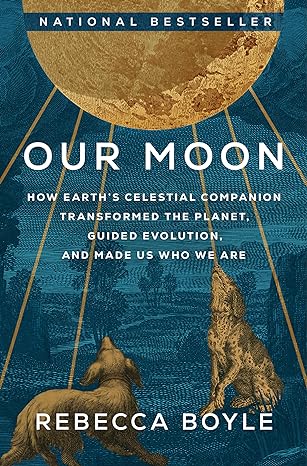
Our Moon: How Earth’s Celestial Companion
Transformed the Planet, Guided Evolution,
and Made Us Who We Are
By Rebecca Boyle
Random House, New York, 2024
Our Moon is organized into three parts. In the first part, Boyle looks at the origins of the Moon. I thought the science on this was relatively settled: billions of years ago a horrific asteroid collision had caused a chunk of the Earth to tear off and form the Moon. It turns out the story is far more complicated and the formation of both the Earth and the Moon are much more deeply intertwined. Boyle leads us through the evolving theories of the Moon’s origin, and the Earth’s. The science is still not settled.
In the second part, Boyle examines the Moon’s role in the evolution of life on Earth, and in the development of human culture, religion and early science. This was fascinating and quite new to me.
Boyle explains that 400 million years ago, ocean tides were stronger and more frequent than they are today. That’s because the day was shorter, about 21.4 hours due to the Earth spinning faster. The Moon was a little closer to Earth too, causing more extreme tides. This means ocean-dwelling organisms were more likely to get carried farther onto shore by stronger tides, and then get stranded on the beaches as the tide went out. Creatures that could survive out of water, breathe air, and even move about on land had an evolutionary advantage.
“The moon guided the strongest creatures to the shoreline, where they transmogrified into a dazzling array of shapes and sizes. The cradle of vertebrate diversity was the tidal zone.” [p. 63]
I was especially interested in Boyle’s account of how humans developed early calendar systems. Stonehenge is the most famous example, but Boyle describes other structures and artifacts from Scotland, Germany and early Pueblo settlements in America that marked the passage of the Moon, the Sun, and sometimes both of them together.
It turns out the Moon is an extremely useful foundation for a calendar. Its phases are clearly visible and spaced just far enough apart to be used as a planning device. You can imagine our Neolithic ancestors saying something like, “let’s meet here at the next quarter moon,” or “let’s plant our crops after the second full moon following the winter solstice.”
The amazing part is that early human civilizations built these incredibly accurate structures with no drafting software, no calculators, no pen and paper and certainly no construction equipment. These were no dull-witted cavemen. They understood their world deeply. And using the Moon, they invented measurable Time and began to organize their lives around it. Boyle does a great job conveying the ingenuity of our Paleolithic and Neolithic ancestors, and their deep connection to earth and sky.
In the final part of Our Moon, Boyle shows how our conception of the Moon has changed as our scientific understanding of it has grown. With the invention of early telescopes by Thomas Harriot and Galileo Galilei, we learned that the Moon was not a perfect, featureless sphere. It’s a world of its own with mountains, plains and craters. It’s not unique either: Jupiter had moons too. So in our eyes the Moon was demoted, as Boyle puts it. And with the new astronomy of Nicolaus Copernicus and Johannes Kepler, Earth got demoted too. It was no longer the center of the universe.
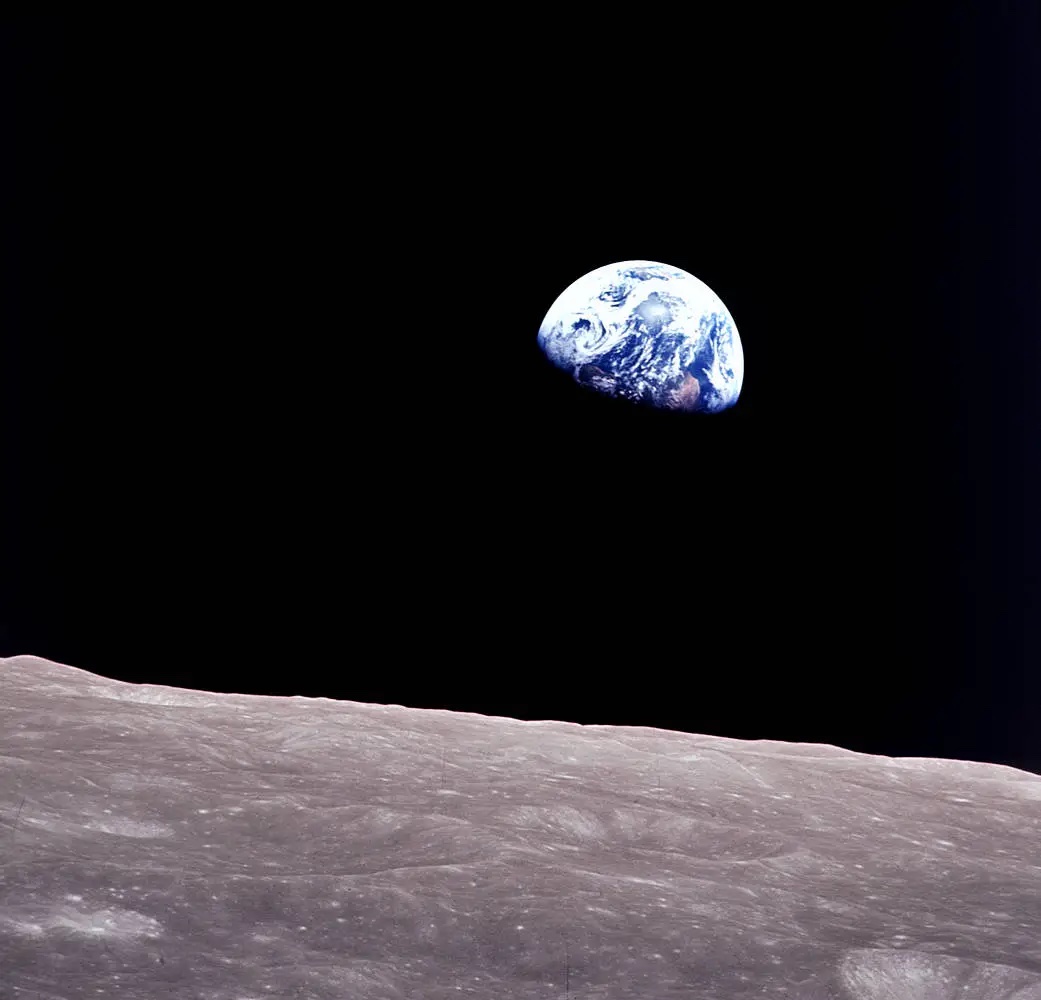
In the most eloquent chapter of the book, Boyle walks us through the Apollo missions, culminating in humans’ first steps on the Moon, and perhaps equally important, our first sight of Earth from another world.
“The Moon shaped our evolution and served as our timekeeper and our spiritual lodestar throughout the ages. It guided the grand barque of civilization through the dawn of religion, the onset of philosophy, the age of exploration, the ideals of the Enlightenment. But only in the age of Apollo did it finally exist as a material place in space and time.” [pp. 238-9]
There were a couple of places where I thought Our Moon dragged or where the book dove deeply into a topic that seemed only tenuously related to the Moon. Also there’s virtually no discussion about the Moon in Asian cultures and history. This seems like a significant gap.
Overall, though, Our Moon tells a fascinating story about how the Moon has shaped our world, physically, biologically, culturally, scientifically and spiritually. We owe a lot to our bright, silvery companion in the night sky.
Thanks for reading.
If you enjoyed this review, please subscribe to Unsolicited Feedback.
Click here for more posts on astronomy.
Discover more from Unsolicited Feedback
Subscribe to get the latest posts sent to your email.


 Unsolicited Feedback
Pingback: Nonfiction November 2024 Week 2: Choosing Nonfiction | Unsolicited Feedback