Trading rare and exotic spices has been a powerful force in history and economics for many centuries. Nutmeg is no exception.
In the early 1600’s, the Dutch East India Company, known by its Dutch initials VOC, formed as the world’s first joint-stock company and was granted a monopoly by the Dutch government to trade spices from Asia.
To secure its monopoly, the VOC, acting together with Dutch authorities, sought control of the sole source of nutmeg, the Banda Islands (map), a small archipelago in southeastern Indonesia.
As Amitav Ghosh tells us in the opening chapters of The Nutmeg’s Curse: Parables for a Planet in Crisis, what actually happened was genocide. In 1621, Dutch forces destroyed Bandanese villages, massacred the islanders, beheaded community elders, and sent survivors to other Dutch colonies as slaves. They then divided up the islands into plantations and repopulated them with imported convict, enslaved and indentured laborers.
Ghosh uses the events of 1621 as just one harrowing example of the main idea of The Nutmeg’s Curse: the origins of today’s climate crisis can be traced back to the beliefs, structures and methods of European colonialism.
Amitav Ghosh is an award-winning novelist and essayist. He was born in Kolkata and grew up in India, Bangladesh and Sri Lanka. He has a PhD from the University of Oxford in social anthropology. The Nutmeg’s Curse was written while Ghosh was living in New York during the COVID-19 pandemic.
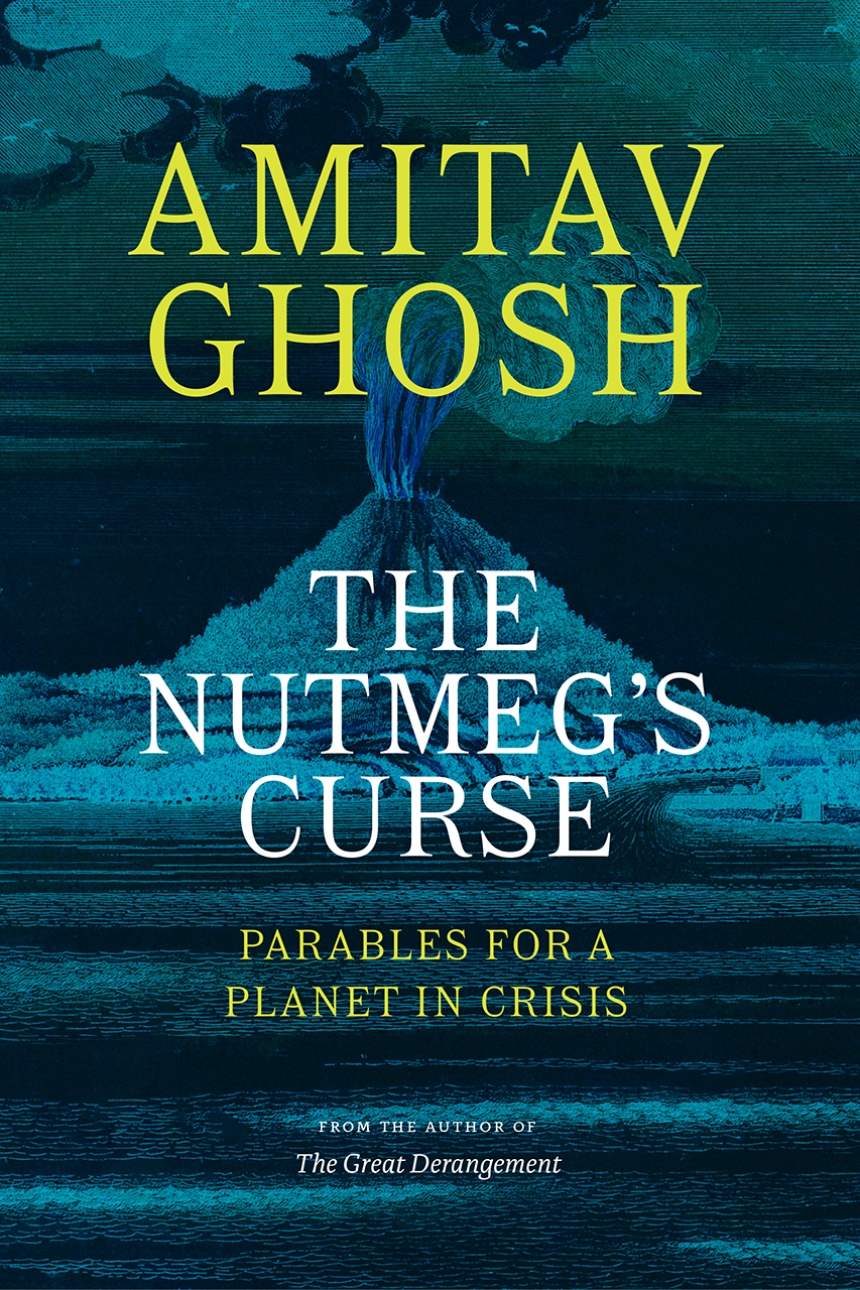
The Nutmeg’s Curse: Parables for a Planet in Crisis
By Amitav Ghosh
University of Chicago Press, Chicago, 2021
The connection between colonialism and climate change might not be obvious – I was only partially aware of it myself – but Ghosh makes a compelling case based on extensive research and his own travels including to the Banda Islands.
World-as-resource
In the 1600’s, the prevailing belief among European elites was that the Earth was a repository of resources waiting to be extracted and exploited. Nature was inert, mute and lacking agency of its own. It certainly had no intrinsic meaning.
Too many people still think this way today.
They viewed alternative beliefs held by Indigenous peoples all over the world as primitive, animistic, uncivilized and “savage,” particularly those expressing a deep connection to living lands and places.
Ghosh shows how colonial powers systematically “terraformed” conquered territories into “neo-Europes” by replicating patterns of land enclosure, plantations, driving away and killing off native game species and exterminating Indigenous peoples. He calls this “biopolitical” warfare.
Indeed, they tried to destroy everything.
“The VOC [Dutch East India Company] was the embodiment of early capitalism; it was run by stolid burghers who prided themselves on their rationality, moderation, and common sense. Yet they pursued a policy that perfectly illustrates the unrestrainable excess that lies hidden at the heart of the vision of world-as-resource – an excess that leads ultimately not just to genocide but an even greater violence, an impulse that can only be called ‘omnicide’ the desire to destroy everything.” [p. 75]
The structures of geopolitical power derived from controlling and exploiting Earth’s resources – especially fossil fuels – persist to this day, and lie at the root of the climate crisis, Ghosh argues.
There is some evidence that the decimation of the Indigenous American population, brought on by European conquest and diseases, may have contributed to the Little Ice Age during the 16th to 18th centuries. A reduced population would have allowed considerable regrowth of forests leading to greater carbon sequestration and colder temperatures.
As a more contemporary example, Ghosh cites research by Thomas Lovejoy and Carlos Nobre showing that deforestation has brought the Amazon rainforest to a tipping point where it could flip from being a carbon sink to a carbon source with devastating implications for the whole planet. (Lovejoy is co-author of Ever Green, a terrific book about the world’s great forests.) Ghosh says:
“In Brazil today we can see, with absolute clarity, how colonial terraforming lies at the heart of the planetary crisis.” [p. 215]
Earth-as-Gaia
Ghosh believes the land is a living, vital entity that is starting to rebel against humanity.
“It is as if climate change were goading the terrain to shrug off the forms imposed on it over the last centuries. This is quickly becoming one of the distinctive features of the planetary crisis; the wildfires in California and southeastern Australia, the repeated flooding of Houston, and the increasing unruliness of the Missouri River all suggest that the planetary crisis will manifest itself with exceptional force in those parts of the Earth that have been most intensively terraformed to resemble European models. Essentially, these landscapes are throwing off the forms that settlers imposed on them, as a preliminary to switching to some new, unknown state.” [p. 144]
He suggests that we need to adopt a “politics of vitalism” based on a view of Earth as Gaia, a single, living organism. He presents alternate viewpoints based mainly on the beliefs of Indigenous people from North and South America. He highlights how those societies see it as their responsibility to protect “all our relatives,” human and non-human.
Ghosh notes some modest success stories too. My favorite is that in 2017 the New Zealand parliament passed a law granting legal personhood to the Whanganui River on the North Island.
He cites recent research showing how the “tragedy of the commons” is a fallacy and that humans often respond to crises with cooperation and sharing. He likens our excessive fixation on personal freedom to a pathology which he calls “morbid individualism.”
Ghosh doesn’t prescribe specific policies or political strategies, but rather recommends a shift, a seismic one, in how we view and relate to the natural world.
“A necessary first step toward finding solutions is to find a common idiom and a shared story – a narrative of humility in which humans acknowledge their mutual dependence not just on each other but on ‘all our relatives.’” [p. 242]
Unsolicited Feedback
The Nutmeg’s Curse covers a lot of ground. Perhaps it’s best seen as a collection of essays on separate but related topics that Amitav Ghosh has neatly woven together. I’ve only touched on a few key points in this review.
Large parts of this book were uncomfortable reading, both because the events Ghosh describes are horrific and because they forced me, a white person living in a colonized country, to confront some of my own ignorance of history. I knew about the genocide perpetrated by colonial powers, but not the specific details Ghosh provides about how this was carried out, and how it became part of the foundation of capitalism and the global economy. And I certainly hadn’t made the deep connection to the climate crisis.
One thing Ghosh doesn’t mention is that today’s globalized, capitalist and technological economy has brought improved standards of living, reduced hunger and poverty and increased lifespans for the large majority of people in the world, especially over the last 50 years. Those gains have come at horrendous cost, and our methods are unsustainable, but how many of us would choose to live in a previous era?
The Nutmeg’s Curse highlights Indigenous ways of relating to the Earth as a better alternative. This seems to be something of a trend: it’s come up in a few other books I’ve read recently. We may have much to learn from Indigenous approaches. I don’t understand yet what this might mean on a practical level for a planet of eight billion mostly urbanized people. I need to learn more about this.
Although Ghosh’s arguments might be discomforting, they’re not hard to follow. He writes with great clarity. I get the impression that he’s not so much angry about the history he presents as he is dismayed and disheartened by how events have unfolded and how little has changed since colonial times.
Ghosh isn’t the first author I’ve read to call for a dramatic change in how we relate to the natural world. Many books about climate change and the environment make similar appeals, but The Nutmeg’s Curse is one of the few that approaches this from an historical perspective and points to possible alternatives.
Thanks for reading.
Click here for more posts on climate change.
If you enjoyed this review, please subscribe to Unsolicited Feedback.
Related Links
Amitav Ghosh: European colonialism helped create a planet in crisis
Article by Hannah Ellis-Petersen in The Guardian, Jan. 14, 2022.
Amazon Tipping Point: Last Chance for Action
Editorial by Thomas E. Lovejoy and Carlos Nobre in Science Advances, Dec. 20, 2019. DOI:10.1126/sciadv.aba2949
Discover more from Unsolicited Feedback
Subscribe to get the latest posts sent to your email.


 Unsolicited Feedback
Pingback: Nonfiction November 2023 Week 3: Book Pairings | Unsolicited Feedback
Pingback: Water Always Wins | Unsolicited Feedback
Pingback: Nonfiction November 2024 Week 4: Mind Openers | Unsolicited Feedback