Last month, I reviewed The Ends of the World by Peter Brannen. It’s all about the destruction of life through mass extinctions. Fascinating but grim.
The book left me with a nagging question, though: after each mass extinction how could life reemerge with such vitality, diversity and, dare I say, speed? (A few million years is fast in geologic time.)
Some Assembly Required: Decoding Four Billion Years of Life, from Ancient Fossils to DNA by Neil Shubin provides, if not a complete answer, then a very solid start.
Some Assembly Required is about the genetic mechanisms that drive evolution. It’s about how life evolves in all its forms and varieties. It’s a perfect follow up to The Ends of the World.
Neil Shubin is a paleontologist and evolutionary biologist who is currently Professor of Organismal Biology and Anatomy at the University of Chicago.
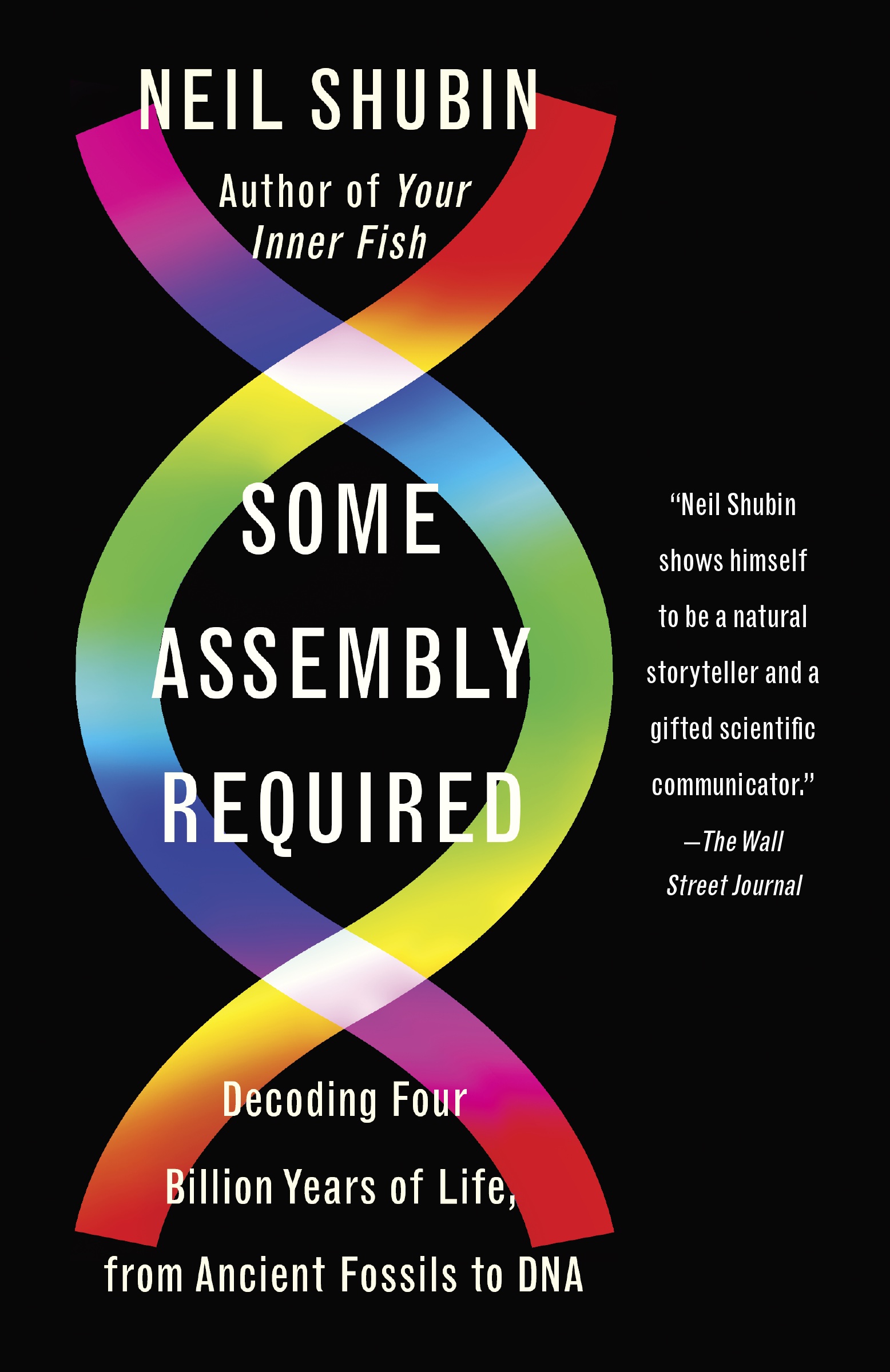
Some Assembly Required:
Decoding Four Billion Years of Life, from Ancient Fossils to DNA
By Neil Shubin
Pantheon Books, New York, 2020
The book follows Shubin’s own career path from a paleontologist cracking apart rocks in search of fossils to an evolutionary biologist focusing on the genetic basis of evolution. This has largely been driven by advances in technology, especially DNA sequencing. These days, scientists can quickly sequence fossil DNA and then search through online databases of known DNA sequences looking for exact or near matches. It’s enabled them to find common patterns shared by organisms across the tree of life.
A major thread running through the book is the history of our evolving understanding of DNA and the scientists who helped advance our knowledge. Shubin presents a fascinating cast of characters, many of whom were ignored or criticized for decades before their work was recognized. He takes us right up to the development of CRISPR-Cas9 gene editing developed by Jennifer Doudna and described in much more detail in Walter Isaacson’s book The Code Breaker.
The question Shubin tries to answer in Some Assembly Required is how new structures like limbs and organs evolve. Ultimately this helps explain how new species evolve too. This question has been central to the debate about evolution ever since Darwin published On the Origin of Species in 1859. That’s because a partially evolved lung or eye is worse than useless. It would condemn an organism to a quick death and prevent it from passing along its genes to future generations. So how does evolution create a fully functioning lung or eye?
Shubin argues, like Darwin before him, that evolution takes place through a change in function of some existing organ or structure. A fish’s internal air sac, used to control buoyancy, gets repurposed into a lung in land-based animals, for example.
I was familiar with this idea before reading Some Assembly Required. Shubin dives deeper, looking at the genetic mechanisms that make it happen.
He makes the case that evolution occurs through changes in when and where various genes are active. For example, development of some structure or organ could be shortened or lengthened and could start early or late. How does the giraffe’s neck get so long? By elongating the time during which the genes controlling neck growth are active.
This implies that our genes don’t just encode instructions for making proteins, they also contain “switches” that activate or deactivate other genes. These genetic switches seem to play a major role in the development of a single individual, and in the evolution of a species.
Mutations can also be caused by transposons or “jumping genes” which can move to different locations within a genome.
Lastly, throughout history, organisms have had to defend themselves from attacking viruses. Sometimes viral DNA has been captured by their hosts, and then been co-opted and repurposed to benefit the host.
Summarizing all this, Shubin notes that the human genome contains about 20,000 genes yet just 2% of them code for proteins.
Wait! What?
Yeah, apparently jumping genes account for about 60% of our genes, and another 10% come from ancient viruses.
I found this the most fascinating, though somewhat bewildering part of the book. Shubin describes how genomes have developed by combining and repurposing genes, by incorporating and co-opting genetic material from invading viruses. And he shows that there’s a constant battle going on within our genes to control which ones are active, where they’re active and for how long.
“Mother Nature is like a lazy baker who crafts a bewildering variety of concoctions by repurposing, copying, modifying and redeploying ancient recipes and ingredients. In this way, through eons of jury-rigging, duplicating, and co-opting, single-celled microbes have evolved to the point where their descendants thrive in every habitat on the planet and have even walked on the moon.” [Kindle loc. 2836]
Another question Shubin explores is whether evolution is truly random – the term he uses is “contingent” – or whether it’s at least partially inevitable. For example, many organisms have wings – birds, bats, insects and let’s not forget the pterosaurs. But there are only so many ways a wing can be designed and still work properly so they all look very similar.
Maybe there’s some deep genetic mechanism that makes certain structures more likely than others? Maybe the genetic deck is stacked to favor certain outcomes or patterns of outcomes?
Shubin is clearly passionate about his field, and it comes through in his writing which is lively and approachable. That said, I did struggle to understand some parts of the book, like the stuff about jumping genes. And I thought other sections could have benefited from more diagrams.
Overall, though, Some Assembly Required is exciting and exuberant and beautifully presents how DNA and evolution have created the amazing diversity and resilience of life on Earth.
Thanks for reading.
Special thanks to Katie @ Doing Dewey for reviewing and recommending this book.
If you enjoyed this review, please subscribe to Unsolicited Feedback.
Discover more from Unsolicited Feedback
Subscribe to get the latest posts sent to your email.


 Unsolicited Feedback
Pingback: Nonfiction November 2022 Week 5: New to My TBR | Unsolicited Feedback
DNA is such a fascinating and mysterious subject. I’m thankful for scientists who continue to learn more about it, and for people like you who break down their thoughts into more manageable chunks. 🙂 Your book reviews are golden.
LikeLiked by 1 person
Thank you so much, Lisa! That’s very kind of you. I still find DNA very mysterious too. Guess I’ll just need to read more. 🙂
LikeLiked by 1 person
Pingback: Nonfiction November 2023 Week 4: Worldview Shapers | Unsolicited Feedback