You might think a 290-page deep dive into mass extinction would be the most depressing book ever. But The Ends of the World: Volcanic Apocalypses, Lethal Oceans, and Our Quest to Understand Earth’s Past Mass Extinctions by Peter Brannen is a well-written walk through deep time and the science is fascinating.
It’s also a warning that today we humans are tampering with fundamental earth systems, especially the carbon cycle, in a way that could cause – may already be causing – another mass extinction, including our own.
Peter Brannen is a science journalist and currently a staff writer at The Atlantic. His work has appeared in The New York Times, The Washington Post, Wired magazine and other publications. The Ends of the World is his first book. I first encountered Brannen’s writing in Geta Thunberg’s The Climate Book where he wrote the opening essay.
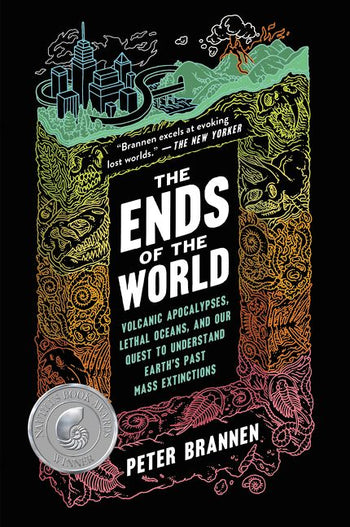
The Ends of the World:
Volcanic Apocalypses, Lethal Oceans, and
Our Quest to Understand Earth’s Past Mass Extinctions
By Peter Brannen
Ecco, New York, 2017
Deep Time
Earth is about 4.5 billion years old. Complex, multi-cellular life first appeared roughly 500 million years ago. And Homo sapiens emerged in East Africa around 200,000 years ago.
How can we possibly understand these vast time scales?
I don’t know about you, but I can barely remember what happened last week. I have childhood memories, of course, and stories from my parents and grandparents that reach back maybe a hundred years. I read history books that describe events from a few hundred or maybe a few thousand years ago. But beyond that, it’s all just the murky distant past.
To understand “deep time” we need to use analogies that recast Earth’s history onto human scale.
Here’s one: the footstep analogy.
Imagine each step you take represents 100 years of history. Now let’s take a walk backwards through time.
Your first step takes you back to about 1920, just after the end of the First World War. Your foot has glided over the internet and the atomic bomb. The earth has more forest cover, coral reefs are in better shape, city lights don’t block out the stars.
After a little more than 100 steps, probably before you reach the end of your block, you’ve walked through all of recorded human history. Wooly mammoths still exist.
Keep walking. You want to see the dinosaurs, right?
You’ll need to walk a little over 300 miles to witness their extinction.
And you’ll need to keep walking 20 miles a day, every day, for nearly four years to cover the rest of Earth’s history.
Brannen uses the footstep analogy to set the scene for The Ends of the World. It’s a walk through deep time examining the causes and effects of five great mass extinctions that each wiped out over 75% of the plant and animal species on Earth.
What Is a Mass Extinction?
Brannen defines a mass extinction as “any event in which more than half of the earth’s species go extinct in fewer than a million years or so.” [p. 3] When I looked into this a little more, I found that it’s actually a pretty fuzzy concept. How many species go extinct and how quickly seems to vary widely. A more general definition would be that there’s a spike in extinctions greater than the normal background rate of extinctions over some time period.
According to this definition, there have been many mass extinctions throughout Earth’s history. However, there is general agreement that each of the Big Five extinctions Brannen covers in the book resulted in 75% or more of Earth’s species getting wiped out.
Brannen describes each of these mass extinctions in graphic detail. A common cause in all of them, including the End-Cretaceous mass extinction that killed off the dinosaurs, was the earth’s carbon cycle going haywire.
(According to Brannen, the widely accepted theory that an asteroid strike at Chicxulub, Mexico caused the extinction of the dinosaurs may not be entirely correct. It seems the earth has been hit by asteroids many times but there’s no evidence of asteroids causing previous mass extinctions. More importantly, around the same time – which in geologic terms could mean plus or minus a few million years – there was massive volcanic activity at the Deccan Traps in western India spewing out “enough lava to cover the contiguous United States in molten rock half a mile deep.” [p. 124] Researchers are investigating whether the asteroid impact in Mexico might have triggered earthquakes which led to the eruptions of the Deccan Traps.)
The Carbon Cycle
The carbon cycle is one of those fundamental systems we’re messing with. In fact, it’s probably the most important one. So how does it work?
Before humans started burning fossil fuels, volcanoes were the main source of atmospheric carbon dioxide. CO2 in the atmosphere mixes with rainwater making it slightly acidic. Acidic raindrops break down rocks, slowly, over hundreds of thousands of years, washing carbon and calcium into rivers, lakes and eventually the oceans. In the oceans, the carbon and calcium are absorbed into the bodies of coral, sponges and plankton. When these organisms die, they settle on the ocean floor basically burying the carbon as layer upon layer of limestone. Millions of years later, some of that carbon gets ejected back into the atmosphere by volcanoes and other geologic activity.
That’s a grossly over-simplified version of the carbon cycle.
You probably know that carbon dioxide is a greenhouse gas that helps warm the earth by trapping heat, preventing it from radiating back out into space. Without carbon dioxide in the atmosphere, the earth would be about 30°C colder.
Over the course of Earth’s history, the amount of carbon dioxide in the atmosphere has fluctuated, sometimes wildly. Too much CO2 means a hot house planet, too little leads to an ice age. The earth has cycled between these two states many times over its history.
It’s a natural but very slow process driven by the carbon cycle.
But today, Brannen tells us, humans are dumping massive quantities of CO2 into the atmosphere, about a hundred times more than volcanoes emit each year. This is warming the earth at alarming rate.
He says we’re running an uncontrolled experiment on one of Earth’s most fundamental systems, one that won’t end well.
“No one knows where our modern experiment with the planet’s geochemistry will lead, but in the End-Permian [one of the Big Five mass extinction events], massive injections of greenhouse gasses into the atmosphere led straight to the cemetery.” [p. 129]
A Sixth Extinction?
Some people think humans are now causing a sixth mass extinction. Elizabeth Kolbert even wrote a book called The Sixth Extinction.
Brannen claims we’re not there yet. He and some of the scientists he interviewed for the book argue that a mass extinction leads to system-wide collapse of entire food webs, not just individual species going extinct.
If we’re really in the middle of a mass extinction, he says, it would be too late to worry about saving polar bears and elephants. Instead, we’d probably be worrying about saving coyotes and rats.
I think the question of whether we’re in a sixth mass extinction or not is pointless. No one disputes that human activity is causing a massive loss of biodiversity, or that we need to take immediate action to prevent further loss. It doesn’t matter whether we’ve crossed some arbitrary definitional line. In the end, the questions will have to be decided by future paleontologists a few million years from now, if we’re still around.
Still, many of us underestimate the impact humanity has on the planet.
“A sentiment exists – particularly among nonscientists – that the idea of humans seriously disrupting the planet on a geological scale is mere anthropocentric hubris. But this sentiment misunderstands the history of life. In the geological past, seemingly small innovations have reorganized the planet’s chemistry, hurling it into drastic phase changes.” [p. 20]
Biological organisms, especially humans, are a potent geological force.
Brannen devotes the last chapters of the book to the future.
Like other authors Brannen argues that our actions in this century will significantly shape where and how life exists on Earth for hundreds and thousands of years to come. The earth will eventually recover from humanity’s uncontrolled experiment: the carbon cycle will wash our excess carbon out of the atmosphere in the next hundred thousand years or so. But what happens to civilization and to life in general could depend on what we do over the next hundred years.
Unsolicited Feedback
I won’t deny that parts of The Ends of the World are truly sobering, But I enjoyed the book and got a lot out of it for two main reasons.
First, Brannen writes really well. The Ends of the World is a book about deep time, mostly examining the distant past, but also peering into the future. Throughout the book, Brannen does an amazing job conveying these inconceivable time scales in a way that’s readable and understandable. He didn’t invent the footstep analogy I described earlier, but he presents it beautifully.
Beyond this, his descriptions of the ancient events, landscapes and the creatures that filled them are powerful and vivid. He shows us how utterly alien Earth has been for most of its history. For example, here’s his description of one particular group of animals that ruled the supercontinent Pangea just before the End-Permian mass extinction:
“… the menacing gorgonopsids – brawny and vaguely wolflike apex predators with skulls like giant staple removers and teeth longer than those of T. rex.” [p. 120]
And here Brannen talks about the Late-Devonian mass extinction about 359 million years ago:
“The final catastrophe would emphatically end the period in an icy climax, taking out the top predators on the planet: heavily armored marine juggernauts that should be finalists on any short list for the scariest animals ever.” [p. 69]
He almost makes mass extinction sound exciting.
Second, the science Brannen presents is fascinating.
I’ve read lots of books and articles that say we need to stop thinking of ourselves as separate from the environment.
The Ends of the World takes this further, at least for me: there is no meaningful separation of humanity from geology.
Earth is a unified whole. It’s one big system, or perhaps a collection of systems. Its geology, ecology, climate, life forms, even cultures, are all part of the whole.
And they all influence and feed back on each other.
Brannen presents the science of all this – including many unsettled questions – with care and clarity.
Our actions over the last few hundred years, especially burning fossil fuels, are interfering with some of the deepest, most fundamental workings of Earth systems, at our peril. What we do in the next hundred years matters enormously. But, consequential though we are, The Ends of the World shows that the earth has gone through many cycles of hot and cold, growth and extinction. Yet “life finds a way.”
But it might not be human life.
Thanks for reading.
Click here for more posts on climate change.
If you enjoyed this review, please subscribe to Unsolicited Feedback.
Discover more from Unsolicited Feedback
Subscribe to get the latest posts sent to your email.


 Unsolicited Feedback
This sounds like another fascinating (albeit sobering) read. Thanks for giving the highlights. I’ve recently connected with a local climate group in my area and the group leader recommended a couple books for me to read so I’m queuing them up.
LikeLiked by 1 person
Thanks Lisa. I’m looking forward to learning about the books you read!
LikeLiked by 1 person
It’s a foregone conclusion what “we will do over the next hundred years.” Brannon writes really well about the science of mass extinction, but we only need to look outside at the highways and data centers and arms manufacturing to know, for certain, where this ends up, and that’s not in hundreds of years, but in mere decades.
LikeLike
I agree the next couple of decades are crucial and most likely outcomes are bad. I still think we can prevent worst-case scenarios and it’s important to make the effort.
LikeLike
Pingback: Some Assembly Required | Unsolicited Feedback
Pingback: Nonfiction November 2023 Week 4: Worldview Shapers | Unsolicited Feedback
Pingback: Our Fragile Moment | Unsolicited Feedback