I was expecting this book to be full of dismal doom and gloom, but it was surprisingly hopeful.
Then again, it was written before this year’s horrendous record-breaking ocean heat waves. More on this later.
Coral reefs are under existential threat everywhere from disease, pollution, predation, ocean acidification, sea level rise and especially global warming. But as Juli Berwald tells us in Life on the Rocks: Building a Future for Coral Reefs, scientists, aquariums, hobbyists, scuba divers, philanthropists, and local communities all over the world are working to save and restore the reefs. Plus, corals themselves are surprisingly resilient.
Juli Berwald is an ocean scientist and writer. Her popular science articles have appeared in The National Geographic Magazine, The New York Times, Nature and Wired.com. She has a PhD in Ocean Science from the University of Southern California.
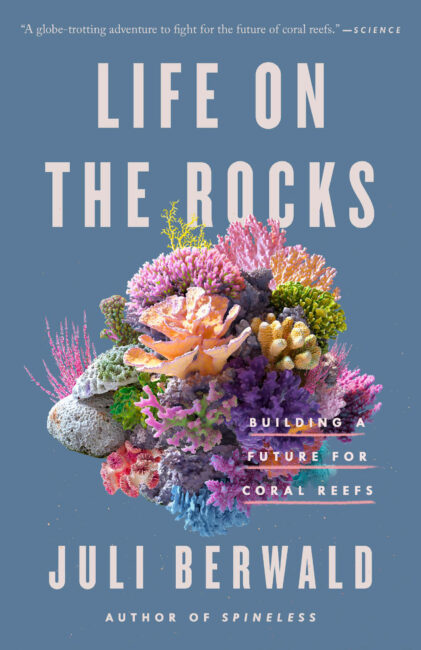
Life on the Rocks:
Building a Future for Coral Reefs
By Juli Berwald
Riverhead Books, New York, 2022
Life on the Rocks is part science, part travelogue and part memoir. In the opening chapters, Berwald takes a deep dive (pun intended) into the science of coral reefs, exploring the complex symbiotic relationship between coral polyps and the algae called zooxanthellae (zoo-oh-zan-thel-ee — say it fast, three times with a mouthful of crackers) which inhabit coral tissues and give them their color. She calls this relationship a “badass merger.”
In later sections of the book, Berwald takes us on tour to visit reef restoration projects in the Florida Keys, the Dominican Republic, Indonesia, and Australia’s Great Barrier Reef. She interviews scientists, divers and community leaders who are all doing, frankly, heroic work to save the reefs. She puts on scuba gear herself and dives down to see how the restorations are going.
Throughout the book, Berwald also talks about her struggle to help her young daughter who suffers from an obsessive-compulsive disorder (OCD). As any parent knows, dealing with a child’s illness, especially mental illness, can be heartbreaking. Berwald openly discusses the impact on her daughter and her own difficulties as a parent.
She draws parallels between her daughter’s illness and the declining health of coral everywhere. Both problems are hidden beneath the surface, and both are the result of complex processes and feedback loops that we don’t fully understand. Both require a full-community effort to heal.
These two worlds finally connect when Berwald’s daughter learns to scuba dive and finds therapeutic benefit from being under water.
And then COVID strikes.
Reef Facts
Here are some quick facts about the importance of coral reefs from the opening chapter of the book.
- Coral reefs occupy less than 1% of the ocean’s area, but about 25% of all marine species spend some part of their lives living in reef ecosystems.
- About 1 billion people depend on reefs for work or food.
- Reefs protect nearby shoreland, absorbing 97% of wave energy.
- The US Geological Survey estimates that reefs provide about $1.8 billion in flood protection to the US and $9 billion worldwide. (This is a great example of an ecosystem service.)
- The total value of food, recreation and storm protection provided by coral reefs globally is estimated to be between $2.7 and $10 trillion per year.
Coral Resilience
The good news from Life on the Rocks is that corals are surprisingly resilient. Berwald interviews scientists all over the world who have discovered coral can survive and adapt to various “stressors” such as higher ocean acidity and marine temperatures. Within limits of course.
Scientists and hobbyists have learned how to grow coral in aquaria from small fragments, and even get them to spawn. They’re cross breeding coral species to increase their resilience. And they’ve learned how to re-introduce lab-grown coral to ocean reefs using structures like reef stars as scaffolding.
Coral can even recover from bleaching. Coral bleaching events occur when corals eject their symbiont zooxanthellae, often due to higher ocean temperatures. This makes the coral tissue transparent, exposing their white skeletons. If temperatures return to normal levels, corals can attract new algae and regain their color. But they’ll die after a few weeks if they don’t find new algae partners.
And despite global warming, some reefs are thriving, although scientists don’t yet understand why. Berwald writes about this in the online science magazine Nautilus in an article titled The Mystery of the Healthy Coral Reef.
Geoengineering
In addition to her survey of global reef restoration efforts, Berwald also includes some discussion of geoengineering. It’s highly controversial so I was a little surprised to see it featured in the book.
Geoengineering is the deliberate large-scale intervention in Earth’s natural systems to modify the climate. Scientists are researching many possible interventions. Berwald talks about one called cloud brightening. This is the idea of spraying small droplets of seawater into marine clouds to make them whiter. Whiter clouds would reflect more of the Sun’s rays back into space, thereby helping to cool the Earth. Of course, we’d need to do this on a massive scale in order to have any impact, and that isn’t yet technically feasible.
Yet reef preservation is a massive scale problem. The Great Barrier Reef, a system of reefs really, is 135,000 square miles. Reef restoration projects, wonderful though they are, are tiny by comparison.
Ultimately we can’t save the reefs without addressing climate change. And we’re not on a good trajectory to meet UN targets for global warming. Geoengineering might be one way to reach those targets more quickly, or to buy us more time to reach them.
As Berwald notes, we may need “crazy ideas” like cloud brightening.
But the hubris! Can we really do this kind of intervention without screwing up the climate even more? Just look at the disastrous outcomes when humans have introduced non-native plants and animals into new ecosystems. We suck at this.
On the other hand, some would argue that we’re already geoengineering the planet, we’re just doing it badly, carelessly, without thinking about it. I agree.
I’m not yet convinced geoengineering is something we should do, but I think it’s important to research these techniques so we have some approaches in our toolkit in case we need them.
OK, I’m getting a little off topic here. Back to Life on the Rocks.
Most books on climate change try to end on a hopeful note. I think this is important. There are things we can and should be doing to make a difference. Despair isn’t helpful. Here’s how Berwald expresses her hope:
“I once heard that hope and grief are two sides of the same coin—that without hope, there is no grief. And without grief, there is nothing to hope for. I believe that to be true. Grief comes from looking back at mistakes, and hope can be found only by looking forward. When I think of corals, and of our planet, I know that I do not yet feel the full weight of grief. There is still too much left to hope for. But I do feel as if the coin has been tossed in the air—or rather many coins have been tossed in the air for the many reefs around the world. I can see them whirling and spinning up there, and I know that they cannot escape the pull of gravity. The coins will inevitably fall. One side will land upward. It is too early to call which side it will be.” [p. 293]
Unsolicited Feedback
In the early 2000’s, we took a family vacation to Australia and stayed for a few days on Green Island in the middle of the Great Barrier Reef. None of us scuba dive, but we did some snorkeling and rode glass-bottomed boats to see the reef. We swam with sea turtles. It was amazing! I understood for the first time the meaning of the phrase “teeming with life.”
But we also saw many ash-grey dead patches and learned about the vulnerability of the reef. It was the first time I witnessed first-hand the direct impact of climate change.
We’re so fortunate to have had the chance to visit the Reef at all, let alone before so much damage has been done.
Life on the Rocks gave me an even deeper understanding of the complexity, beauty and fragility of coral reef ecosystems. Berwald does a fine job showing us valiant human efforts to preserve reefs around the world – that’s really the heart of the book.
She also makes it clear that unless address we climate change, all those efforts could be in vain.
I read Life on the Rocks during this summer’s devastating marine heat waves. You may have seen reports about massive bleaching events like this one: A Desperate Push to Save Florida’s Coral: Get It Out of the Sea.
It brings more urgency, and more poignancy, to the preservation of these vital ecosystems that Berwald describes so well in Life on the Rocks.
Thanks for reading.
Click here for more posts on climate change.
If you enjoyed this review, please subscribe to Unsolicited Feedback.
Related Links
Organizations involved in coral reef research and restoration
Allen Coral Atlas
Interactive atlas of the world’s coral reefs developed by the University of Arizona.
Coral Assisted Evolution
Collaborative research by the Hawai’i Institute of Marine Biology and the Australian Institute of Marine Science into enhancing coral resilience.
Coral Restoration Consortium
“A high-level community of practice that comprises scientists, managers, coral restoration practitioners, and educators dedicated to enabling coral reef ecosystems to adapt and survive the 21st century and beyond.”
Coral Restoration Foundation
“Headquartered in Key Largo Florida, we were founded in response to the wide-spread loss of the dominant coral species on Florida’s Coral Reef.”
Global Fund for Coral Reefs
“The Global Fund for Coral Reefs (GFCR) provides grant funding and private capital to support sustainable interventions to save coral reefs and the communities that rely on them.”
International Coral Reef Initiative
Founded in 1988 by Australia, France, Japan, Jamaica, the Philippines, Sweden, the UK and the USA., ICRI is “a global partnership between Nations and organizations which strives to preserve coral reefs and related ecosystems around the world.”
International Coral Reef Society
An all-volunteer org whose mission is “to promote the acquisition and dissemination of scientific knowledge to secure coral reefs for future generations.”
Mote Marine Laboratory & Aquarium
“We are an independent, nonprofit marine research institution comprising world-class marine scientists committed to the belief that the conservation and sustainable use of our oceans begins with research and education.”
Articles about coral reefs
Humanes, A., Lachs, L., Beauchamp, E. et al. Selective breeding enhances coral heat tolerance to marine heatwaves. Nat Commun 15, 8703 (2024). https://doi.org/10.1038/s41467-024-52895-1.
Paper in Nature Communications about promising research in selective breeding of corals to be more resistant to short-term (1 week) and long-term (1 month) heat waves. Oct. 14, 2024.
As record heat risks bleaching 73% of the world’s coral reefs, scientists ask ‘what do we do now?’
Article by Graham Readfearn in The Guardian about scientists’ reaction to record global bleaching of coral reefs in the past year. July 29, 2024.
Is the Great Barrier Reef reviving – or dying?
Report by Mike Emslie and colleagues at the Australian Institute of Marine Science in The Conversation. August 8, 2023.
A Desperate Push to Save Florida’s Coral: Get It Out of the Sea
Article by Catrin Einhorn in The New York Times about catastrophic coral bleaching off the Florida Keys in the summer of 2023. July 31, 2023.
Is the Great Barrier Reef making a comeback?
Article by Daniel Hentz in Oceanus about regrowth of coral on the Great Barrier Reef. February 15, 2023.
The Mystery of the Healthy Coral Reef
Article by Juli Berwald in Nautilus about the surprisingly healthy coral reefs in Tela Bay, Honduras. January 18, 2023.
Discover more from Unsolicited Feedback
Subscribe to get the latest posts sent to your email.


 Unsolicited Feedback
Pingback: Under a White Sky | Unsolicited Feedback
Pingback: Nonfiction November 2023 Week 2: Choosing Nonfiction | Unsolicited Feedback